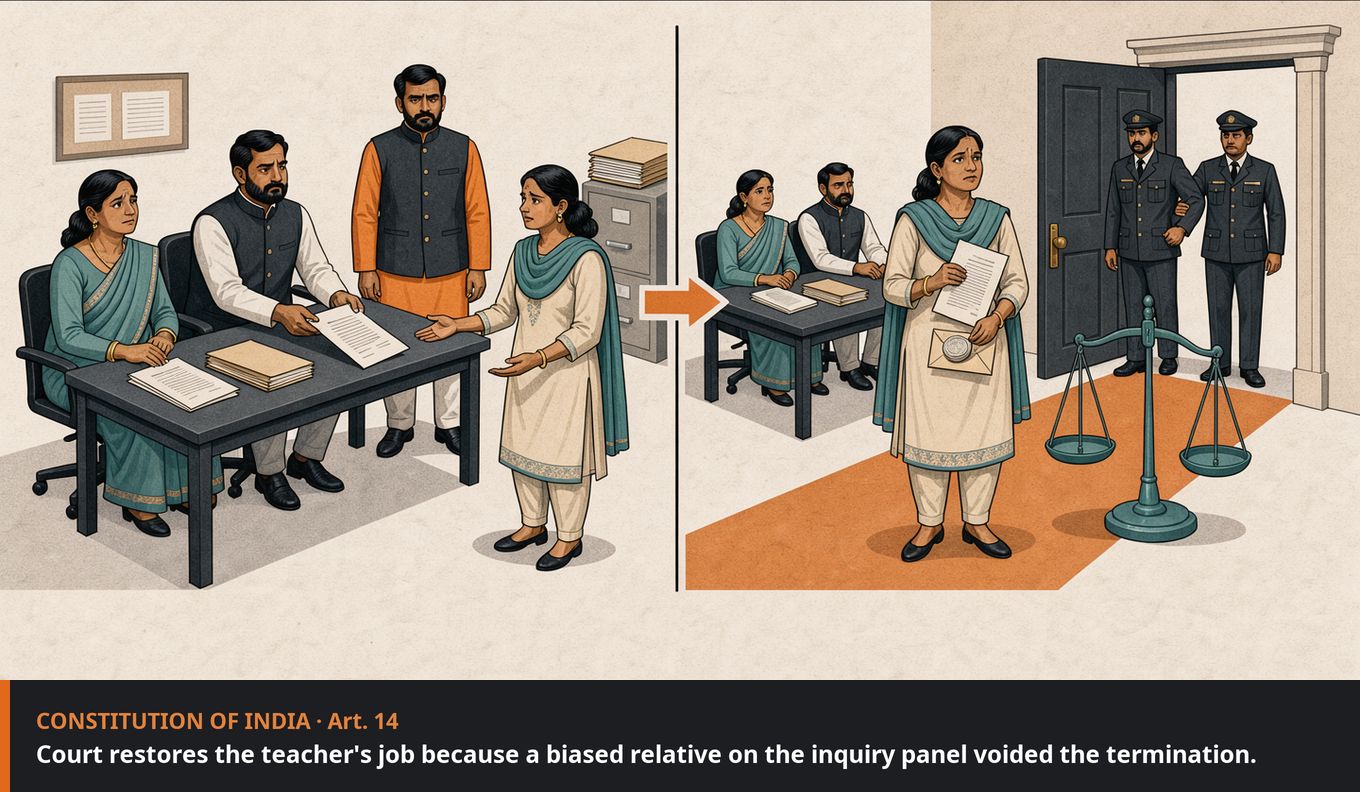
The Appellant, an Assistant Teacher, was terminated on 23rd February 2022 following a departmental inquiry by a three-member Inquiry Committee constituted under Rule 36 of the MEPS Rules.
The Convenor of the Inquiry Committee, Prakash Masurkar, was the real brother of Rajesh Masurkar, who simultaneously acted as complainant, CEO issuing chargesheets, principal witness on eleven of twenty charges, and signatory of the termination order.
The School Tribunal quashed the termination and granted reinstatement with full back wages, but the High Court set aside the Tribunal's order and upheld the termination.
The Appellant raised objection to the Convenor's appointment at every stage, including before the Inquiry Committee, the Tribunal, and in the writ proceedings.
Legal concepts
The test of bias is not proof of actual bias but whether a reasonable likelihood of bias exists in the mind of a reasonable person, as distinguished from a merely fanciful apprehension.
Reaffirmed · para 49
An immediate blood relative of a person who initiates disciplinary action or is directly interested in its outcome is disqualified from acting as an adjudicator; breach of Nemo Judex in Causa Sua is a fundamental jurisdictional defect under Article 14, not a curable procedural irregularity.
Laid down · para 55
Mere compliance with procedural formalities such as multiple hearings, examining witnesses or permitting cross-examination cannot cure a foundational illegality arising from bias in the decision-making process.
Laid down · para 57
The doctrine of necessity does not apply where unrelated members of the Executive Committee were available to be nominated to the Inquiry Committee.
Reaffirmed · para 58 · Krishnadatt Awasthy vs. State of Madhya Pradesh and Ors., (2025) 7 SCC 545, para 41
An alleged waiver of objection to a biased decision-maker must be voluntary, informed and unequivocal to be effective.
State of U.P v. Mohammad Azam Khan, Crl.A. No.-005376-005378 - 2026
Bench: HON'BLE MR. JUSTICE DIPANKAR DATTA, HON'BLE MR. JUSTICE SHEEL NAGU (2 judges). Judgment by HON'BLE MR. JUSTICE DIPANKAR DATTA
Stay of conviction extended to co-convicts on identical footing, upholding parity under Article 14
Facts that mattered
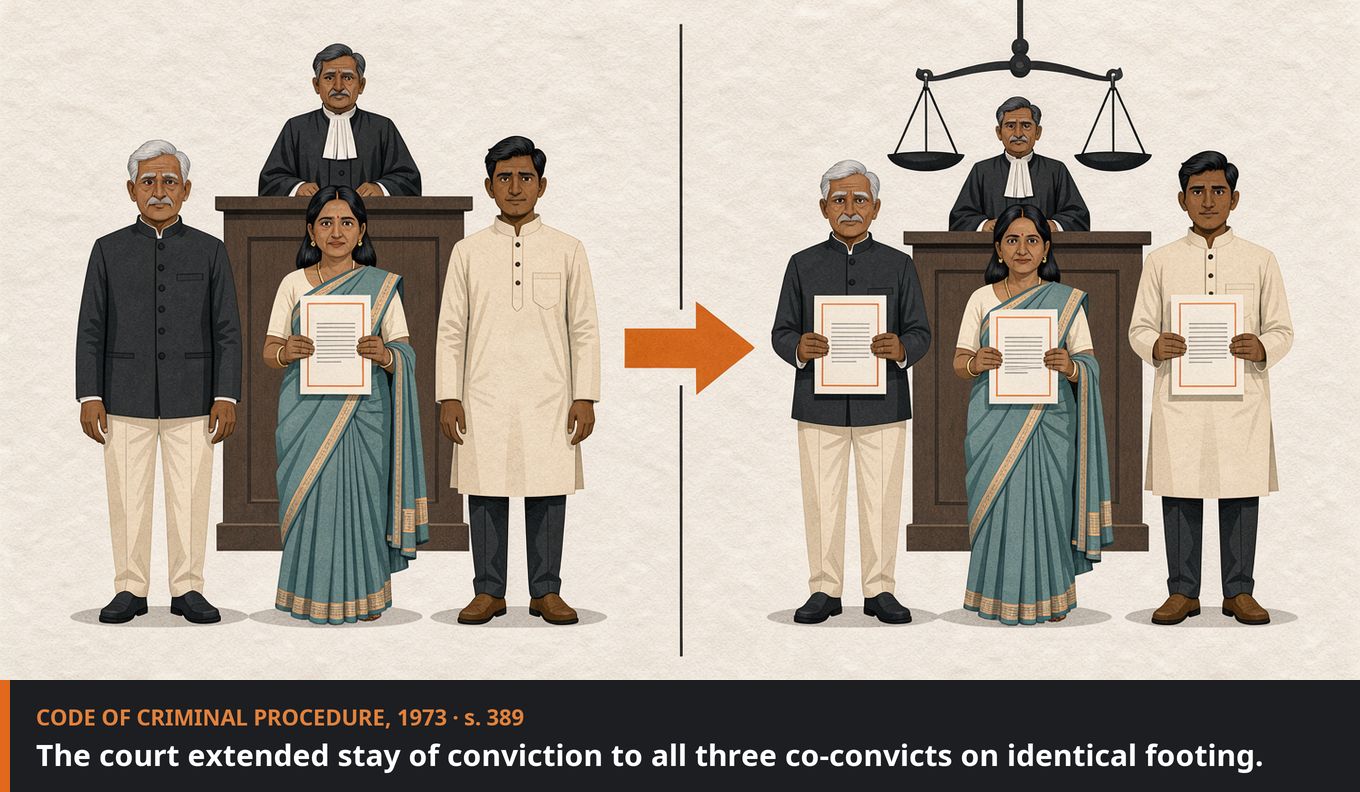
Three family members were convicted by a trial court on 18 October 2023 for criminal conspiracy involving two conflicting birth certificates, affirmed on appeal on 23 December 2023.
The High Court suspended all three sentences and enlarged all three on bail, but stayed only Mohammad Azam Khan's conviction, rejecting stay applications of his son and wife.
The State challenged the stay of conviction, while the son and wife challenged denial of stay of conviction, all under Article 136.
The High Court recorded no coherent reason distinguishing the patriarch's case from those of the co-convicts convicted under the identical conspiracy charge.
Legal concepts
Where several convicts stand on the same evidentiary footing, an order granting stay of conviction to one while denying it to others must identify and expressly state the distinguishing feature; an order silent on that point is by itself arbitrary.
Laid down · para 19
Stay of conviction is an exceptional remedy requiring distinct, compelling judicial justification, qualitatively different from mere suspension of sentence.
Reaffirmed · para 9 · Ravikant S. Patil v. Sarvabhouma S. Bagali, (2007) 1 SCC 673, para 21
A stay of conviction cannot be anchored purely on political expediency, electoral ambitions, or the exigencies of upcoming election campaigns.
Laid down · para 23
Judicial discretion under Section 389(1) must balance the grave and irreversible consequences of conviction for the convict against the sanctity that must attach to a conviction until it is set aside.
Reaffirmed · para 22 · Afjal Ansari v. State of U.P., (2024) 2 SCC 187, para 21
Bench: HON'BLE MR. JUSTICE K.V. VISWANATHAN, HON'BLE MR. JUSTICE ARUN PALLI (2 judges). Judgment by HON'BLE MR. JUSTICE K.V. VISWANATHAN
Forgery and record manipulation by public servant fall outside Section 197 CrPC sanction protection
Facts that mattered
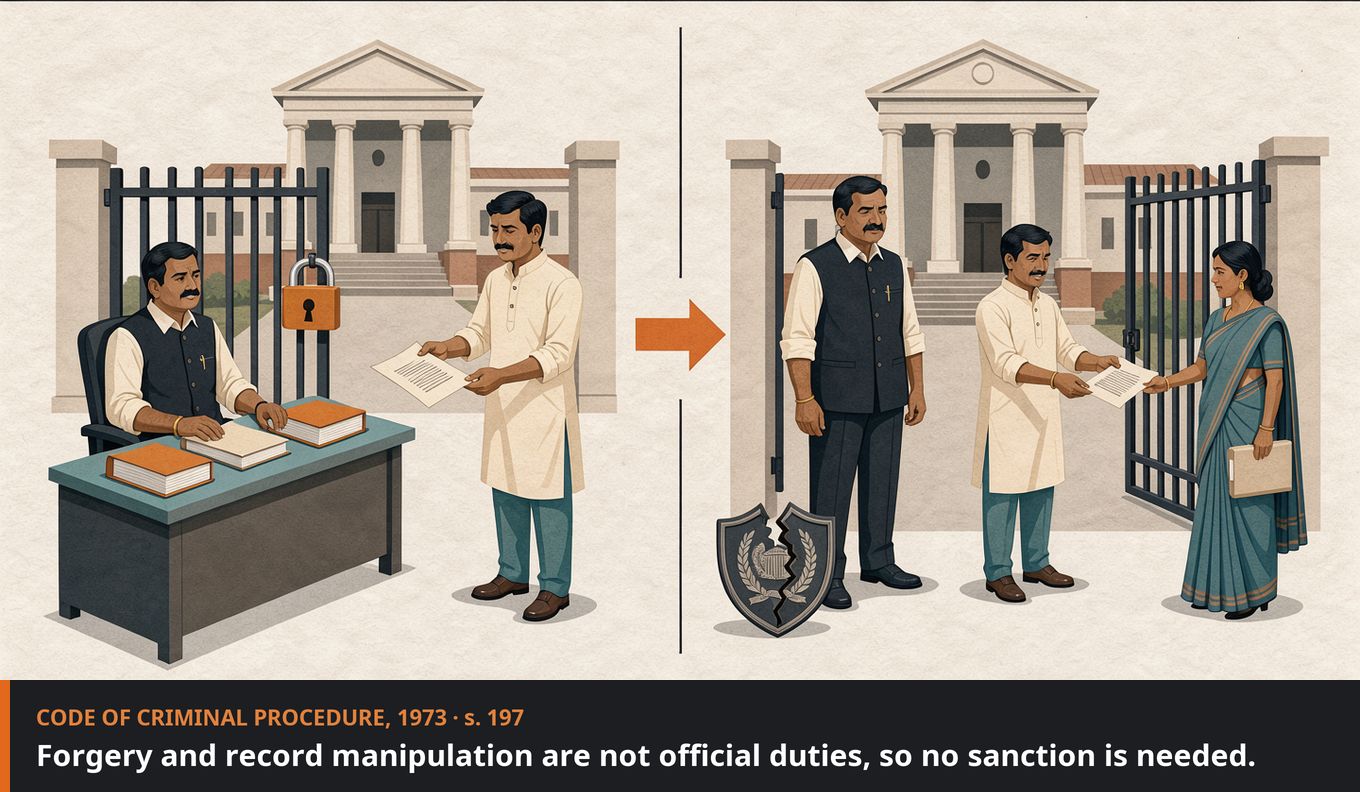
The High Court quashed proceedings against a City Survey Officer, holding sanction under Section 197 CrPC was needed before a Section 156(3) investigation against a public servant.
The complainant alleged the officer colluded to mutate land records based on a forged application, removing a charitable trust's name from property records.
Chargesheets were filed for forgery, cheating and criminal conspiracy under the IPC arising from two FIRs registered on Magistrate's directions.
The Supreme Court held the alleged acts of forgery and record manipulation were not in discharge of official duty, so sanction was not required.
Legal concepts
Section 197 CrPC protection applies only where the act complained of has a reasonable connection with the discharge of official duty, judged by the quality of the act rather than the mere opportunity furnished by office.
Reaffirmed · para 33 · Om Prakash Yadav vs. Niranjan Kumar Upadhyay and Others, 2024 SCC OnLine SC 3726, para 33
Acts of preparing forged documents, fabricating records and conspiring to cheat cannot form part of discharge of official duty and fall outside the protective umbrella of Section 197 CrPC.
Laid down · para 34
Where the acts complained of are not in discharge of official duty, prior sanction under Section 197 CrPC and the Maharashtra Amendment to Section 156(3) CrPC are not attracted.
Bench: HON'BLE MR. JUSTICE SATISH CHANDRA SHARMA, HON'BLE MR. JUSTICE NONGMEIKAPAM KOTISWAR SINGH (2 judges). Judgment by HON'BLE MR. JUSTICE SATISH CHANDRA SHARMA
Supreme Court upholds restored arbitral awards, finding no patent illegality in any claim
Facts that mattered
RVUNL and PKCL entered a Coal Mining and Delivery Agreement for the Parsa East and Kanta Basan coal block, later continued under the Coal Mines (Special Provisions) Act, 2015.
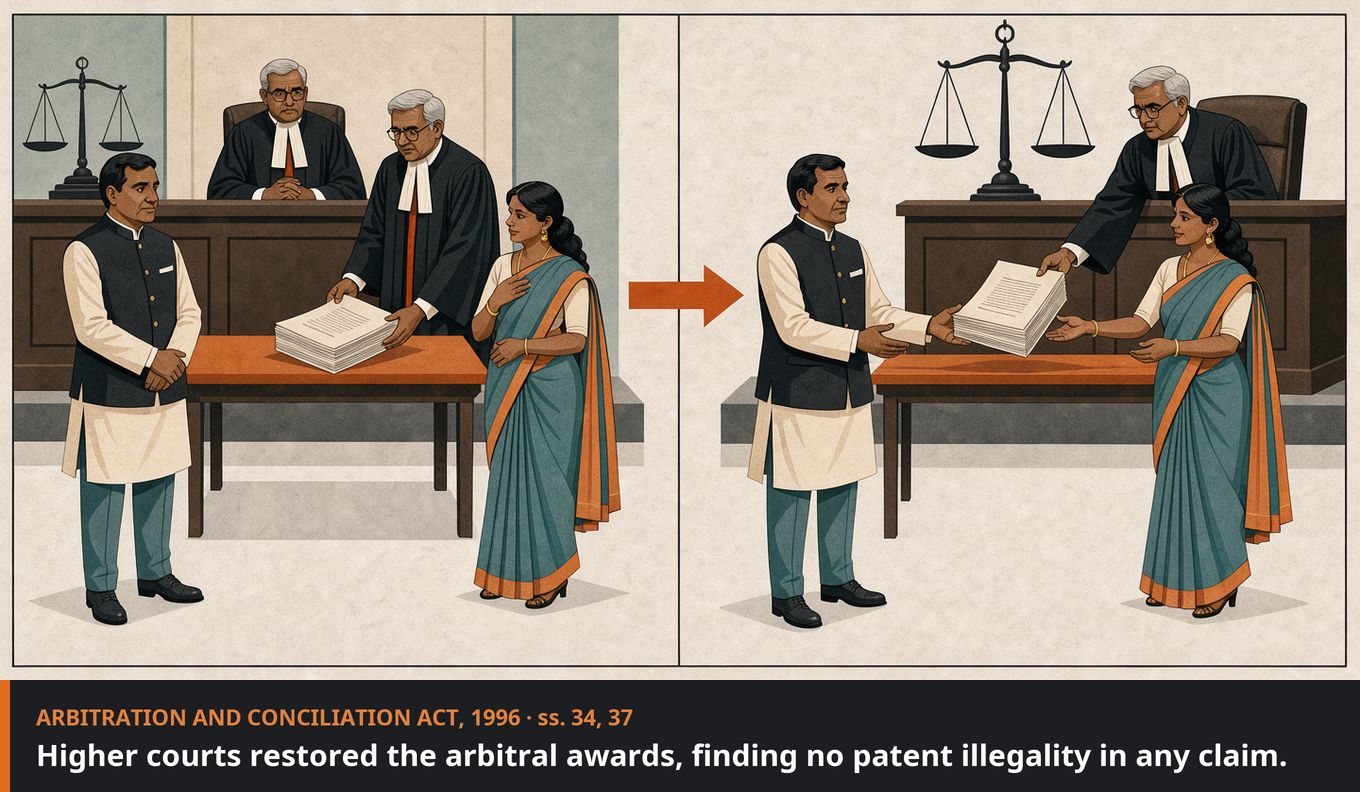
PKCL invoked arbitration raising nine claims; the sole arbitrator passed an Award on 15.01.2021 and an Additional Award on 05.07.2021 allowing most claims.
The Commercial Court set aside both awards in their entirety, holding it lacked power to modify, though it upheld findings on some claims.
The High Court under Section 37 restored both awards; the Supreme Court examined each claim and found no patent illegality or perversity, dismissing the SLP.
Legal concepts
Article 136 is a discretionary and exceptional jurisdiction to be exercised sparingly where exceptional circumstances exist, as an award attains finality at the Section 37 stage.
Reaffirmed · para 10 · DMRC Ltd. v. Delhi Airport Metro Express (P) Ltd., (2024) 6 SCC 357, para 7
Patent illegality goes to the root of the matter and appears on the face of the award; it does not extend to an error in appreciating evidence or a different construction of the contract.
Reaffirmed · para 49
An award is perverse only where a finding is based on no evidence, based on irrelevant material, or ignores vital evidence.
Reaffirmed · para 49
The Section 37 court is confined to the grounds available under Section 34 and cannot undertake an independent assessment of the merits of the award.
Har Parsad Gaur v. State(nct of Delhi), Crl.A. No.-000571-000571 - 2015
Bench: HON'BLE MR. JUSTICE UJJAL BHUYAN, HON'BLE MR. JUSTICE ATUL S. CHANDURKAR (2 judges). Judgment by HON'BLE MR. JUSTICE UJJAL BHUYAN
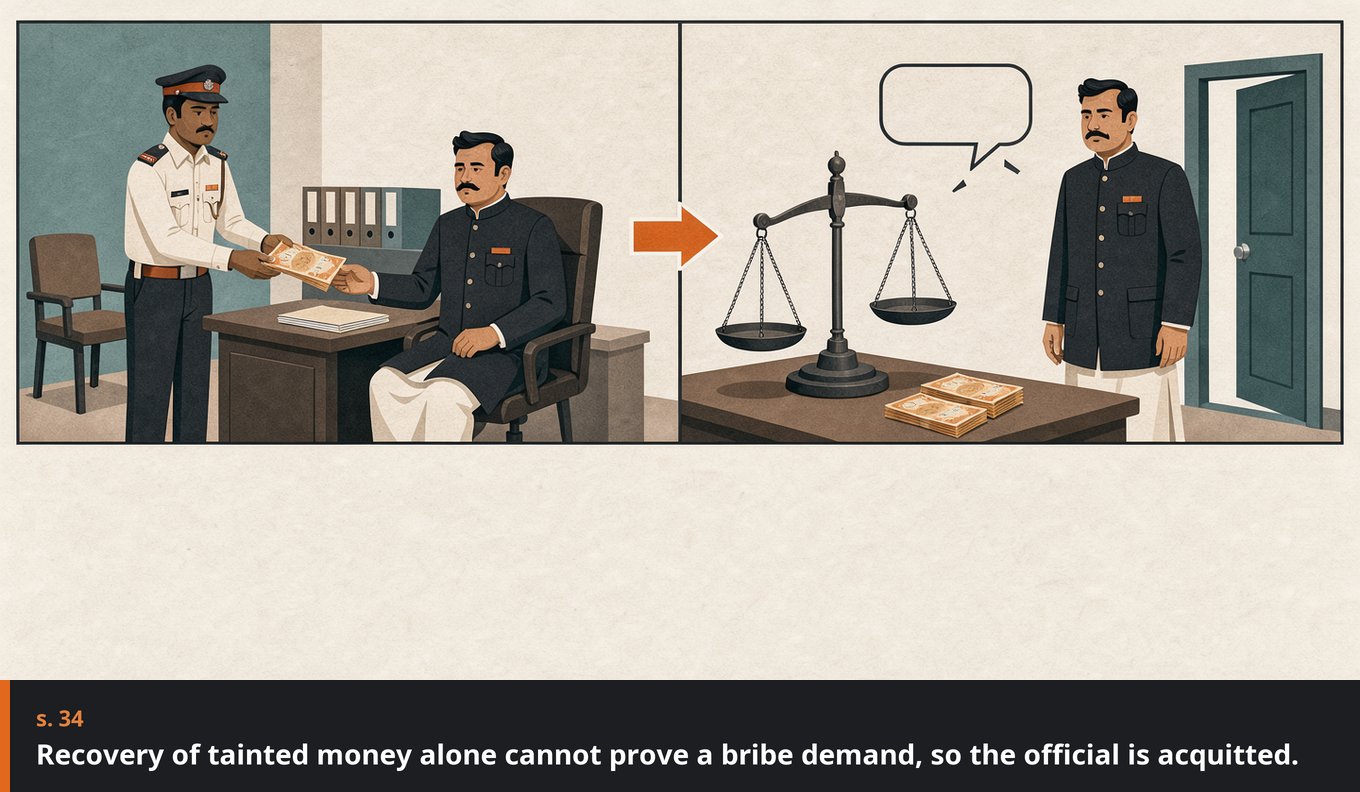
Acquittal as no proof of bribe demand; Section 20 presumption cannot rest on recovery alone
Facts that mattered
The appellant, a Tehsildar, was convicted under Sections 7 and 13(1)(d) of the Prevention of Corruption Act for demanding and accepting a Rs. 1,000 bribe from a labour-court decree holder.
The complainant and the panch witness both died before their depositions could be recorded, leaving only the trap officer's testimony about what the panch witness relayed to him.
Tainted currency notes were recovered from the appellant's coat pocket and chemical washes turned pink, but official records showed the recovery cheques had already been dispatched on 28.12.2002.
The High Court upheld conviction relying on the Section 20 presumption, reducing sentence from two years to one year, and the appellant appealed to the Supreme Court.
Legal concepts
Proof of demand of illegal gratification is the sine qua non for an offence under Sections 7 and 13(1)(d)(i) and (ii) of the PC Act; mere recovery of tainted money without proof of demand cannot sustain conviction.
Reaffirmed · para 32 · P. Satyanarayana Murthy Vs. State of A.P., (2015) 10 SCC 152, para 32
The presumption under Section 20 of the PC Act can be invoked only when the two basic facts of demand and acceptance of gratification are proved beyond reasonable doubt.
Reaffirmed · para 34
Hearsay testimony of a trap officer relaying what a deceased panch witness told him is inadmissible and cannot establish demand for and voluntary acceptance of illegal gratification.
Laid down · para 42
To rebut the Section 20 presumption the accused need only establish his defence on the touchstone of preponderance of probabilities, unlike the prosecution's burden of proof beyond reasonable doubt.
This digest summarises Supreme Court of India judgments for general information. It is not legal advice and does not create a lawyer-client relationship. Please read the full judgment before relying on it. See also our disclaimer.