In Re: Phalodi Accident v. National Highways Authority of India, SMW(C) No.-000009-000009 - 2025
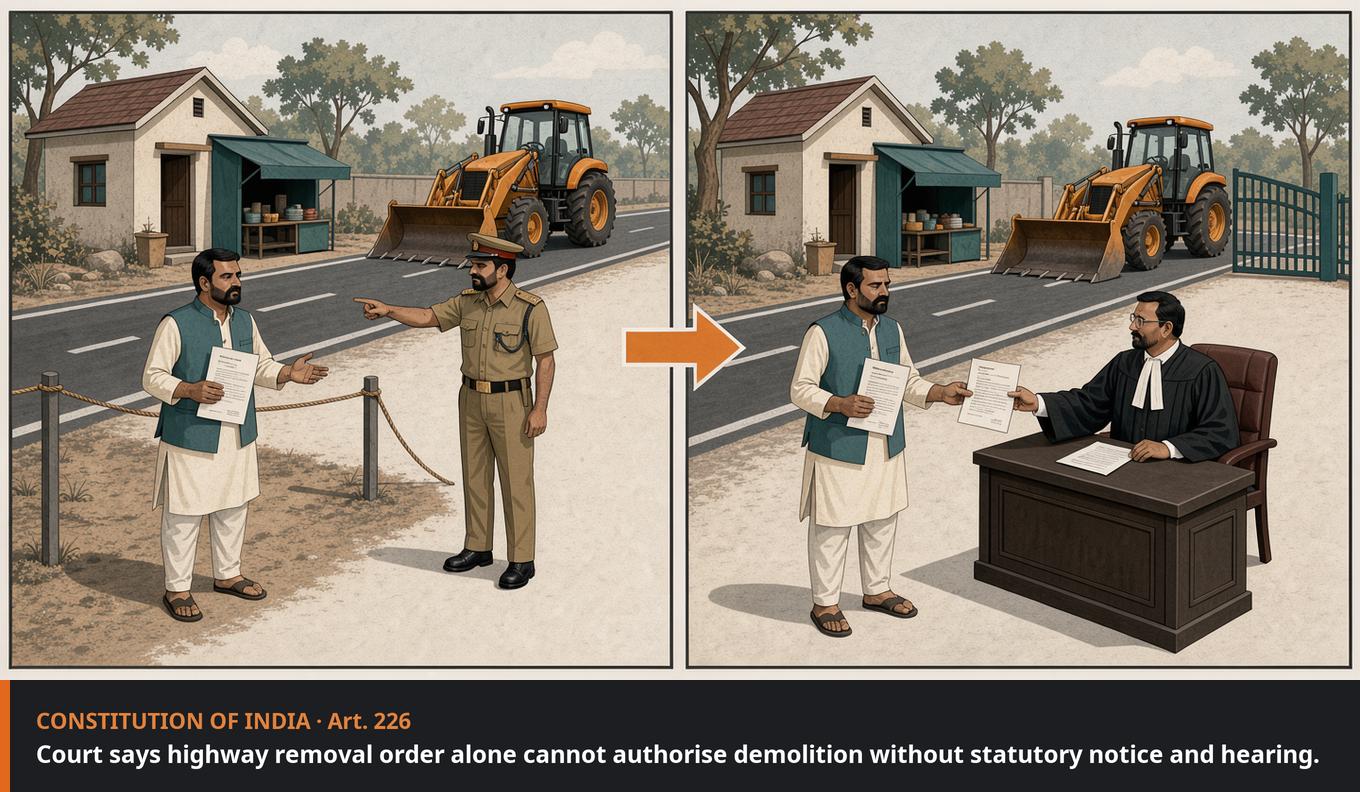
Court clarifies highway encroachment directions do not authorise demolition without statutory procedure
Facts that mattered
The suo motu proceedings arose from road accidents at Phalodi, Rajasthan, and the Court issued directions on 13.04.2026 requiring removal of unauthorised encroachments from National Highway Right of Way.
NHAI initiated demolition action against structures alleged to be encroachments, and numerous applicants claimed ownership of privately held land adjoining National Highways.
Applicants disputed NHAI's demarcation of the Right of Way and contended the directions did not authorise demolition without following the statutory procedure under the 2002 Act.
The Court had earlier granted interim protection and status quo in several matters pending resolution of these applications.
Legal concepts
A general direction to remove encroachments is not a conclusive adjudication that a particular structure is an unauthorised encroachment, and cannot dispense with the statutory determination required under law.
Laid down · para 15
Section 26 of the Control of National Highways (Land and Traffic) Act, 2002 prescribes the essential procedure of notice, representation and consideration of cause shown, required for compliance with natural justice before removal of unauthorised occupation.
Reaffirmed · para 16 · Gyan Prakash v. Union of India and Others, 2025 SCC OnLine SC 1189, para 16
Individual disputes over ownership, boundaries and Right of Way demarcation arising from highway encroachment removal are to be adjudicated by the jurisdictional High Courts rather than in suo motu Supreme Court proceedings directed at systemic road safety issues.
Prithviraj S. Singh (deceased) Through Lrs Etc. v. the Secretary, School Education Department, State of Maharashtra, C.A. No.-010193-010194 - 2016
Bench: HON'BLE MR. JUSTICE DIPANKAR DATTA, HON'BLE MR. JUSTICE SHEEL NAGU (2 judges). Judgment by HON'BLE MR. JUSTICE DIPANKAR DATTA
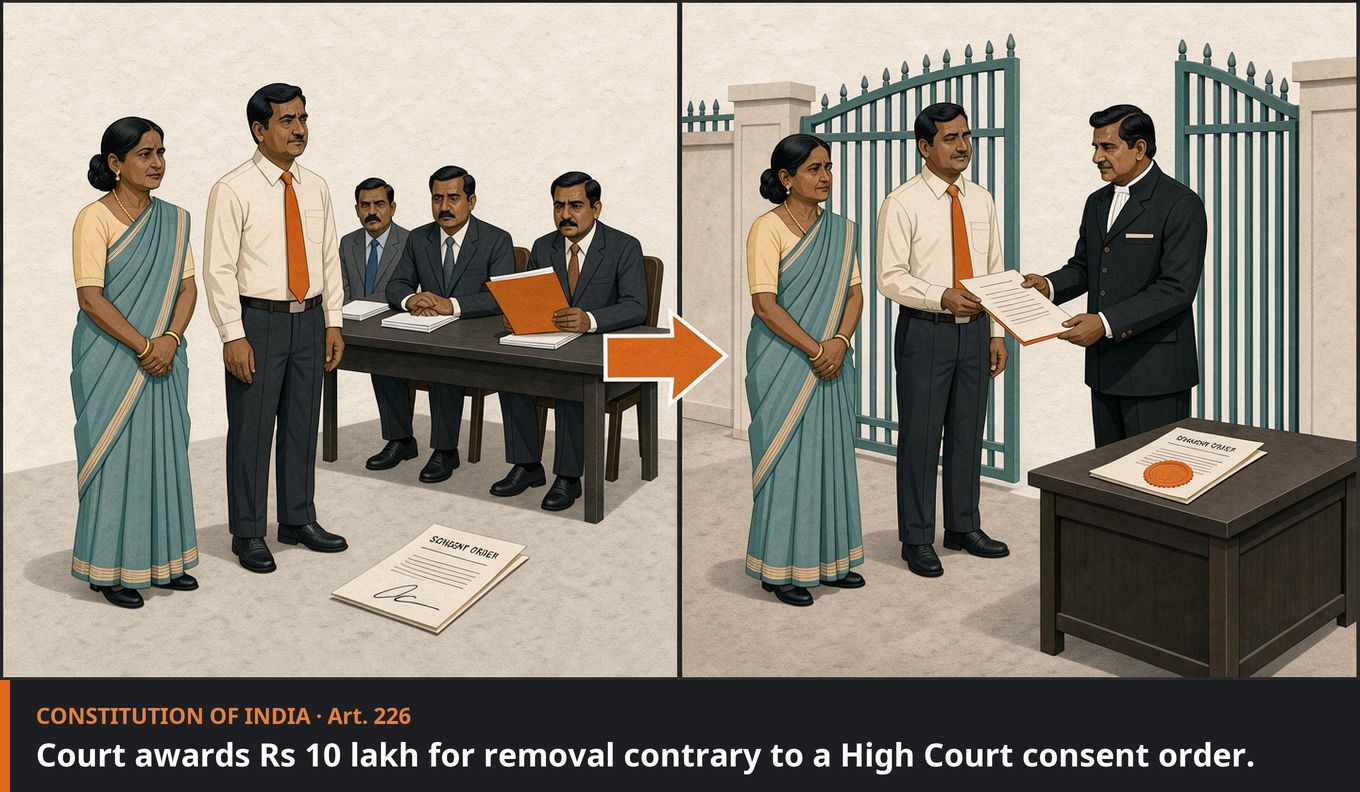
Court awards Rs 10 lakh compensation for termination contrary to a High Court consent order
Facts that mattered
The appellants, a senior clerk and a head clerk, faced departmental proceedings for misappropriation of public money in a private school.
They objected to inquiry committee members, then abstained from the inquiry, which proceeded ex parte, and they were removed from service without being furnished the inquiry reports.
The School Tribunal dismissed their appeals; their writ petitions before the High Court rested only on parity with the headmaster and did not plead violation of the consent order.
The High Court dismissed the writ petitions, holding the headmaster and the appellants did not stand on the same footing.
Legal concepts
A party must plead its case with the averments needed for the relief claimed, and a court is under no obligation to entertain a plea unsupported by such averments in the petition.
Reaffirmed · para 9
An action or order wholly contrary to an express judicial order passed in exercise of competent jurisdiction is a nullity and cannot be accepted.
Reaffirmed · para 11 · Ram Saran Varshney v. State of U.P., (2016) 3 SCC 724, para 11
A High Court cannot grant relief under Article 226 to a litigant who has approached it without pleading an appropriate case for relief.
Ashok Kumar v. Central Bank of India, C.A. No.-014308-014308 - 2026
Bench: HON'BLE MR. JUSTICE DIPANKAR DATTA, HON'BLE MR. JUSTICE SHEEL NAGU (2 judges). Judgment by HON'BLE MR. JUSTICE DIPANKAR DATTA
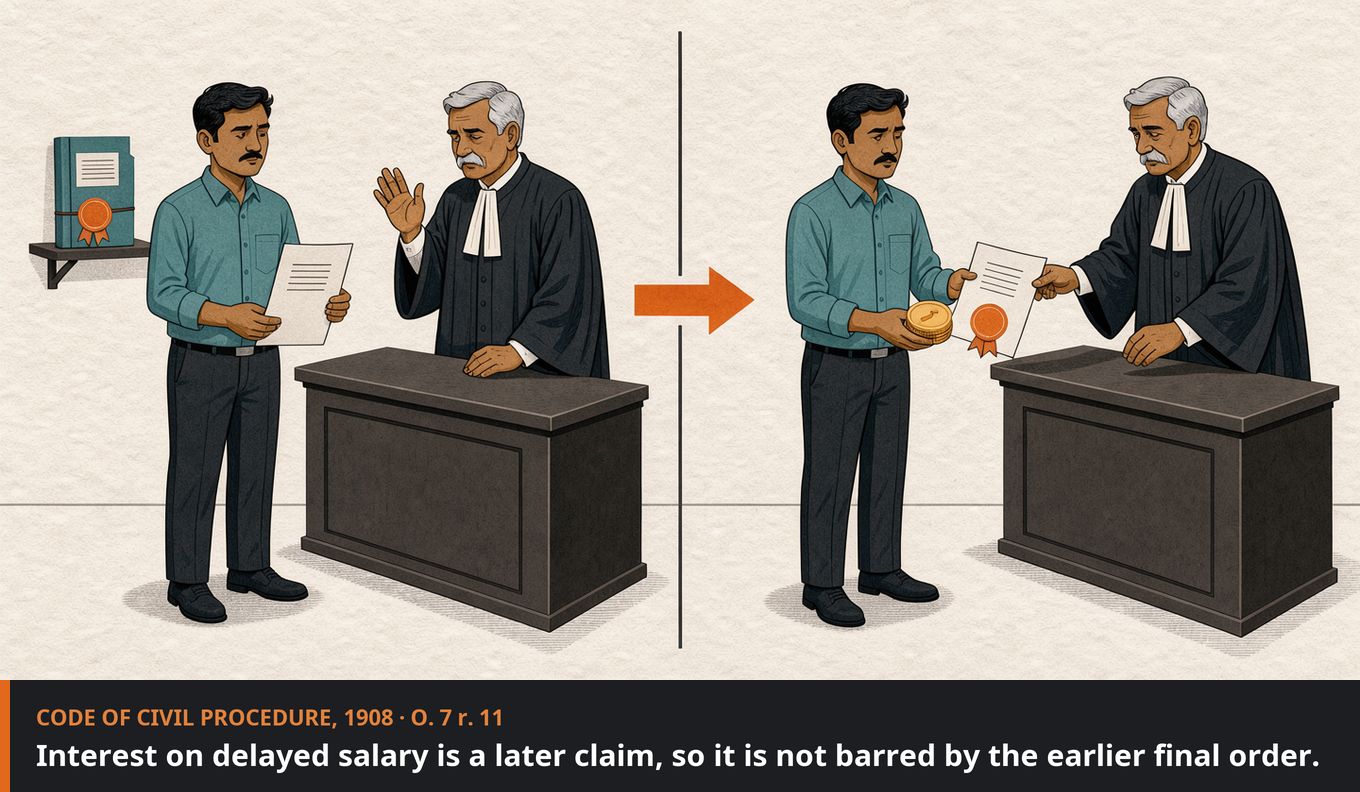
Court allows Rs.5 lakh to employee, holding interest claim was a separate subsequent cause of action
Facts that mattered
Kumar, a bank employee, was acquitted in 1983 of defalcation charges; the acquittal attained finality in 1991 when the High Court dismissed appeals against it.
The High Court quashed the departmental enquiry in 2007 and ordered reinstatement with consequential benefits; that order attained finality when the Bank's SLP was dismissed in 2011.
Kumar was paid over Rs.42 lakh in 2011 but later sought 18% interest on delayed salary, first by a fresh writ petition dismissed in 2023, then by a miscellaneous application in the earlier writ petition filed in 2024.
The Single Judge and Division Bench dismissed the miscellaneous application, holding it barred by constructive res judicata and finality of the 2007 order.
Legal concepts
A miscellaneous application in a finally decided writ petition is not an independent proceeding; it has a narrow scope, is procedural not substantive, and cannot be used to agitate a subsequent or independent cause of action.
Laid down · para 21
Res judicata and the bar of Order II Rule 2 CPC apply only to a claim that could have been raised when the earlier proceeding was instituted, and a claim based on a subsequent cause of action cannot be barred by a judgment on a prior cause of action.
Laid down · para 20
Interest is a restitution for delay pendente lite and during appeals, a distinct cause of action arising subsequently, and it is not a penalty but a normal accretion on capital.
Reaffirmed · para 23 · Alok Shanker Pandey v. Union of India, (2007) 3 SCC 545, para 23
The technical plea of constructive res judicata should not stand in the way of a litigant where relief is otherwise due, in view of the rule that an act of court should harm no litigant.
Bharat Bhushan Jain (dead) Thr. Lrs. v. M/s Goodyear India Ltd ., C.A. No.-009668-009669 - 2013
Bench: HON'BLE MR. JUSTICE PRASHANT KUMAR MISHRA, HON'BLE MR. JUSTICE SHREE CHANDRASHEKHAR (2 judges). Judgment by HON'BLE MR. JUSTICE PRASHANT KUMAR MISHRA
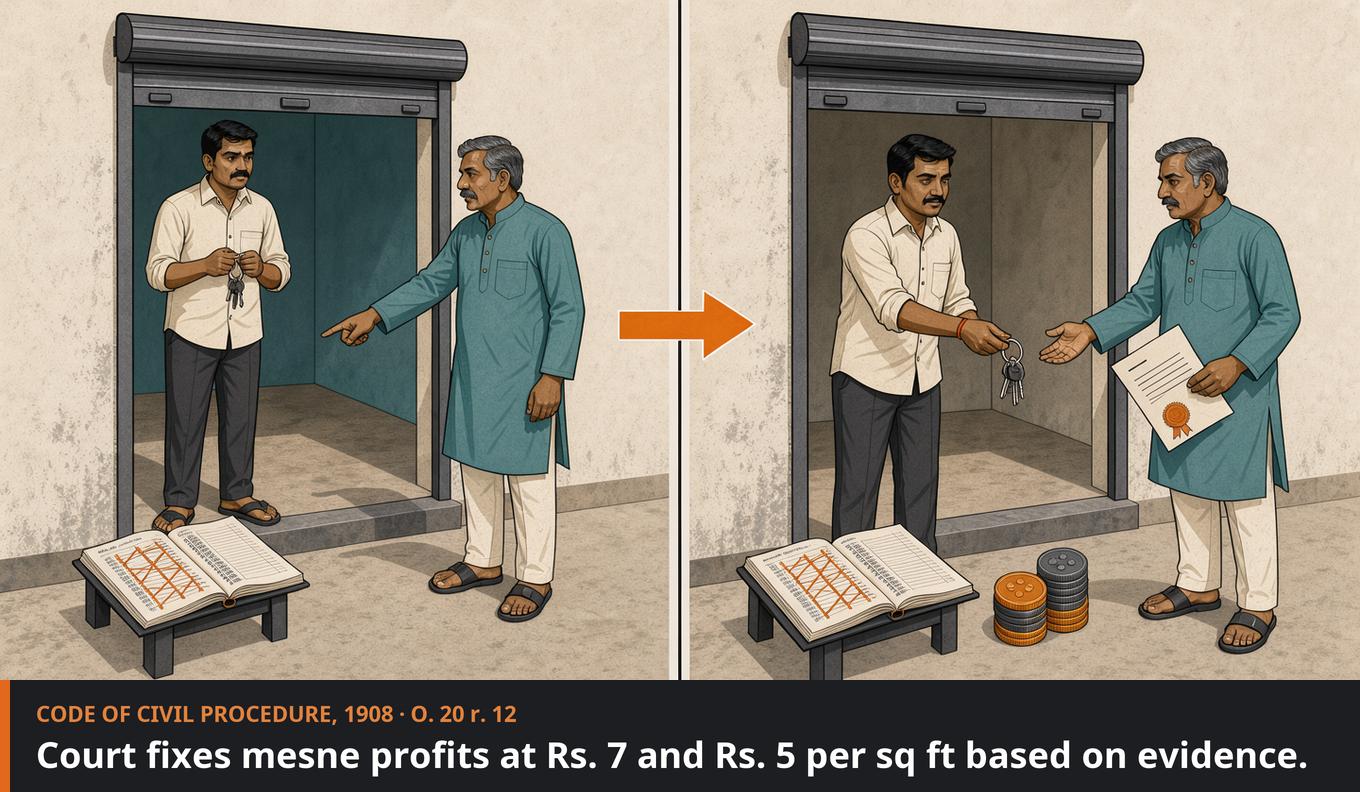
Supreme Court upholds High Court's mesne profits rate of Rs. 7 and Rs. 5 per sq ft as fair and evidence-based.
Facts that mattered
The suit premises at Ansari Road, Daryaganj, New Delhi were let to Goodyear India Ltd., with tenancy terminated w.e.f. midnight of 31.12.1989; the decree for possession attained finality in 2001.
The Trial Court passed a preliminary decree under Order XX Rule 12 CPC directing separate inquiry into mesne profits, later fixing Rs. 22/sq ft (ground floor) and Rs. 11/sq ft (mezzanine) with 15% interest.
The First Appellate Court set aside the Trial Court's rate as speculative, limiting mesne profits to the admitted rent, but overlooked an admission by the tenant's own witness DW-1 about prevailing locality rent of Rs. 5-8 per sq ft.
The High Court found this omission a substantial question of law, fixing Rs. 7/sq ft (ground) and Rs. 5/sq ft (mezzanine) with 7.5% simple interest; the Supreme Court dismissed appeals against that determination.
Legal concepts
Mesne profits are compensatory in nature, intended to recompense the true owner for loss caused by continued wrongful occupation, and their assessment is not governed by any rigid formula.
Reaffirmed · para 10 · Martin and Harris Private Limited and Another vs. Rajendra Mehta and Others, (2022) 8 SCC 527, para 10
Determination of mesne profits is essentially an appreciation of evidence and does not warrant appellate interference unless manifestly arbitrary, unsupported by the record, or based on erroneous application of law.
Reaffirmed · para 10 · Martin and Harris Private Limited and Another vs. Rajendra Mehta and Others, (2022) 8 SCC 527, para 10
Interest forms an integral component of mesne profits, compensating the owner for deprivation of beneficial enjoyment of the property during wrongful occupation.
Reaffirmed · para 16
Omission by an appellate court to consider a material piece of evidence having direct bearing on mesne profits determination gives rise to a substantial question of law warranting interference.
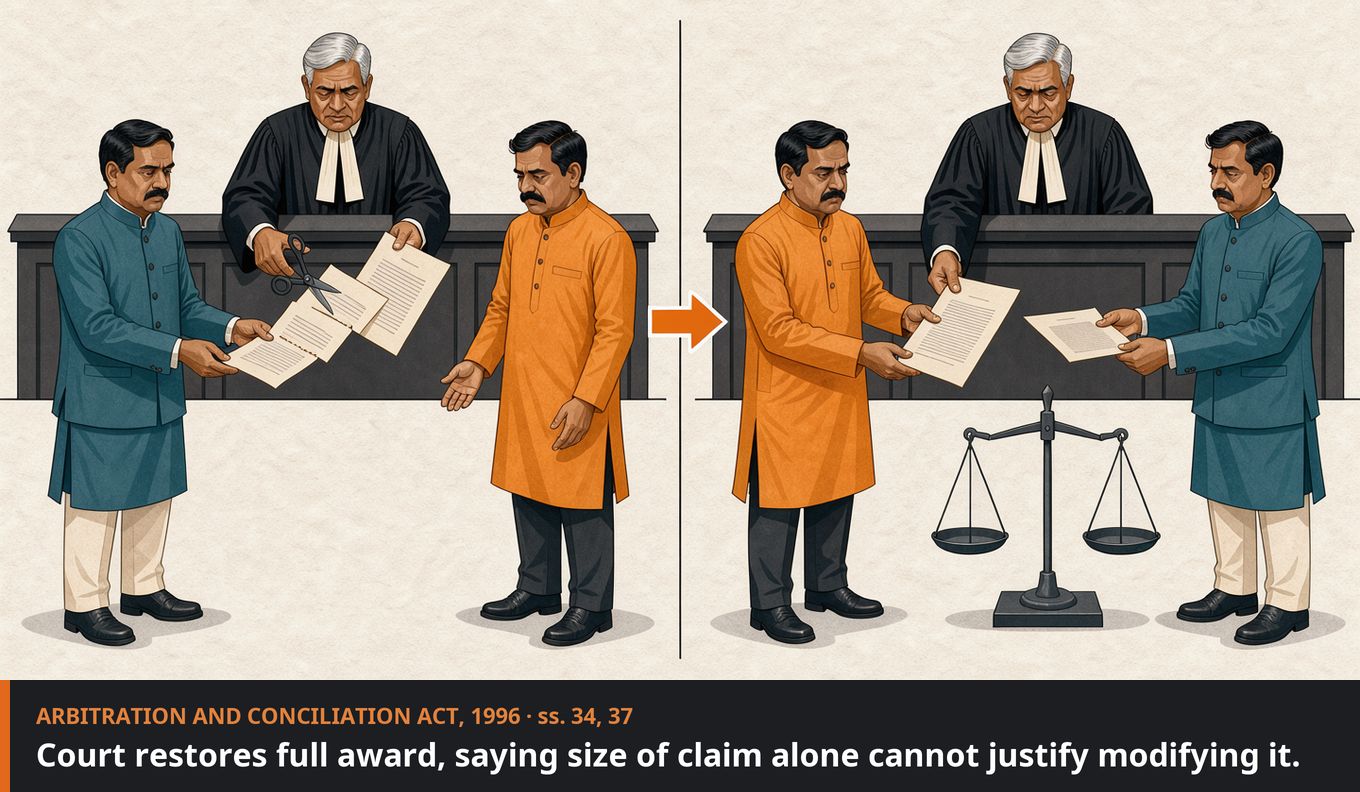
The Port Trust of Kolkata awarded a contract for dredging a channel and basin at Sagar Island; additional work was entrusted due to siltation, force majeure, and mismatch of soil data supplied by the Port Trust.
The Arbitrator quantified amounts for the additional work based on measurements and invoices; the Single Judge under Section 34 affirmed the award.
The Division Bench under Section 37 modified the award to 50% and reduced interest to 6%, holding that additional work claims exceeding 70% of the original contract shocked the conscience of the Court.
The Supreme Court restored the award, finding the modification outside Section 37 jurisdiction since the award was based on adequate evidence and not perverse.
Legal concepts
An award cannot be modified under Section 37 merely because the court's conscience is shocked by the size of the claim, absent a substantive reason showing conflict with basic notions of morality or justice.
Laid down · para 8 · Somdatt Builders–NCC–NEC (JV) v. National Highways Authority of India & Ors., (2025) 6 SCC 757, para 10
Parties to arbitration must be treated equally, and no special treatment or adverse inference can be drawn merely because the award debtor is a government entity.
Reaffirmed · para 13
An award may be set aside in part only where the valid and invalid portions are legally and practically separable, not inter-dependent or intrinsically intertwined.
Reaffirmed · para 11
Re-examining measurements and invoices under Section 37 would amount to adjudication on the merits, prohibited under the Arbitration and Conciliation Act, 1996.
Bibol Toppo v. State of Odisha, C.A. No.-008294-008294 - 2026
Bench: HON'BLE MR. JUSTICE DIPANKAR DATTA, HON'BLE MR. JUSTICE SATISH CHANDRA SHARMA (2 judges). Judgment by HON'BLE MR. JUSTICE DIPANKAR DATTA
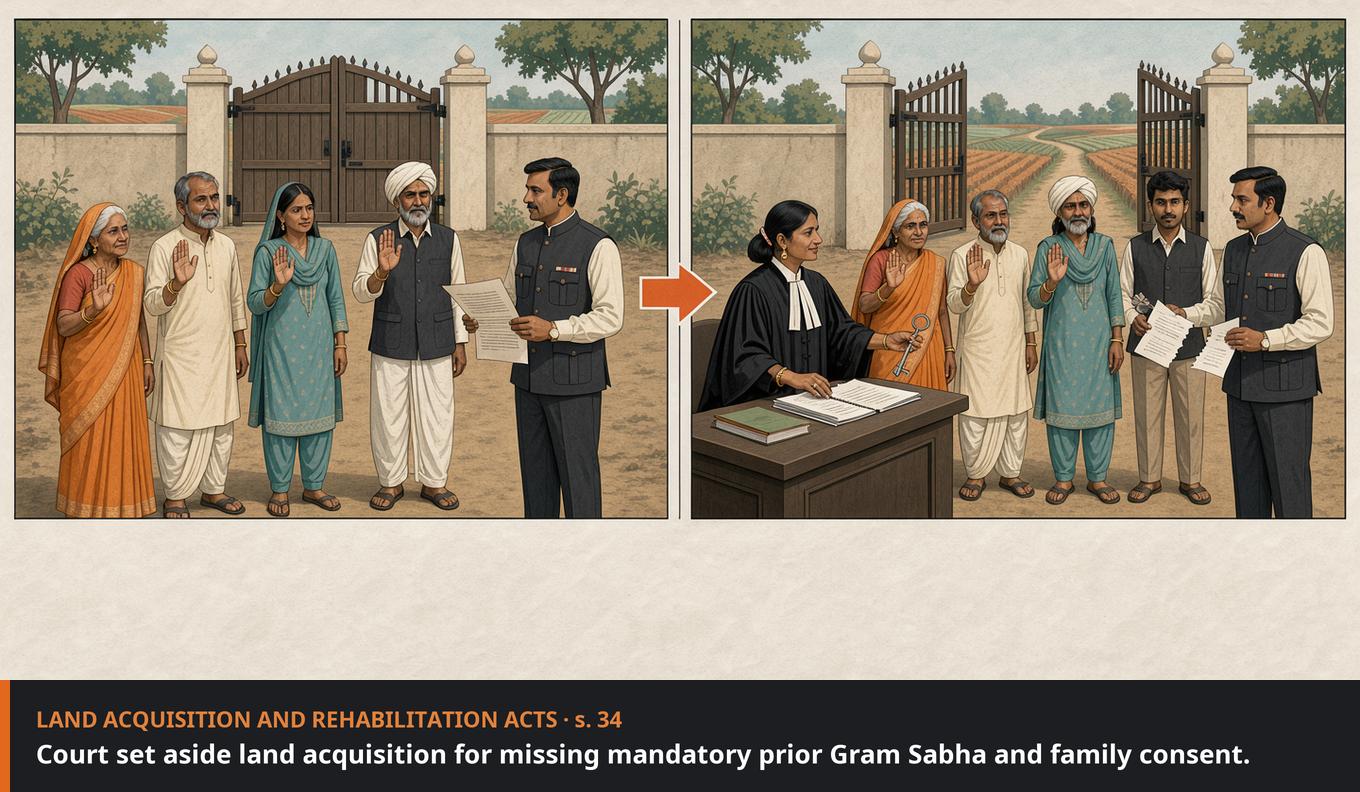
Acquisition set aside for lacking mandatory prior Gram Sabha consent and 80% family consent under 2013 Act
Facts that mattered
The State of Odisha initiated land acquisition under the 2013 Act for surface rights over land in three villages, at the instance of a private company holding a mining lease.
Gram Panchayats unanimously rejected the proposal in January 2020, and no public hearing on the draft SIA was conducted due to Covid-19 restrictions.
The Expert Group included a person connected to the company as Advisor, Land Acquisition, and prior consent of 80% affected families was not obtained before Section 8 examination.
The High Court dismissed the writ petition, holding consent requirements were directory and the acquisition substantially compliant; the Supreme Court set aside the acquisition.
Legal concepts
Prior consent under Section 2(2)(b) must be obtained along with the SIA study and before the government examines the proposal under Section 8, not as a continuing process throughout acquisition proceedings.
Laid down · para 31
The requirement of prior Gram Sabha consent under Section 41(3) for land acquisition in Scheduled Areas is mandatory, not directory, and cannot be negated by the directory language of sub-sections (1) and (2).
Laid down · para 39
The Expert Group evaluating the SIA report must be independent under Section 7(1); including a person connected to the project proponent compromises this statutory independence.
Laid down · para 46
The 2013 Act and the MMDR Act operate in distinct spheres and can be harmoniously construed; a mining lease between State and lessee cannot affect third-party landowners' proprietary rights.
Power Grid Corporation of India Limited v. Tangedco, C.A. No.-014780-014781 - 2025
Bench: HON'BLE MR. JUSTICE J.B. PARDIWALA, HON'BLE MR. JUSTICE K. VINOD CHANDRAN (2 judges). Judgment by HON'BLE MR. JUSTICE K. VINOD CHANDRAN
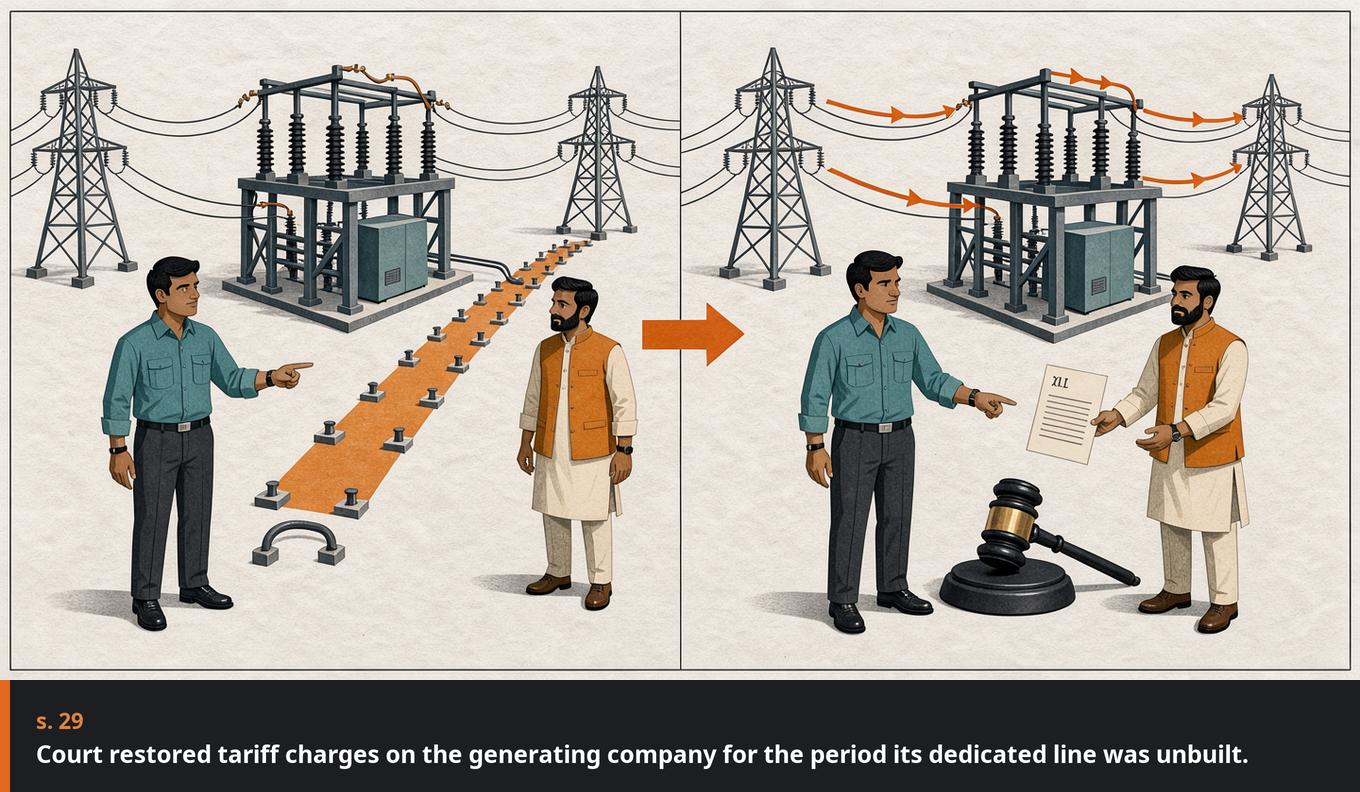
Supreme Court restores CERC order, holding LILOs used in transmission and tariff claim sustainable
Facts that mattered
PGCIL, the Central Transmission Utility, commissioned two LILOs on the Tuticorin JV-Madurai 400kV line at Tuticorin Pooling Station on 04.01.2015 and 08.01.2015, part of the transmission scheme approved in the 30th Standing Committee Meeting and the Bulk Power Transmission Agreement.
The generating company, Coastal Energen (now Moxie Power), delayed constructing its dedicated transmission line to the Tuticorin Pooling Station until 27.10.2016, while upstream lines to Salem and Madhugiri were commissioned only later.
CERC accepted the COD and cast transmission charges on the generating company till DTL commissioning; APTEL set this aside, holding the LILOs were not put to beneficial use since upstream lines were not operational.
The Supreme Court found power was necessarily diverted through the LILOs to the Pooling Station and restored the CERC order, allowing PGCIL's non-PoC tariff claim for 04.01.2015 to 27.10.2016.
Legal concepts
Regulation 4(3)(ii) of the Tariff Regulations applies only where regular service of a transmission element is prevented by delay in commissioning the generating station or the upstream or downstream transmission system, not attributable to the transmission licensee.
Laid down · para 40
COD of a transmission element is the date declared by the transmission licensee after successful trial operation and issue of the RLDC certificate, so no redetermination under Regulation 4(3)(ii) is warranted where regular service was not prevented.
Reaffirmed · para 41
CERC may impose liability on a defaulting party under Section 79(1) even in the absence of a regulation framed under Section 178, provided the levy is reasonable.
Reaffirmed · para 45 · Energy Watchdog v. Central Electricity Regulatory Commission and Ors. Etc., (2017) 14 SCC 80, para 45
Decisions of the Standing Committee taken under Section 29(4) of the Electricity Act in furtherance of grid stability and coordinated transmission planning have legal sanctity and bind all stakeholders.
This digest summarises Supreme Court of India judgments for general information. It is not legal advice and does not create a lawyer-client relationship. Please read the full judgment before relying on it. See also our disclaimer.