Poornima Gupta v. Saurav Gupta, CONMT.PET.(C) No.-000738 - 2026
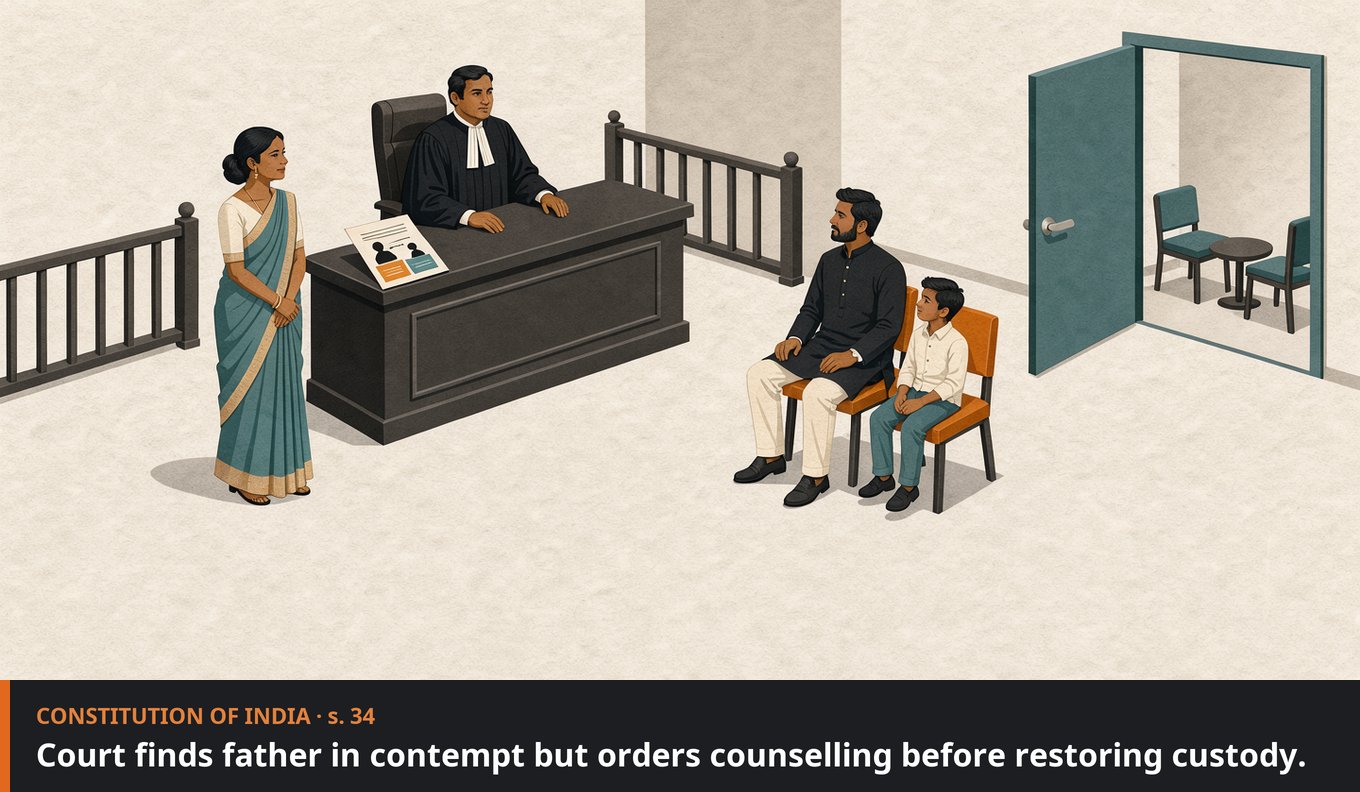
Father in contempt for retaining son; Court orders counselling before restoring custody.
Facts that mattered
A transfer petition between spouses was resolved by a mutual settlement dated 13 November 2025, recorded in this Court's order dated 12 December 2025.
The settlement placed custody of the two children with the mother and granted the father visitation twice a year for four days at Dholpur.
The father took the minor son from his school on 22 July 2026 and retained him in Rajasthan, contrary to the settlement, and did not return him.
The Court found the father in contempt but declined abrupt restoration of custody, directing counselling of the child by the Family Court, Dholpur.
Legal concepts
A parent who retains custody of a child contrary to a settlement recorded in this Court's order is in clear contempt, though the Court may decline abrupt restoration of custody where it would harm the child.
Laid down · para 14
Where a child's mind appears tutored against the custodial parent, the Court may direct counselling by a child counsellor through the Family Court before restoring custody.
Helena Anna Maria Lersch v. State of Goa, SLP(Crl) No.-011625 - 2026
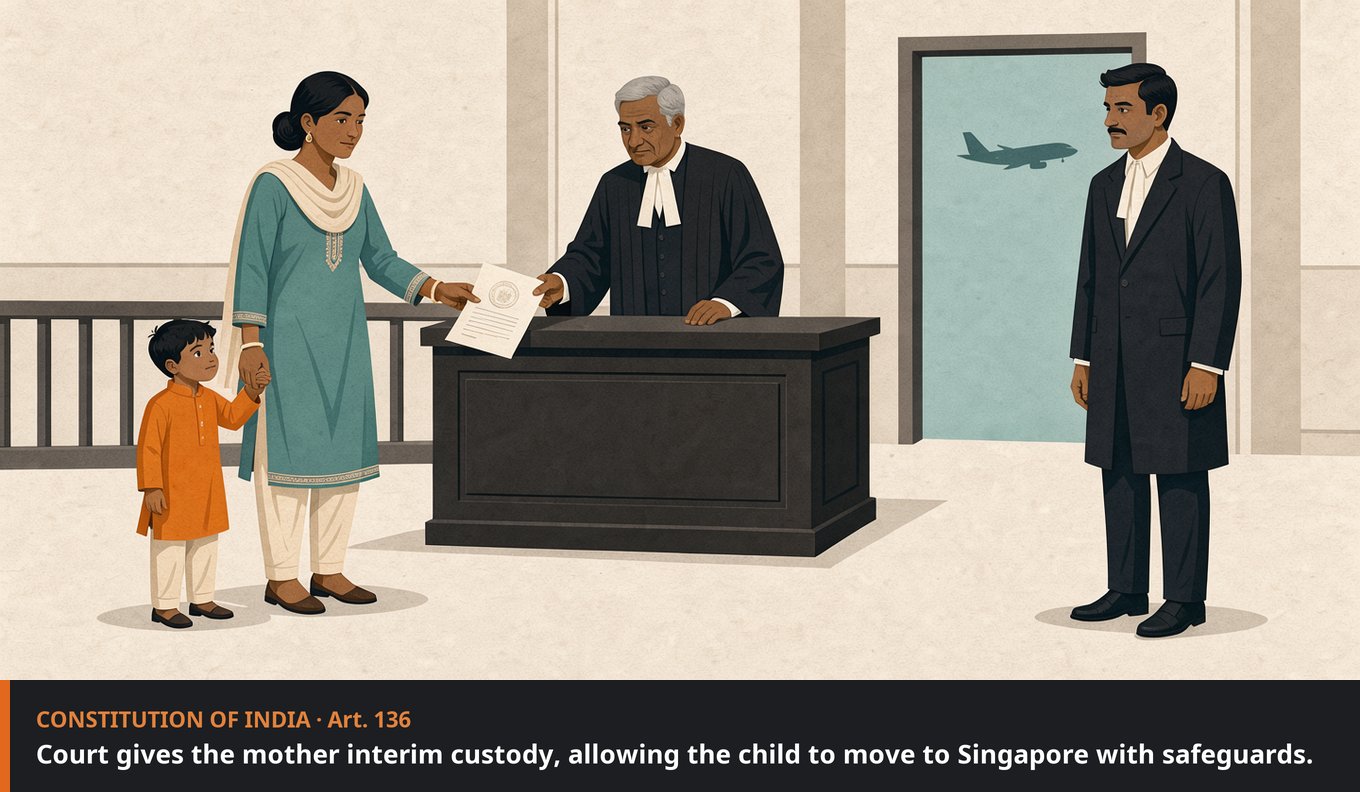
Court grants unwed mother interim custody, allowing child's relocation to Singapore with mirror order safeguards.
Facts that mattered
An unmarried German mother working in Singapore sought access and interim custody of her four-year-old son, an Indian-resident child, from the father, an Indian lawyer based in Delhi.
The mother filed habeas corpus proceedings in the Bombay High Court; the father later filed guardianship proceedings in West Bengal, later transferred to the Family Court at Patiala House, New Delhi.
The Supreme Court directed NIMHANS to assess both parents and the child, which found both parents psychologically fit and equally invested in the child's welfare.
The Court granted interim custody to the mother, permitting relocation to Singapore subject to a mirror order from a Singapore court and a Rs. one crore security deposit.
Legal concepts
This Court has jurisdiction to decide interim custody in a habeas corpus proceeding in exercise of parens patriae jurisdiction, and procedural or jurisdictional issues must yield to the child's best interests.
Laid down · para 125 · Rajeswari Chandrasekar Ganesh v. State of T.N., (2023) 12 SCC 472, para 46
In a dispute between unwed parents, the mother has a better prima facie claim of custody of a child of tender age, as recognized across legal jurisdictions.
Reaffirmed · para 68 · X1 v. State (NCT of Delhi), (2015) 10 SCC 1, para 66
The child's best interests must be the preeminent consideration in any custody matter, prevailing over all other considerations including parents' rights and jurisdictional issues.
Reaffirmed · para 51 · Sheetal Vasant Thakur v. Chirag Arora, 2026 SCC OnLine SC 1110, para 52
Irreparable harm in a custody dispute must be assessed from the perspective of the child, the most vulnerable party and subject of parens patriae jurisdiction, not the parents.
Uttar Pradesh Ground Water Department Non Gazetted Employee Association (regd.) v. the Chief Secretary, W.P.(C) No.-001458 - 2020
Bench: HON'BLE MR. JUSTICE DIPANKAR DATTA, HON'BLE MR. JUSTICE SATISH CHANDRA SHARMA (2 judges). Judgment by HON'BLE MR. JUSTICE DIPANKAR DATTA
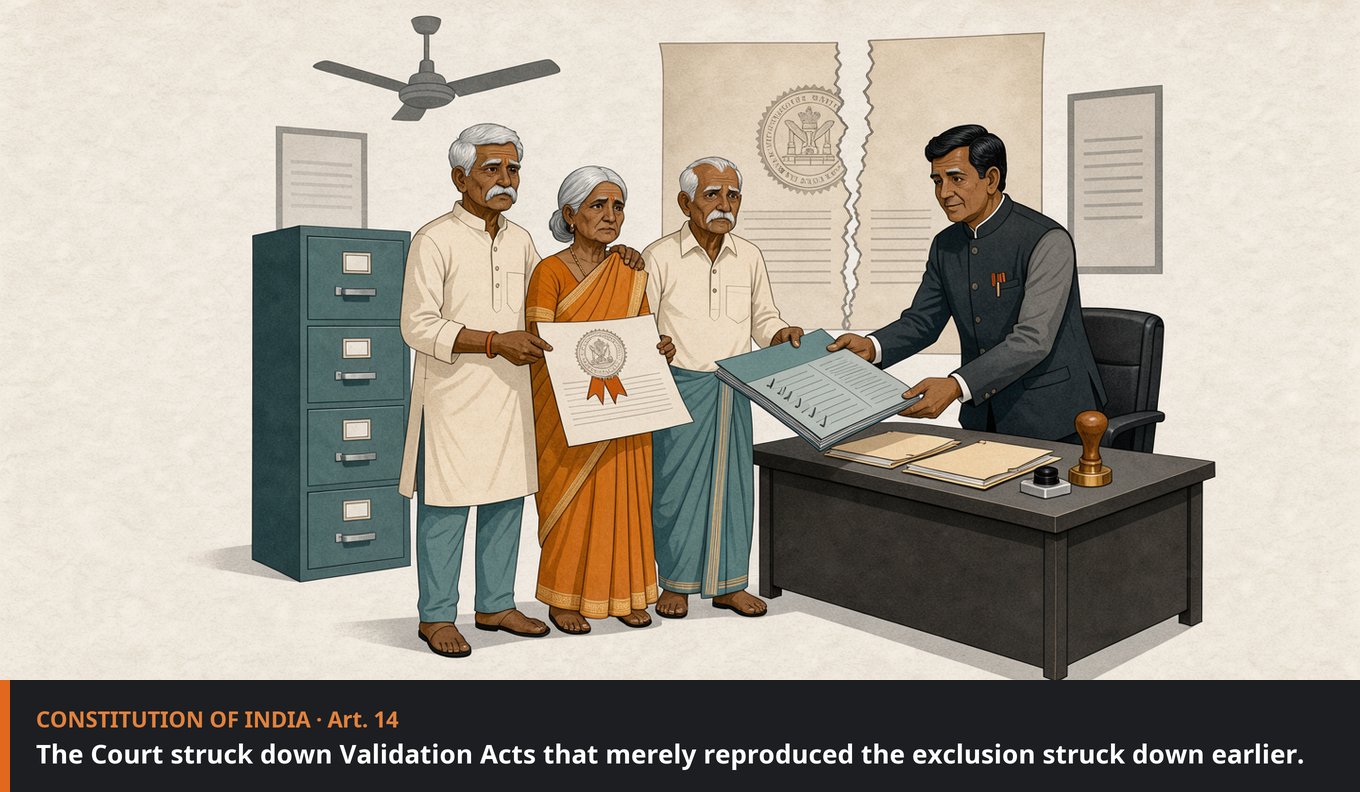
Validation Acts reproducing the exclusion struck down in Prem Singh held constitutionally infirm
Facts that mattered
Employees of Uttar Pradesh departments, engaged as work-charged, daily-wage or muster-roll staff from the late 1970s and later regularised, claimed that pre-regularisation service count towards pension.
In Prem Singh, this Court read down Rule 3(8) of the 1961 Rules, holding work-charged service as qualifying service for pension, with arrears restricted to three years; review was dismissed.
The State responded with a 2020 Ordinance and Validation Act, 2021, then a 2025 Ordinance and Validation Act, 2025, retrospectively excluding non-substantive appointees from pension and validating past denials notwithstanding court judgments.
The Court examined whether these validating enactments removed the constitutional defect identified in Prem Singh or merely reproduced the same exclusion in new statutory language.
Legal concepts
A validating enactment must be tested not only against general constitutional compliance but also against whether it removes the specific defect identified in the earlier judgment.
Laid down · para 58
The legislature may change the law but may not, under the guise of changing the law, command that a final judicial determination be treated as though it had never been made.
Laid down · para 70 · Madan Mohan Pathak, para 71
Validating enactments that extinguish the operative effect of a final adjudication without removing the legal defect on which it was premised are constitutionally infirm.
Laid down · para 72
Mere non-consideration of an earlier decision does not furnish a sustainable basis for not following its ratio, and per incuriam cannot be invoked on that ground alone.
Subhasindu Das v. Bacchu Ranjan Das, C.A. No.-000841-000842 - 2023
Bench: HON'BLE MR. JUSTICE VIKRAM NATH, HON'BLE MR. JUSTICE R. MAHADEVAN, HON'BLE MR. JUSTICE APARESH KUMAR SINGH (3 judges). Judgment by HON'BLE MR. JUSTICE VIKRAM NATH
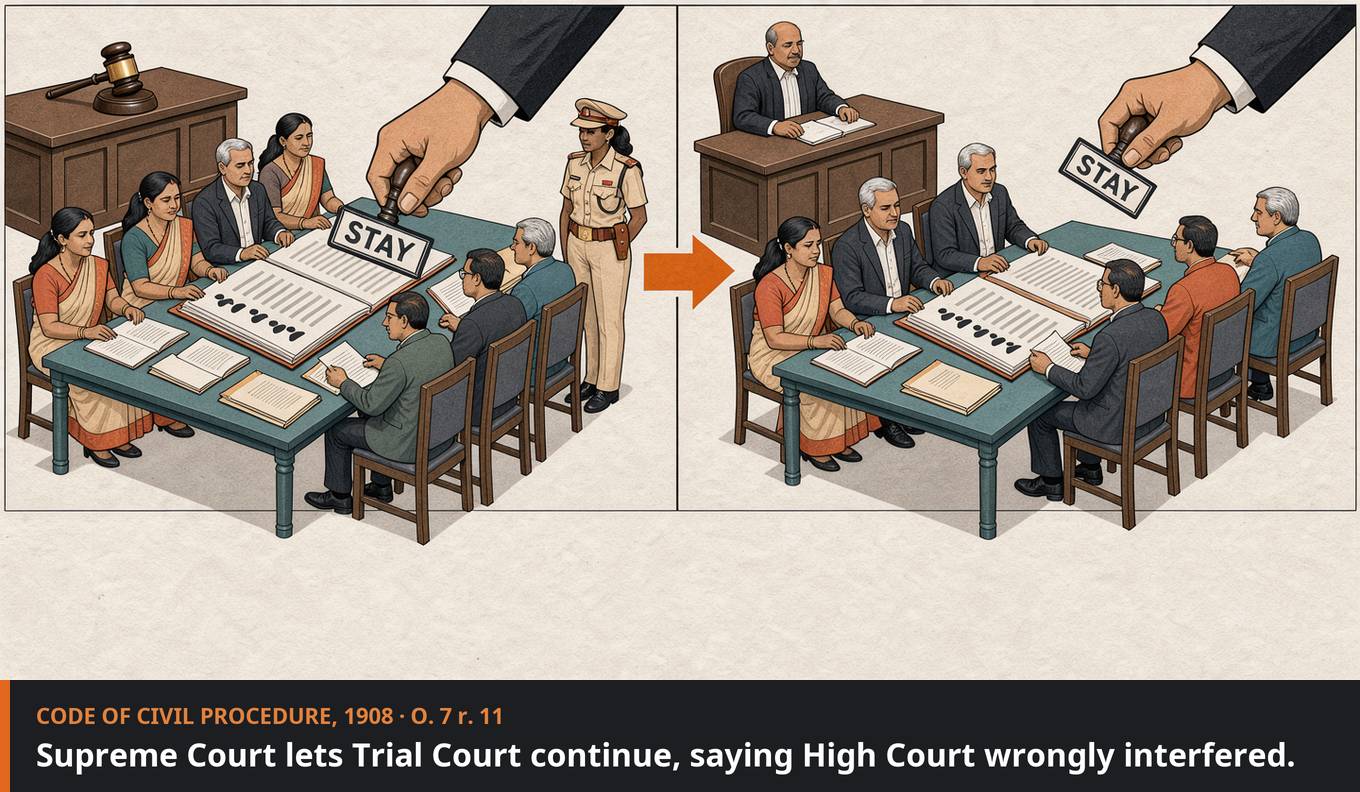
Supreme Court sets aside High Court's interim interference with Trial Court's management and impleadment orders
Facts that mattered
The appellants sued under Section 92 CPC for removal of office bearers and a scheme to manage Sri Guru Sangha, a charitable society with its Ashram at Kolkata.
The Trial Court removed Special Officer Banani Ghosh after considering her written explanation and constituted a 13-member ad hoc committee on a joint application of the parties.
The High Court stayed the Trial Court's order and later set aside its rejection of impleadment applications, holding the suit was representative in nature.
The Supreme Court stayed the High Court's orders and permitted the Trial Court to continue with the suit.
Legal concepts
Supervisory jurisdiction under Article 227 is not meant to correct every error of fact or law or to substitute the High Court's conclusions for those of the subordinate court; interference is warranted only for patent jurisdictional error, perversity or grave miscarriage of justice.
Reaffirmed · para 8
A suit under Section 92 of the CPC is representative in nature, but that does not confer an automatic right of impleadment upon every member; the applicant must show that presence is necessary or proper under Order I Rule 10(2).
Laid down · para 9
The representative nature of a suit cannot by itself dispense with the requirements of Order I Rule 10(2) of the CPC, and the High Court must identify perversity or legal infirmity before setting aside a reasoned rejection of impleadment.
Bench: HON'BLE MR. JUSTICE DIPANKAR DATTA, HON'BLE MR. JUSTICE SATISH CHANDRA SHARMA (2 judges). Judgment by HON'BLE MR. JUSTICE DIPANKAR DATTA
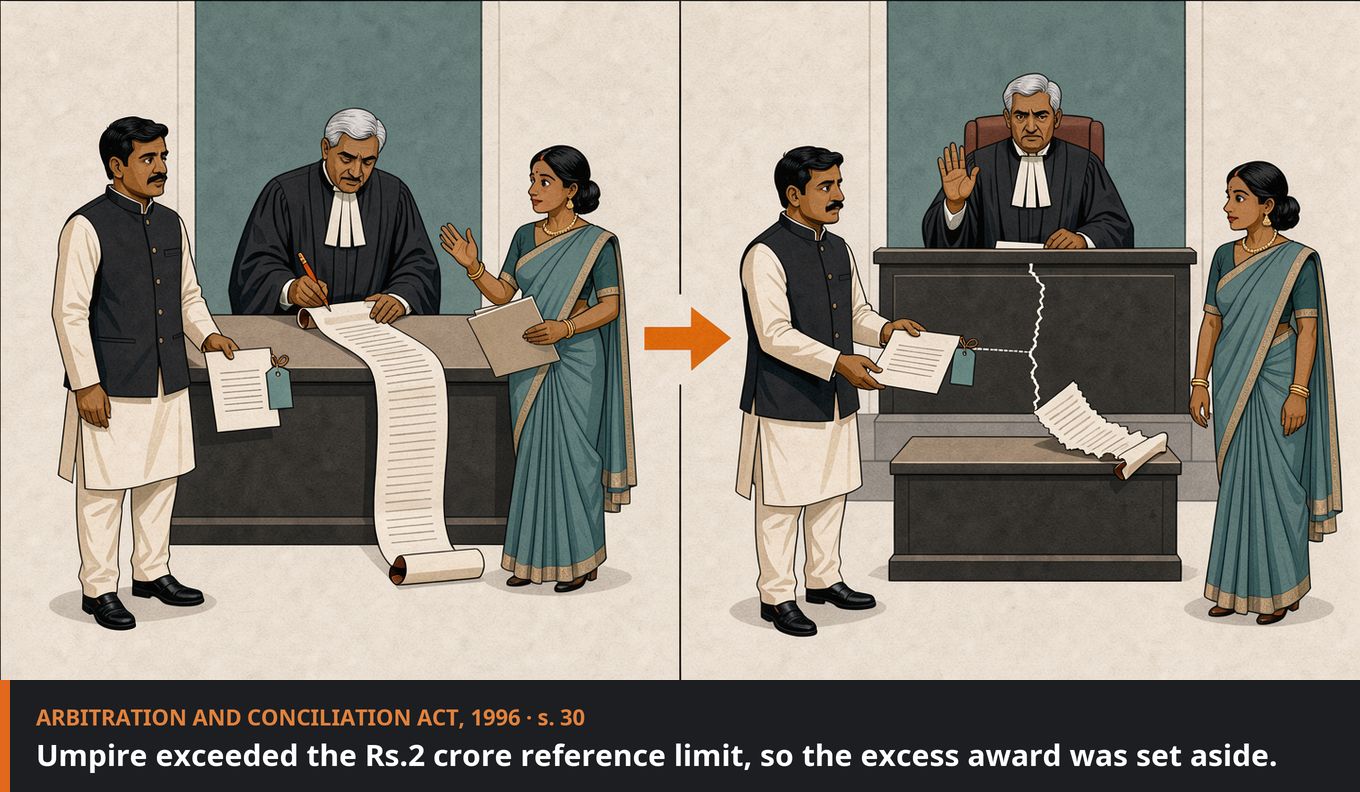
Umpire exceeded jurisdiction; award restored to Rs.2 crore reference limit
Facts that mattered
GMB's pre-reference correspondence quantified its project cost overrun claim at Rs.2,00,00,000/- and its arbitrator nomination defined the reference to that sum alone.
The Umpire awarded Rs.11,69,62,910/- with 15% interest, and the Division Bench restored this award in full, reversing the Single Judge's restriction to Rs.2 crore.
The Single Judge had set aside the Schedule 'C' award for brand-name damages as speculative, based on a 1990 estimate when actual audited expenditure was available.
The Court found the Umpire exceeded jurisdiction by entertaining claims beyond Rs.2 crore and could not construe Clause 20 as making Neycer an insurer of GMB's project.
Legal concepts
An error within jurisdiction cannot be interfered with unless erroneous and apparent on the face of the award, whereas an error in excess of jurisdiction going to the root of the arbitrator's authority can be set aside.
Reaffirmed · para 6
A dispute as to the jurisdiction of the umpire or the scope of the submission lies outside the award and must be determined by the Court on an objective examination of the documents constituting the reference.
Laid down · para 7
Contesting claims on merits without prejudice to a pleaded jurisdictional objection does not amount to waiver or confer jurisdiction by acquiescence.
Laid down · para 13
Where claims under different schedules are distinct and severable, the valid portion of an award can be sustained after severing the invalid excess.
The Gem & Jewellery Export Promotion Cou v. State of Maharashtra ., C.A. No.-001889-001889 - 2015
Bench: HON'BLE MR. JUSTICE S.V.N. BHATTI, HON'BLE MR. JUSTICE N.V. ANJARIA (2 judges). Judgment by HON'BLE MR. JUSTICE S.V.N. BHATTI
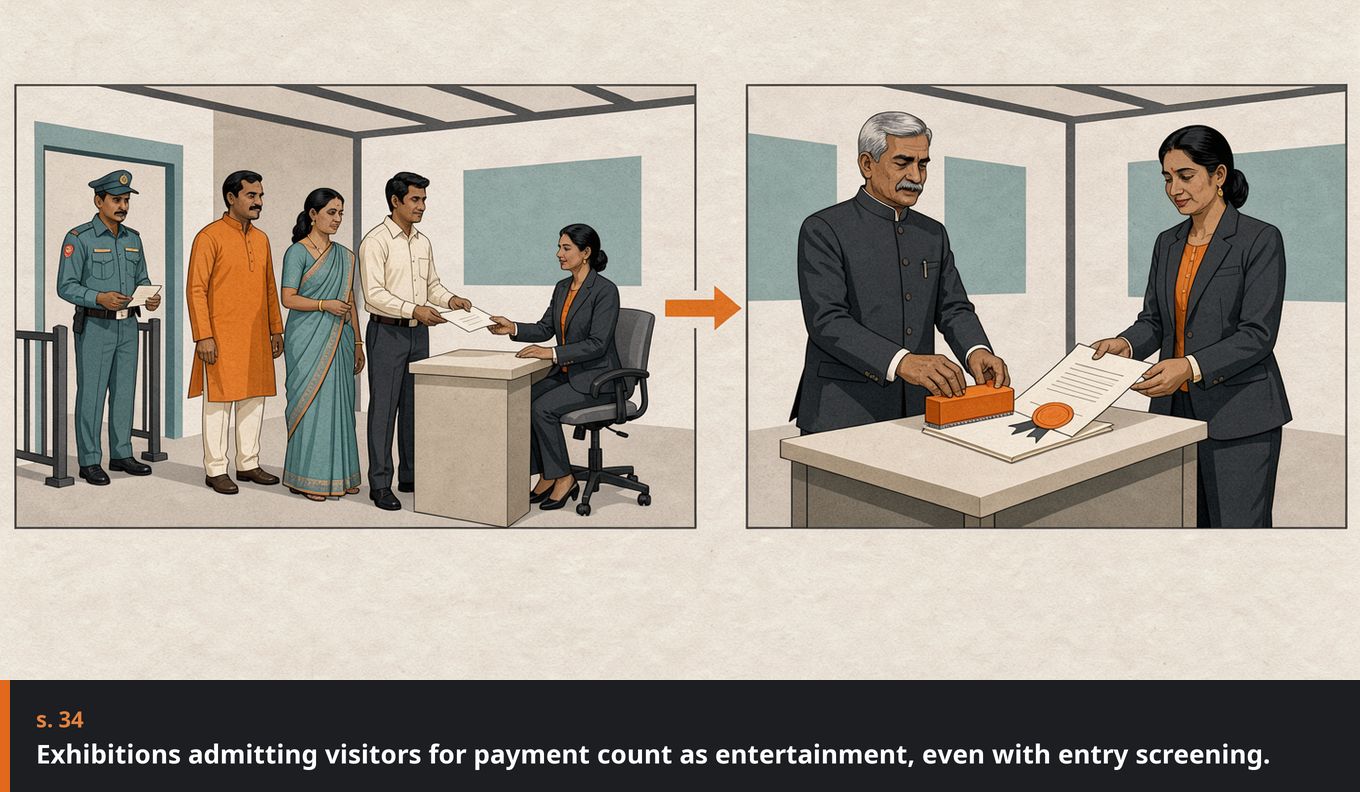
Trade exhibitions admitting visitors on payment are entertainment exigible to duty under the 1923 Act
Facts that mattered
The Appellant, a Section 25 company, organises the IIJS and IIJS Signature trade exhibitions in Mumbai and deposited entertainment duty under protest to obtain a Collector's NOC.
The Additional Collector assessed liability of Rs. 97,09,500 for IIJS 2011, and the Divisional Commissioner on appeal reduced it to Rs. 45,40,125 while holding the trade show taxable under Section 2(a) of the Act, 1923.
The Bombay High Court dismissed the Appellant's writ seeking a declaration that business-to-business exhibitions are not entertainment, prompting the present appeal.
Entry to the exhibitions is on payment of an entry fee after scrutiny of trade credentials, and the general public and individual consumers are barred from registering.
Legal concepts
An exhibition to which persons are admitted for payment falls within the inclusive definition of entertainment, and a screening or application procedure for entry does not take it outside that definition.
Reaffirmed · para 20 · M/s Geeta Enterprises & Ors. v. State of U.P. & Ors., (1983) 4 SCC 202, para 11
Where a definition clause uses the word includes, the definition is enumerative but not exhaustive, and the defined term retains its ordinary meaning while its scope is extended.
Reaffirmed · para 17 · Bharat Coop. Bank (Mumbai) Ltd. v. Coop. Bank Employees Union, (2007) 4 SCC 685, para 17
An interpretation clause which extends the meaning of a word does not take away its ordinary, popular and natural sense, and is not to be taken as strictly defining the term under all circumstances.
Reaffirmed · para 18 · Forest Range Officer & Ors. v. P. Mohammed Ali & Ors., para 18
This digest summarises Supreme Court of India judgments for general information. It is not legal advice and does not create a lawyer-client relationship. Please read the full judgment before relying on it. See also our disclaimer.