s. 17 · Judgment of
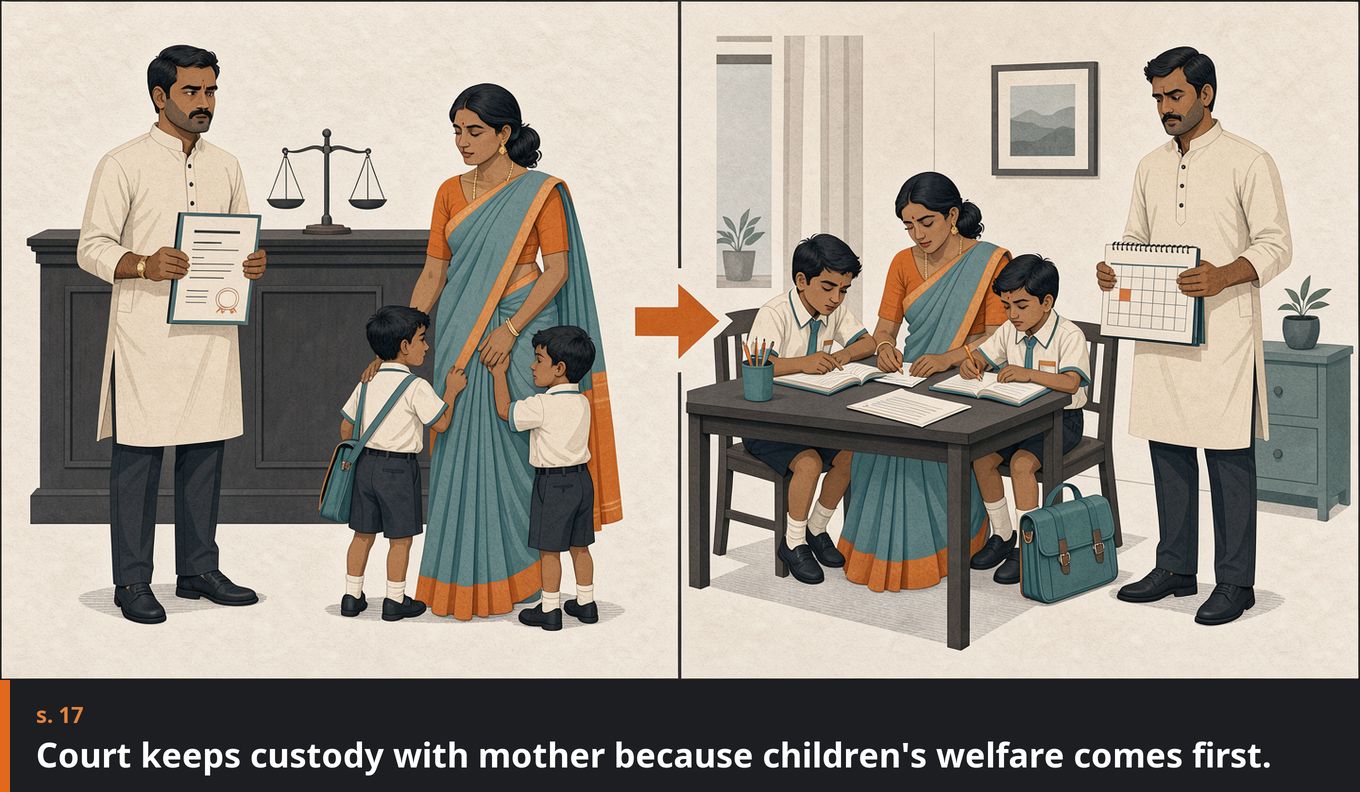
Custody kept with mother despite father being natural guardian, as children's welfare is paramount
The facts
- The Family Court, Madurai granted custody of two minor sons to the father under the Guardians and Wards Act, 1890, and the High Court affirmed it on the ground that no material showed the father was mentally retarded.
- The children had lived continuously with their mother since 2014, and during interaction with the Court they clearly expressed their unwillingness to live with their father.
- The mother singularly supported the children's upbringing and education in good schools, while the father, a natural guardian, was not shown to have any disentitling factors.
- The father had met the children only four to five times in 10 to 12 years despite visitation rights, and the mother had not permitted contact.
What the Court held
Welfare of the minor is the paramount consideration in appointing a guardian, and the court must have regard to the age, sex and religion of the minor and the character and capacity of the proposed guardian.
Reaffirmed · para 26
Other principles
If the minor is old enough to form an intelligent preference, the court may consider that preference under Section 17(3) of the Act.
Reaffirmed · para 26
What would best serve the welfare and interest of the child is the sole and predominant criterion while exercising the power vested in the Court under Section 17 of the Act.
Reaffirmed · para 29 · Elizabeth Dinshaw v. Arvand M. Dinshaw, para 33
Children should not be separated from the parent with whom they have developed a strong natural bond, even where the other parent is not shown to be unfit, as removal would not be conducive to their well-being.
Laid down · para 34 · Anjali Kapoor (SMT) Vs. Rajiv Baijal, (2009) 7 SCC 322, para 32
Summaries are for information and are not legal advice. Read the full judgment before relying on it. See also our disclaimer.