Ajit Patel v. Evita Co-Operative Housing Society Ltd., C.A. No.-014683-014683 - 2026
Bench: HON'BLE MR. JUSTICE VIKRAM NATH, HON'BLE MR. JUSTICE SANDEEP MEHTA, HON'BLE MR. JUSTICE APARESH KUMAR SINGH (3 judges). Judgment by HON'BLE MR. JUSTICE VIKRAM NATH
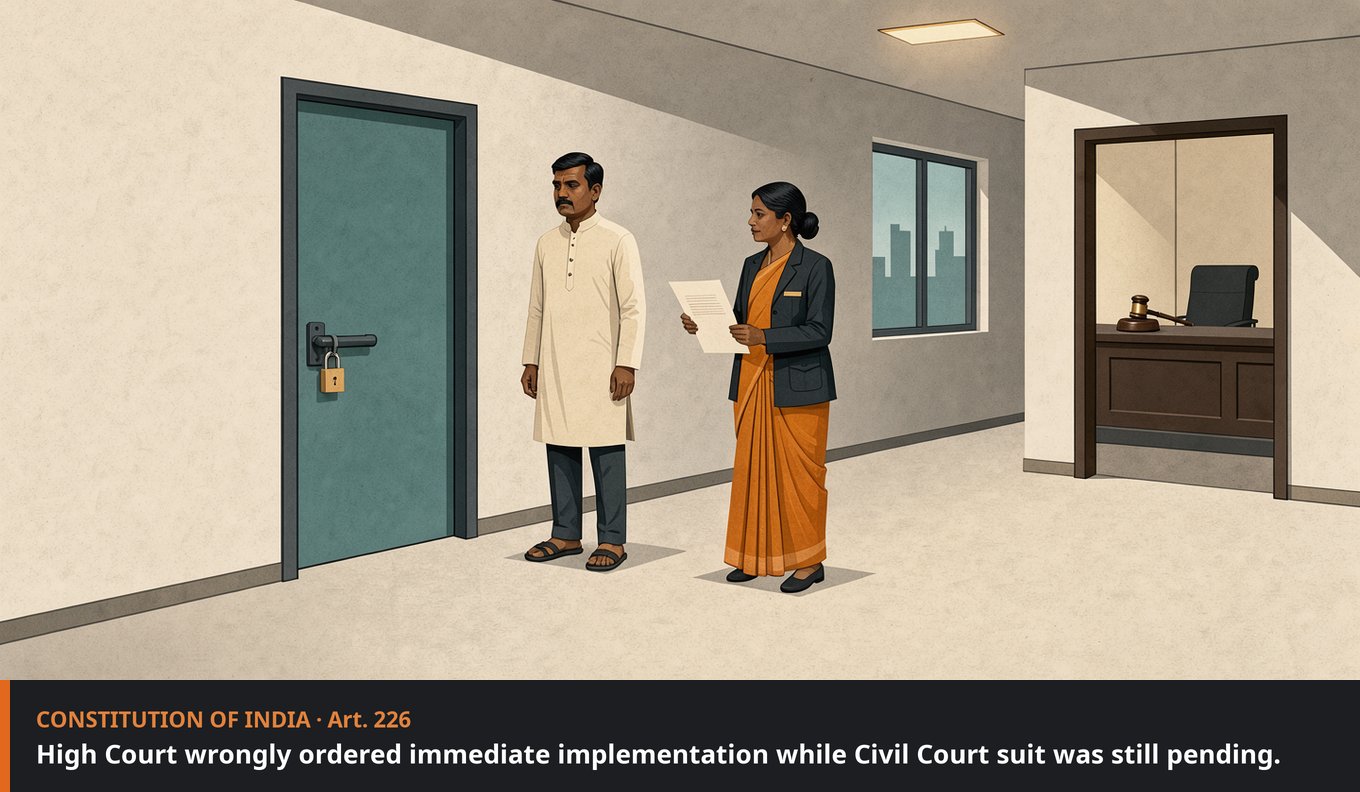
High Court erred in Article 226 directing implementation of order pending before Civil Court
Facts that mattered
The appellant purchased four flats in the Evita high-rise under registered agreements, claiming the corresponding terrace areas were conveyed to him as an integrated arrangement.
The Society alleged the terrace was a fire refuge area under the Fire NOC and could not be sold, and complained of encroachment by the appellant.
The MCGM issued a notice and speaking order directing removal of alleged unauthorised works, which the appellant challenged in a pending Civil Court suit.
The High Court, in a writ petition, directed the Corporation to immediately implement its order and opened the common terrace door, prompting this appeal.
Legal concepts
A Court examining a lis under Article 226 is not obliged to entertain a challenge involving seriously disputed factual aspects, which may more appropriately be examined by the competent Civil Court or prescribed statutory authority.
Reaffirmed · para 25
Once a party has availed the jurisdiction of the Civil Court by challenging a statutory order, a High Court direction requiring implementation of that order would adversely bear on the pending suit, virtually making the remedy redundant.
Laid down · para 26
Mandatory directions for immediate implementation of a statutory order have the effect of pre-empting adjudication of seriously disputed questions of fact overlapping with issues pending before the Civil Court, prejudicing the pending suit.
Pawankumar Fakirchand Uike v. State of Maharashtra, Crl.A. No.-005571-005571 - 2026
Bench: HON'BLE MR. JUSTICE DIPANKAR DATTA, HON'BLE MR. JUSTICE SHEEL NAGU (2 judges). Judgment by HON'BLE MR. JUSTICE DIPANKAR DATTA
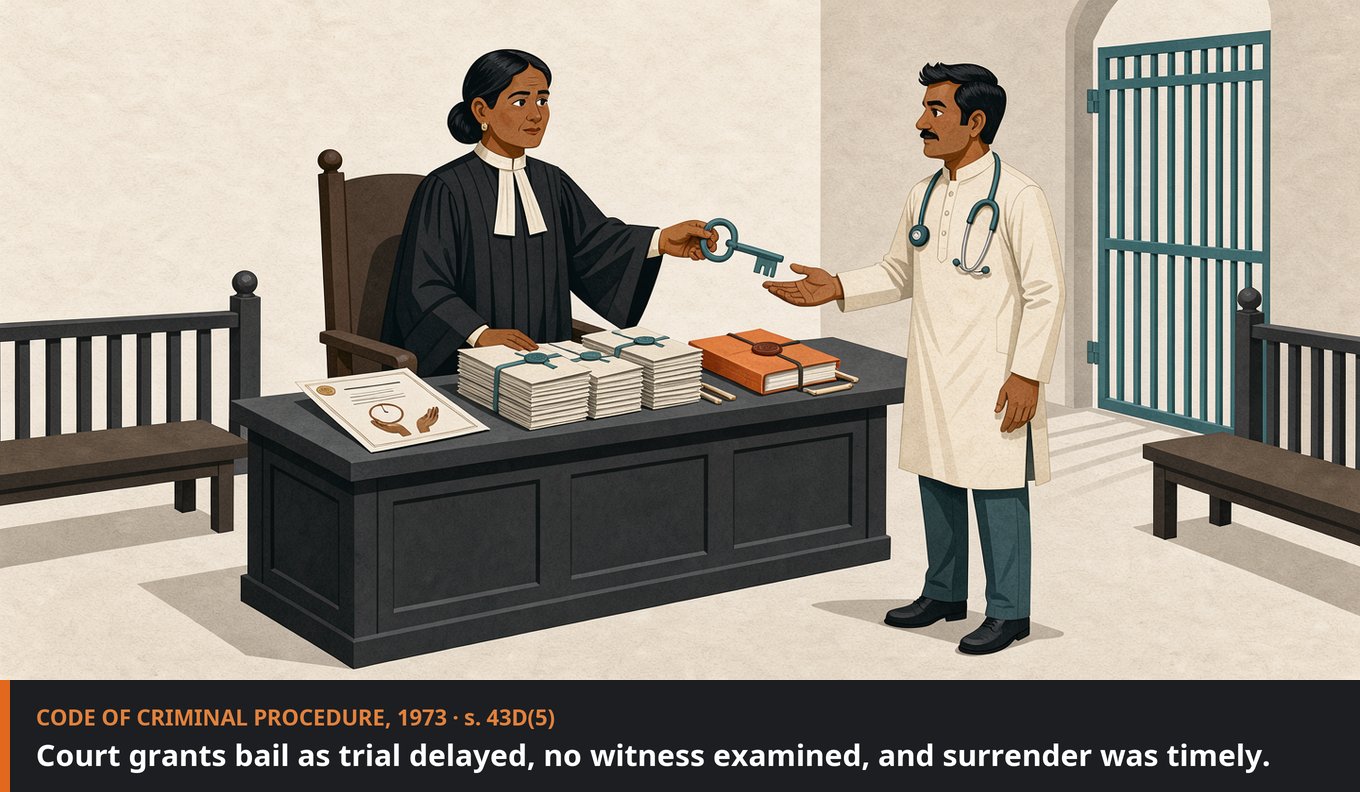
Supreme Court grants bail under UAPA citing trial delay, custody period and High Court's error on surrender
Facts that mattered
The appellant, a doctor, was arrested in July 2022 in a Naxal-affected forest area after a cloth banner hailing the Naxal movement was seized from him and his co-accused.
A chargesheet was filed in January 2023 and the case committed to the Sessions Court; the co-accused were granted bail by the High Court in January 2024.
The High Court rejected his bail in July 2026, attributing trial delay to him and finding he failed to surrender within the stipulated time after temporary bail.
The custody certificate showed he surrendered on 24th October 2025 per the temporary bail terms, charges were framed only in July 2026, and none of the 39 witnesses had been examined.
Legal concepts
The bail bar under Section 43D(5) of the UAPA does not do away with a Constitutional Court's discretionary power to grant bail on grounds of violation of fundamental rights, particularly where there is undue delay in completion of the trial.
Reaffirmed · para 14
The statutory bar on bail under the UAPA comes into operation when perusal of the material collected against the accused leads the Court to believe the allegations are prima facie true.
Reaffirmed · para 13
A High Court errs grossly in rejecting bail on the ground of belated surrender when the custody certificate on record shows the accused surrendered within the terms of the temporary bail order.
State of Karnataka v. Vinay Rajashekharappa Kulkarni, Crl.A. No.-005556-005556 - 2026
Bench: HON'BLE MR. JUSTICE PRASHANT KUMAR MISHRA, HON'BLE MR. JUSTICE SHREE CHANDRASHEKHAR (2 judges). Judgment by HON'BLE MR. JUSTICE SHREE CHANDRASHEKHAR
Supreme Court sets aside stay of conviction and suspension of sentence granted to life convicts in murder case
Facts that mattered
Eight life convicts and an MLA, A-15, convicted of murdering Yogesh Goudar in furtherance of criminal conspiracy, were granted bail by the High Court by suspending sentences and staying A-15's conviction.
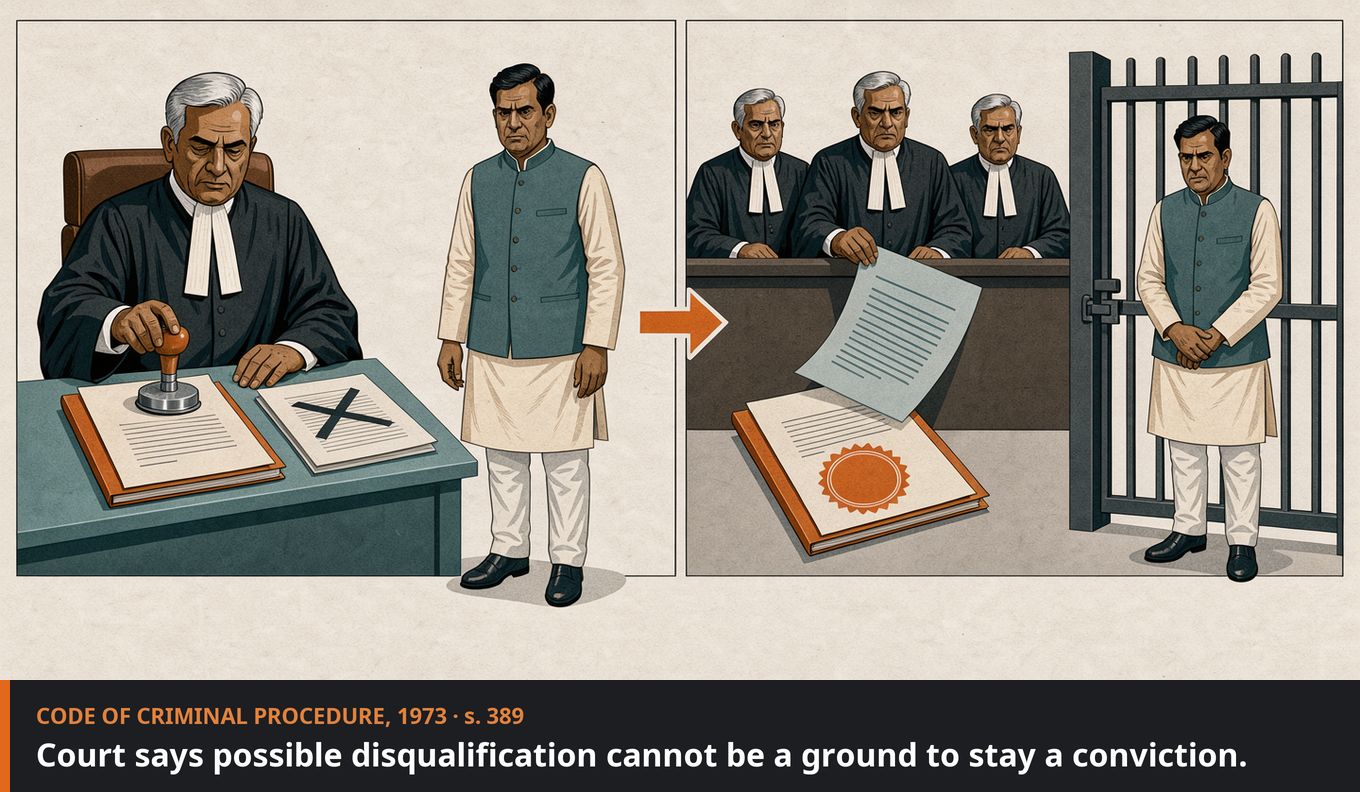
The High Court stayed A-15's conviction reasoning that failure to do so would cause irreversible consequences through disqualification under section 8(3) of the Representation of the People Act, 1951.
The prosecution case rested substantially on PW10, an approver, with several witnesses including the deceased's wife turning hostile during trial.
The Supreme Court found the High Court orders did not address the State's contentions nor identify any palpable error in the conviction judgment.
Legal concepts
Stay of conviction requires a higher threshold than a prima facie case: the convict must show a palpable mistake apparent on the face of the record that strikes at the foundation of the conviction.
Laid down · para 12
Possible disqualification of a legislator under section 8(3) of the Representation of the People Act, 1951 cannot be the primary ground to stay a conviction, as every convicted legislator would then be automatically entitled to stay.
Laid down · para 13
Suspension of sentence requires only a good prima facie case with a fair chance of acquittal, a clearly lower threshold than the palpable mistake required for stay of conviction.
Laid down · para 23
The testimony of an approver found truthful by the Court can be the basis for conviction; seeking corroboration is merely a rule of prudence, not a rule of law.
Reaffirmed · para 19 · Rameshwar v. State of Rajasthan, AIR 1952 SC 54: 1951 SCC 1213 : 1951 SCC OnLine SC 83, para 18
Pendency of criminal appeals and remote possibility of early hearing is not a ground to suspend sentence in grave offences like murder.
Deepti Singh v. State of U.P, Crl.A. No.-005555-005555 - 2026
Bench: HON'BLE MR. JUSTICE PRASHANT KUMAR MISHRA, HON'BLE MR. JUSTICE SHREE CHANDRASHEKHAR (2 judges). Judgment by HON'BLE MR. JUSTICE SHREE CHANDRASHEKHAR
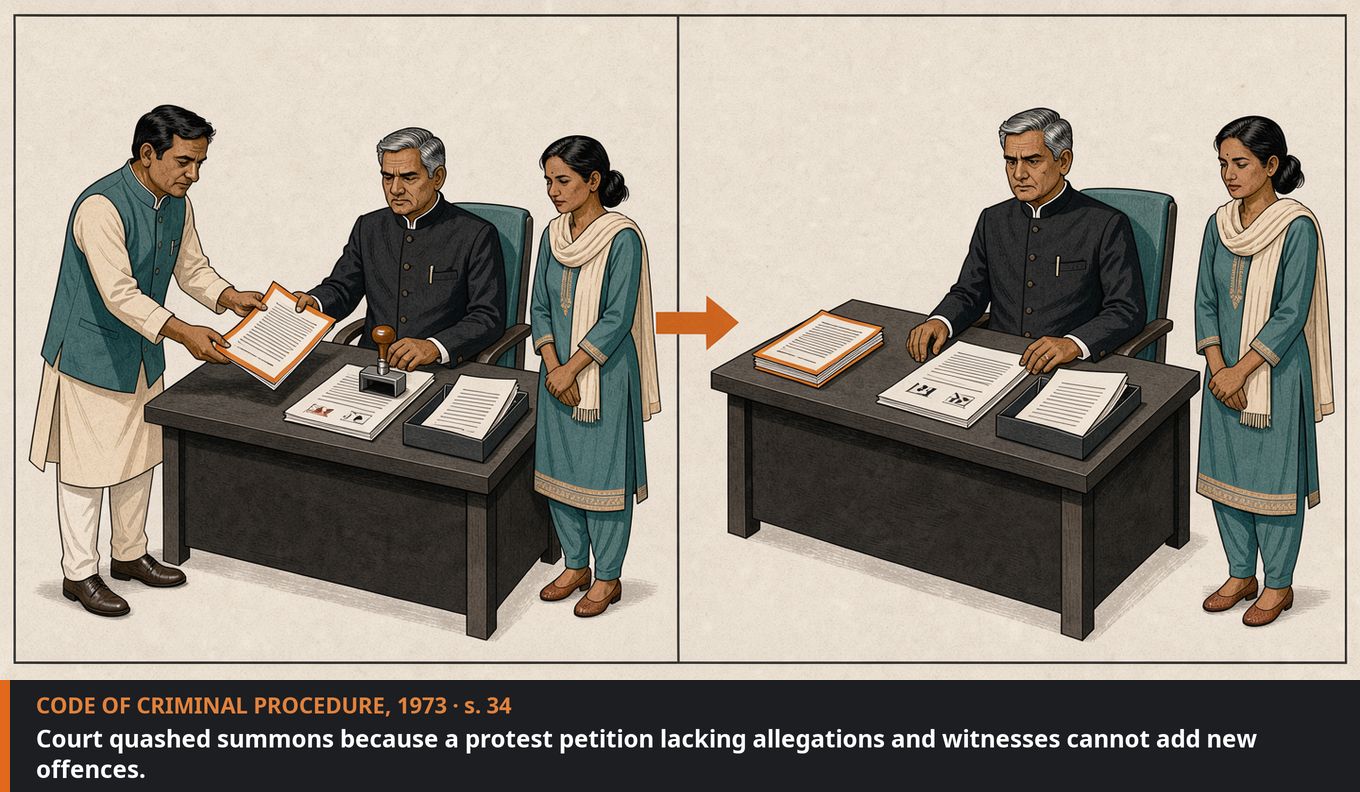
Cognizance on a Protest Petition not meeting complaint requirements is quashed
Facts that mattered
Crime No. 487 of 2022 was registered under sections 302, 352 and 504 IPC after Abhishek Singh died following an altercation with neighbour Gaurav Singh, husband of the appellant.
The chargesheet was filed only against Gaurav Singh under sections 323, 504 and 506 IPC, recording that involvement of the appellant was not established.
The informant filed a Protest Petition, and the Chief Judicial Magistrate took cognizance of offences including murder and issued summons to the appellant and many others.
The High Court dismissed the quashing application, holding that disputed questions of fact could not be decided at that stage.
Legal concepts
A Protest Petition may be treated as a complaint under Chapter XV only if it contains specific allegations against the accused and a list of witnesses; merely summing up objections to the police investigation does not satisfy the definition of complaint under section 2(d).
Laid down · para 14
When a Magistrate proceeds on a Protest Petition as a complaint, he must follow the Chapter XV procedure, including inquiry under section 202 and the power of dismissal under section 203, before issuing process.
Laid down · para 14
A Magistrate accepting a chargesheet in toto has no power to add any new offence in the order taking cognizance under section 190(1)(b).
Laid down · para 8
An order taking cognizance need not be a reasoned or elaborate order; it is enough that the Magistrate applies his mind to the suspected commission of an offence.
Reaffirmed · para 13 · Kanti Bhadra Shah & Anr. v. State of W.B., (2000) 1 SCC 722, para 13
The High Court's inherent power under section 482 CrPC, preserved under section 528 BNSS, must be exercised where the trial Judge has acted illegally and without jurisdiction, transcending technical barriers.
Prabhu Singh v. State of Uttar Pradesh, Crl.A. No.-001000-001000 - 2015
Bench: HON'BLE MR. JUSTICE PRASHANT KUMAR MISHRA, HON'BLE MR. JUSTICE SHREE CHANDRASHEKHAR (2 judges). Judgment by HON'BLE MR. JUSTICE SHREE CHANDRASHEKHAR
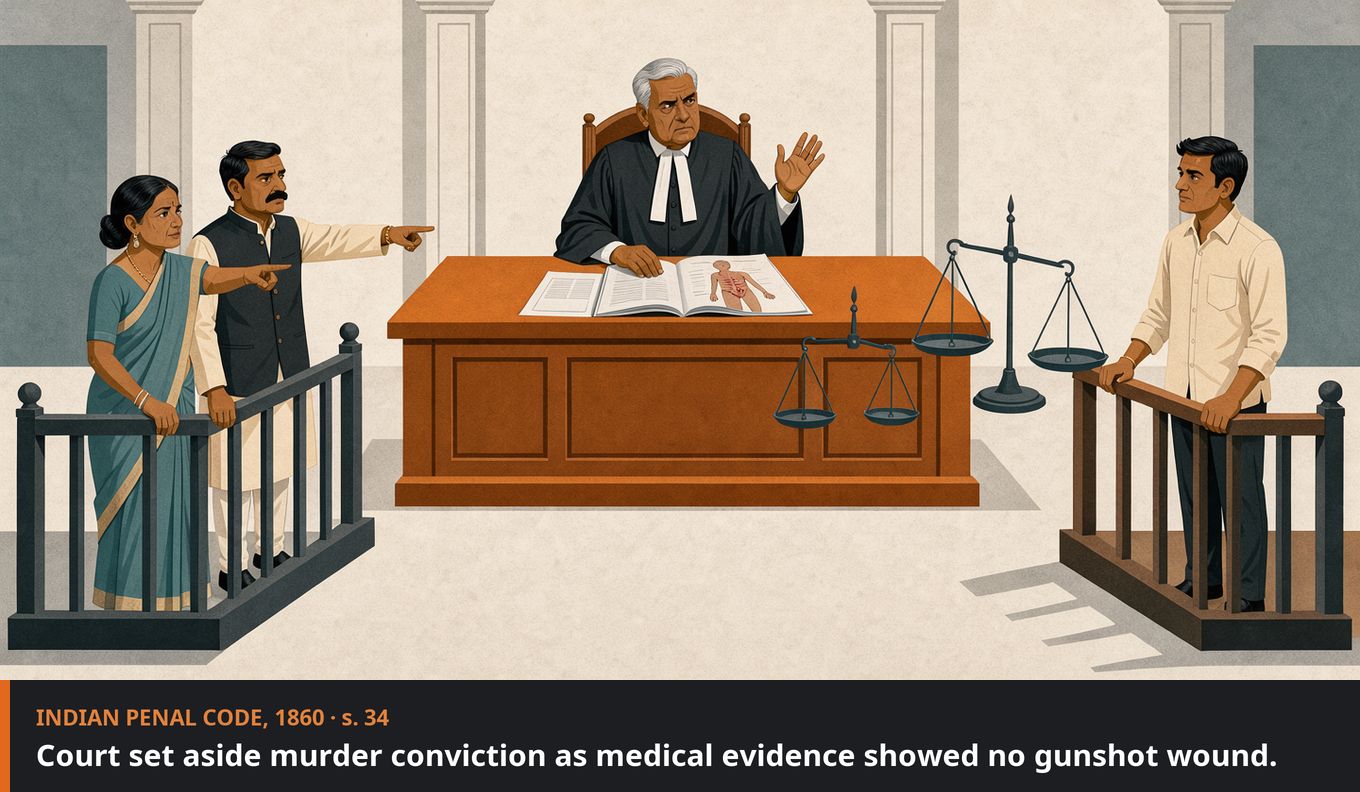
Murder conviction set aside as medical evidence contradicted the eyewitness account of a gunshot.
Facts that mattered
Gajram Singh was allegedly shot by Diwan Singh and then stabbed by Prabhu Singh and an unidentified man in a sugarcane field on 15 November 1986.
The post-mortem doctor found eight incised wounds and one lacerated wound on the forehead, but no firearm injury, entry or exit wound, and no bullet was recovered.
PW1 and PW2, the victim's wife and daughter, deposed that Diwan Singh fired the fatal shot, contradicting the prosecution's case against Prabhu Singh.
The trial Court and High Court convicted Prabhu Singh under section 302 r/w section 34 of the Indian Penal Code, preferring ocular over medical evidence.
Legal concepts
Where eyewitness account and medical evidence are completely opposite and there is no possibility of accepting the eyewitness testimony, the Court is bound to hold that the prosecution failed to establish the charge beyond reasonable doubt.
Laid down · para 7
It is the duty of the public prosecutor to cross-examine and seek explanation from the post-mortem doctor as to the cause of a disputed injury, particularly where no bullet was recovered.
Laid down · para 8
A court may refuse to act on medical opinion if it is demonstratively unreliable, but it cannot substitute its own view for the opinion of the medical man.
Reaffirmed · para 10
When the prosecution puts forward a specific case it must prove it on all material points beyond reasonable doubt, and failure entitles the accused to the benefit of doubt.
Reaffirmed · para 9 · Himachal Pradesh Administration v. Shri Om Prakash, (1972) 1 SCC 249, para 9
United Bank of India sanctioned a loan of Rs.12,26,00,000 to Kalpataru Cold Storage Pvt. Ltd.; first default occurred on 31.12.2013 and the account was declared NPA on 31.03.2014.
The debts were assigned to UV Asset Reconstruction Company Ltd. by registered Assignment Agreement on 29.03.2017, and the company filed a Section 7 IBC application on 26.10.2018.
The NCLAT held the balance sheets contained no acknowledgment and the application was time-barred, setting aside the NCLT order admitting the application.
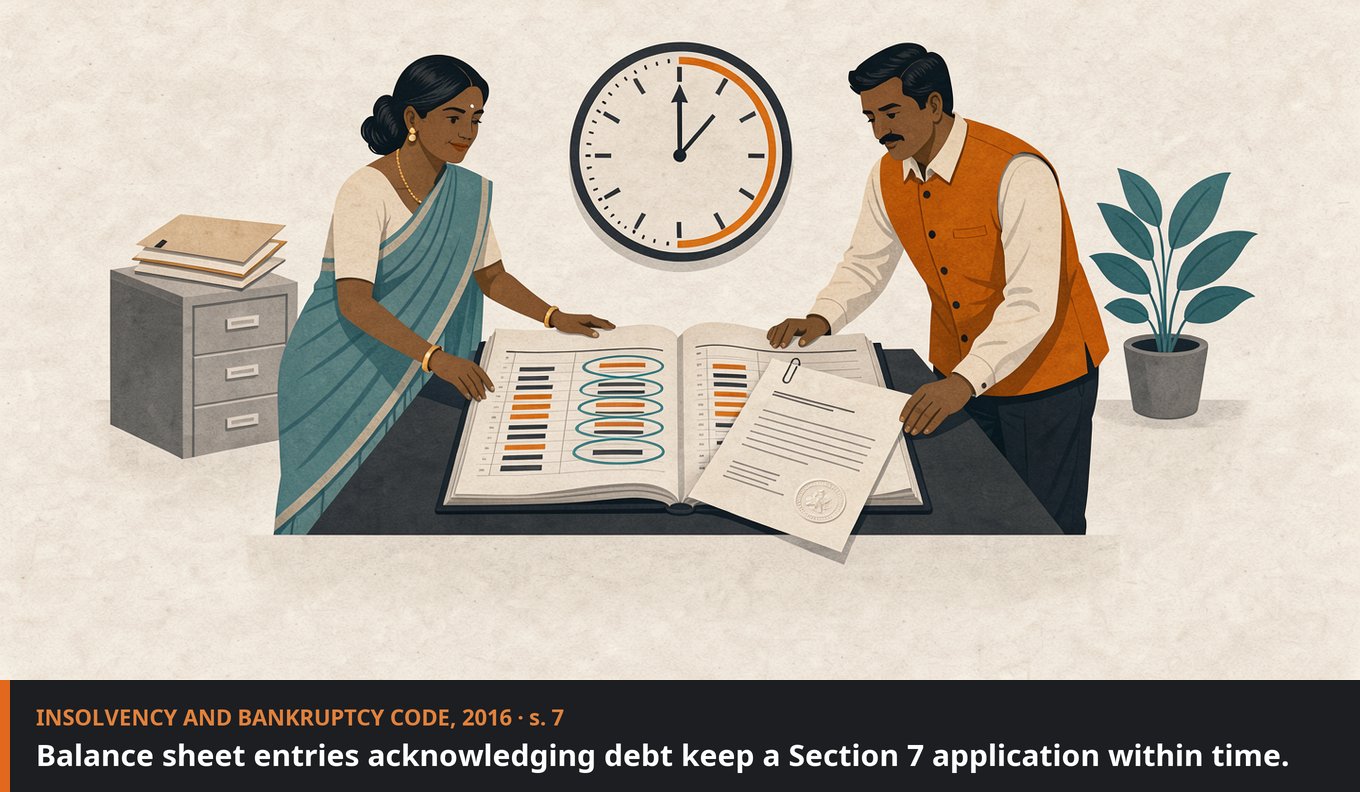
The Supreme Court found the balance sheets for FY 2015-16, 2016-17 and 2017-18 acknowledged the liability, so the Section 7 application was within time, and remitted the matter on the question of default.
Legal concepts
Balance sheet entries reflecting long-term borrowings constitute a clear written acknowledgment of liability under Section 18 of the Limitation Act, extending limitation for a Section 7 IBC application.
Reaffirmed · para 32 · Asset Reconstruction Co. (India) Ltd. v. Bishal Jaiswal, (2021) 6 SCC 366, para 30
Section 18 of the Limitation Act cannot be construed with pedantic rigidity in relation to proceedings under the IBC.
Reaffirmed · para 28 · Dena Bank (Now Bank of Baroda) vs. C. Shivakumar Reddy and Another, (2021) 10 SCC 330, para 28
Notes appended to a balance sheet must be read together; a note stating no default cannot negate an acknowledgment where another note records NPA declaration and SARFAESI proceedings.
Bench: HON'BLE MR. JUSTICE VIKRAM NATH, HON'BLE MR. JUSTICE SANDEEP MEHTA, HON'BLE MR. JUSTICE APARESH KUMAR SINGH (3 judges). Judgment by HON'BLE MR. JUSTICE VIKRAM NATH
Appeal against absorption from eligibility date dismissed; no right without sanctioned post
Facts that mattered
The appellant was appointed as Lecturer on a fifth Hindi post on 22.02.1986, but acquired minimum qualifications only on 05.12.1987.
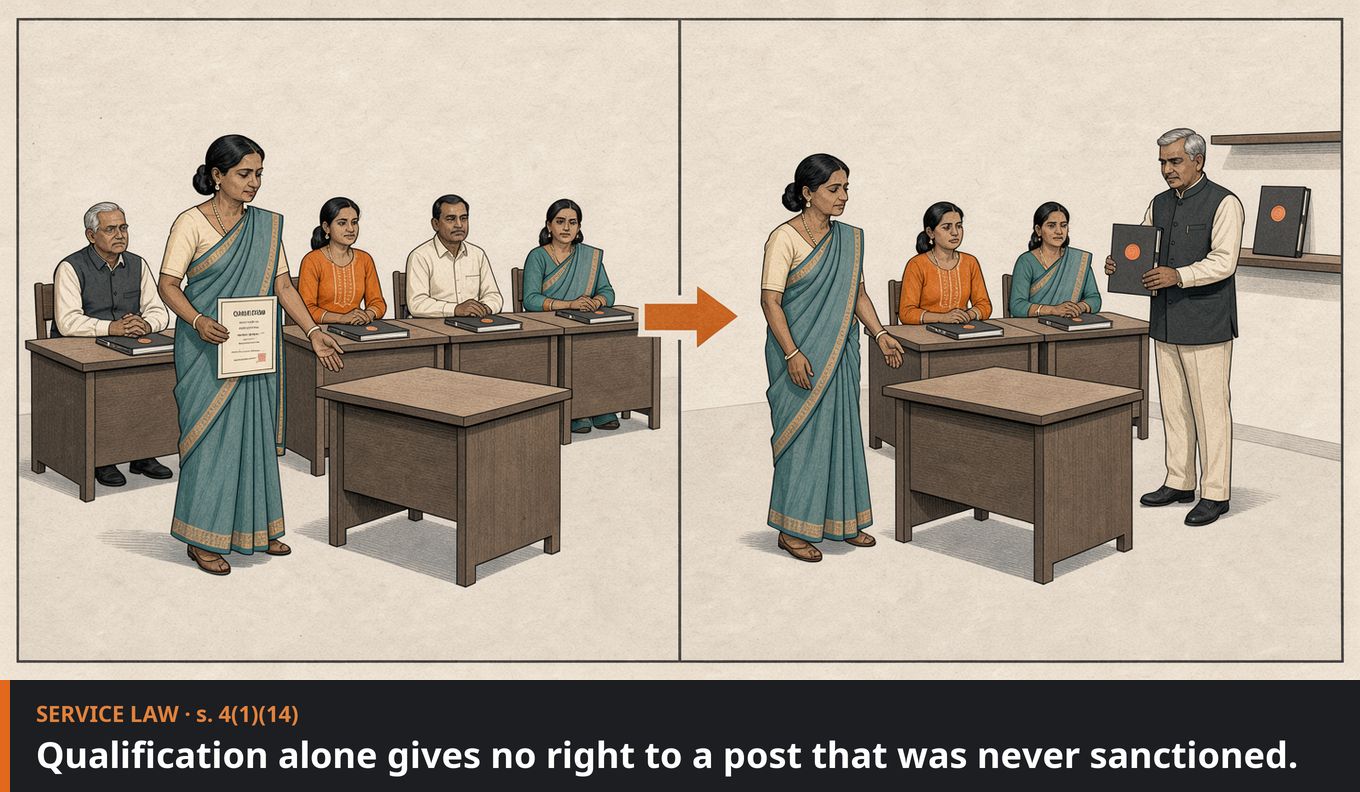
Only four Hindi Lecturer posts were sanctioned by the cut-off date of 31.03.1987, all held by persons appointed before the appellant.
The Justice Sinha Commission found the fifth post was never recommended to the State before the cut-off date and upheld absorption from 01.06.2003 when a post fell vacant.
The Writ Court directed absorption from 05.12.1987 based on Annexure IV-A, but the Division Bench set this aside, and the Supreme Court dismissed the appeal.
Legal concepts
Eligibility is merely a qualifying condition and cannot create a right to absorption where no sanctioned post exists.
Laid down · para 33 · Bihar Rajya MSESKK Mahasangh & Ors., para 33
Absorption must be examined against three categories: appointees on sanctioned posts, posts recommended up to the cut-off date, and posts recommended after or never recommended.
Reaffirmed · para 33 · Bihar Rajya MSESKK Mahasangh & Ors., para 33
Findings of the Justice Sinha Commission on individual absorption claims, made after meticulous adjudication, are appropriate and in accordance with law.
Reaffirmed · para 27 · Krishna Nand Yadav & Ors. vs Magadh University & Ors., para 27
B. Prema v. B. Rajkumar, C.A. No.-014680-014680 - 2026
Bench: HON'BLE MR. JUSTICE VIKRAM NATH, HON'BLE MR. JUSTICE SANDEEP MEHTA, HON'BLE MR. JUSTICE APARESH KUMAR SINGH (3 judges). Judgment by HON'BLE MR. JUSTICE VIKRAM NATH
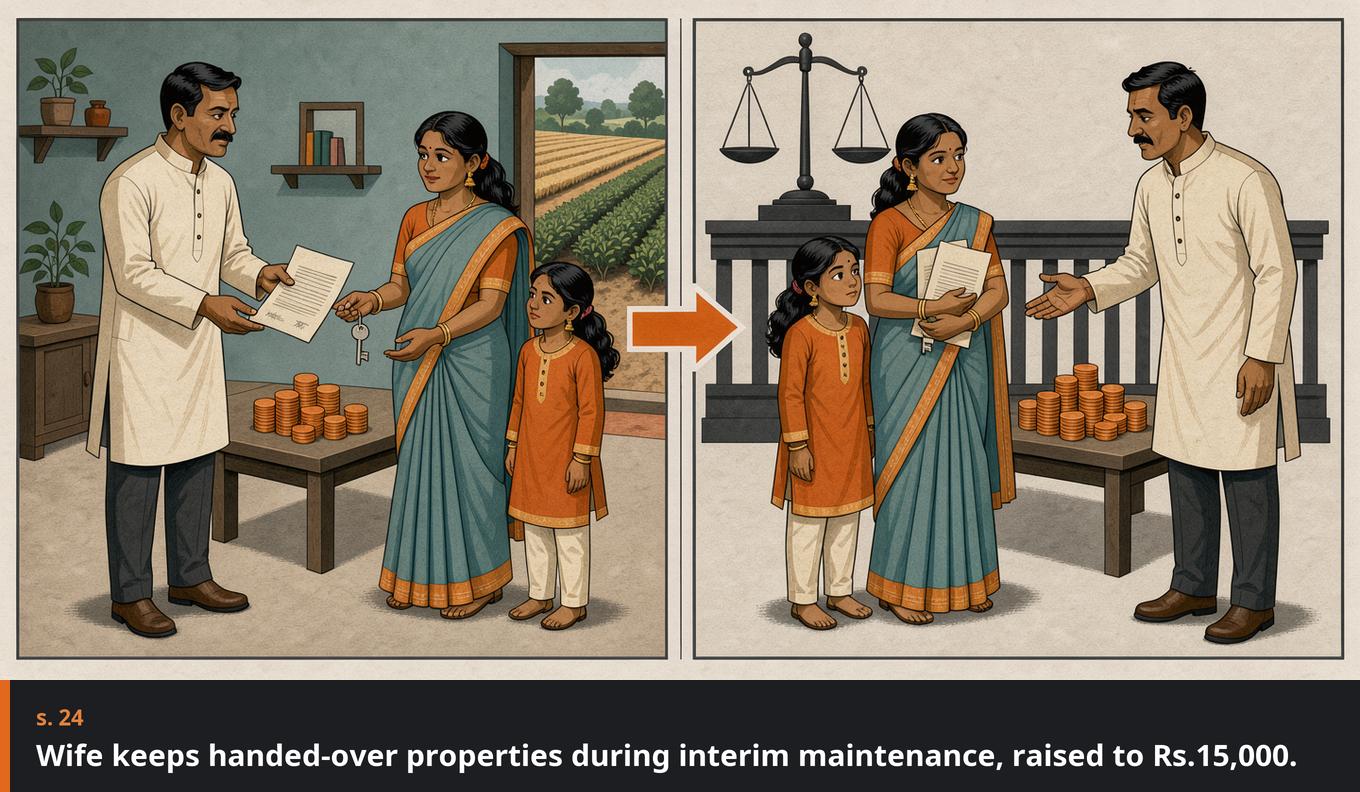
Wife need not surrender maintenance properties at interim stage; maintenance enhanced to Rs.15,000
Facts that mattered
The parties married in 2007 and a daughter was born in 2009; the wife left the matrimonial home in 2011 alleging non-maintenance.
By an agreement dated 08.12.2011 the husband handed over possession of a tea estate, agricultural lands and part of a residential house towards maintenance of the wife and daughter, restricting sale or mortgage.
During the pending divorce petition the wife sought interim maintenance under Section 24; the Trial Court awarded Rs.4,000 per month, unchanged for over twelve years.
The High Court in revision directed the wife to hand back the agricultural properties as a condition of future maintenance, prompting the present appeal.
Legal concepts
Possession of properties by the wife is a relevant consideration in fixing interim maintenance, but actual income derived, expenses of cultivation and her ability to manage them must be assessed rather than assumed from mere possession.
Laid down · para 10
Properties handed over to a wife under an agreement to secure maintenance of mother and daughter cannot be directed to be surrendered as a condition of the husband discharging his maintenance obligation at the interim stage.
Laid down · para 14
While fixing maintenance, the court must consider the passage of time, the growing needs of the child and the circumstances of both parties; an award unchanged for over twelve years requires reassessment.
This digest summarises Supreme Court of India judgments for general information. It is not legal advice and does not create a lawyer-client relationship. Please read the full judgment before relying on it. See also our disclaimer.