3S and Our Health Society v. Union of India, MA-001177 - 2025
Court directs FSSAI to adopt interpretive warning labels with pictograms as nutrients-of-concern labelling
Facts that mattered
A non-profit organisation filed a writ petition seeking mandatory front-of-package nutrition labelling (FoPNL) to curb consumption of foods high in saturated fat, sugar and salt linked to non-communicable diseases.
FSSAI's 2022 draft amendment proposed a star-rating Indian Nutrition Rating format, but over 14,000 public comments and stakeholder consultations showed no consensus, with consumers favouring warning labels.
The Court directed FSSAI's Expert Committee to report on the comments; the Committee recommended interpretive warning labels over non-interpretive formats.
FSSAI later proposed a label restating daily limits for added fat, added sugar and salt from the Dietary Guidelines for Indians, 2024, which the Court found would undermine the FoPNL's purpose.
Legal concepts
Introducing an interpretive front-of-package nutrition labelling framework is a reasonable measure through which the fundamental rights to health, food and informed choice under Article 21 can be secured.
Laid down · para 111
Because the interpretive FoPNL is a measure through which fundamental rights find expression, a concomitant duty is enjoined upon the State to ensure the framework is not only proposed but also capable of appropriate and effective implementation.
Laid down · para 112
The right to health, and the right to choice and information, cannot be made subject to a consumer's literacy, language or means, and the FoPNL must be designed so that it serves every consumer alike.
Laid down · para 157
FSSAI should adopt total sugars and saturated fat, along with salt, as the nutrients-of-concern for the FoPNL rather than added sugar and added fat.
Bench: HON'BLE MR. JUSTICE PAMIDIGHANTAM SRI NARASIMHA, HON'BLE MR. JUSTICE ALOK ARADHE (2 judges). Judgment by HON'BLE MR. JUSTICE ALOK ARADHE
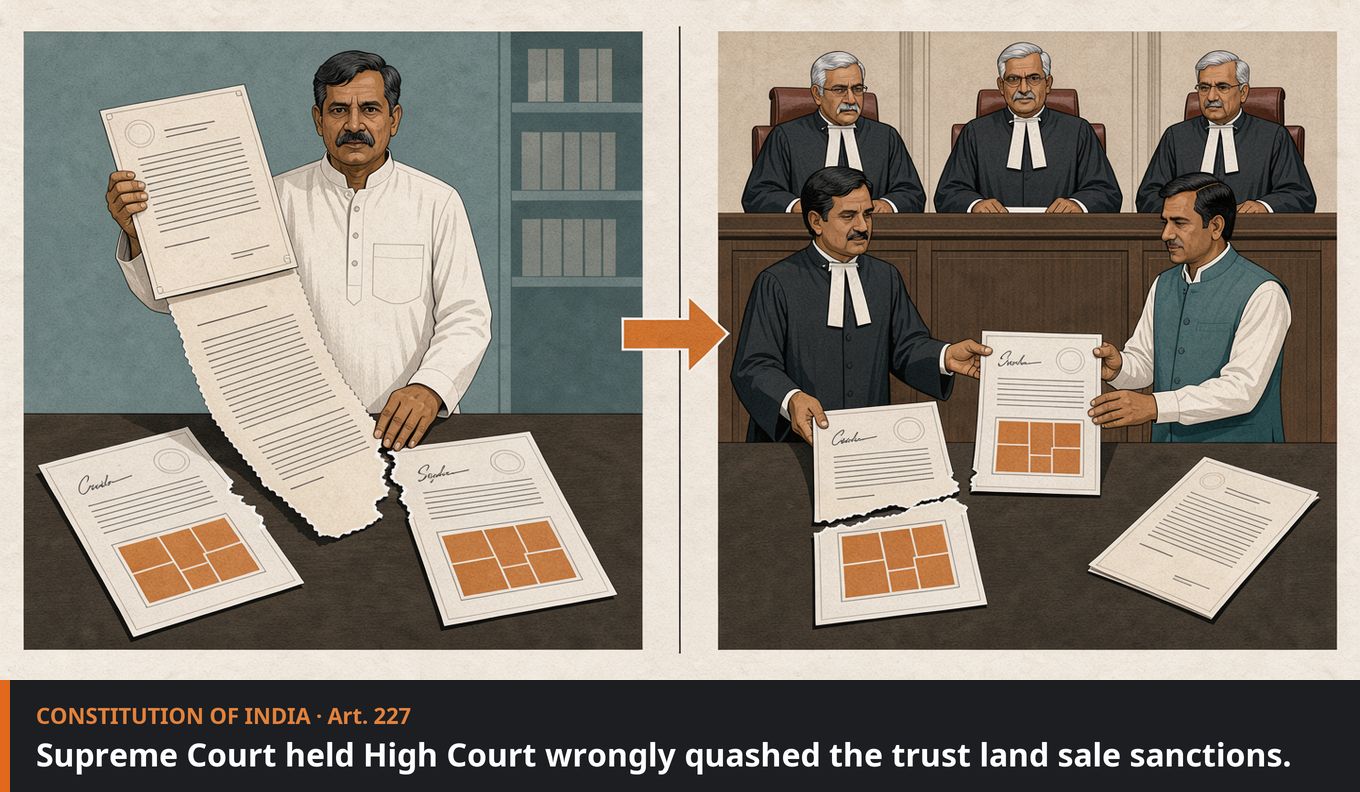
Supreme Court restores Charity Commissioner's sale sanctions, holding High Court exceeded Article 227 jurisdiction
Facts that mattered
A public trust resolved to sell two parcels of land at villages Vadavali and Owale, citing hilly marshy terrain, encroachments, litigation and meagre income, and invited bids through public notices in two newspapers.
The purchaser was the highest bidder for both lands; the Charity Commissioner obtained a second valuation and accorded sanction under Section 36(1)(a) with conditions securing the sale proceeds for the trust's objects.
A registered conveyance deed was executed for the Vadavali land, and the purchaser later transferred the reserved portion to the Corporation against TDR.
A former trustee filed writ petitions under Article 227 about seven months after the notices; the High Court quashed the sanctions, annulled the conveyance deed and remitted the proceedings for fresh consideration.
Legal concepts
A reasoned decision taken on elaborate consideration of relevant facts by a subordinate authority cannot be interfered with in exercise of supervisory jurisdiction under Article 227, which is not appellate jurisdiction.
Reaffirmed · para 30 · Garment Craft, (2022) 4 SCC 181, para 29
After execution of a conveyance deed, sanction under Section 36(2) of the Maharashtra Public Trusts Act cannot be revoked except on the ground of fraud practised on the Charity Commissioner.
Reaffirmed · para 33
While granting sanction under Section 36(1)(a), the Charity Commissioner must consider the three classic requirements of interest, benefit and protection of the trust and be objectively satisfied of necessity to dispose of the property.
Reaffirmed · para 28 · Cyrus Rustom Patel v. Charity Commissioner, Maharashtra State and Others, (2018) 14 SCC 761, para 20
Section 36 does not contemplate a trial; the Charity Commissioner is required to arrive at his satisfaction on the material placed before him.
P. Kathirvel v. State, Crl.A. No.-001192-001192 - 2021
Bench: HON'BLE MR. JUSTICE J.B. PARDIWALA, HON'BLE MR. JUSTICE K. VINOD CHANDRAN (2 judges). Judgment by HON'BLE MR. JUSTICE K. VINOD CHANDRAN
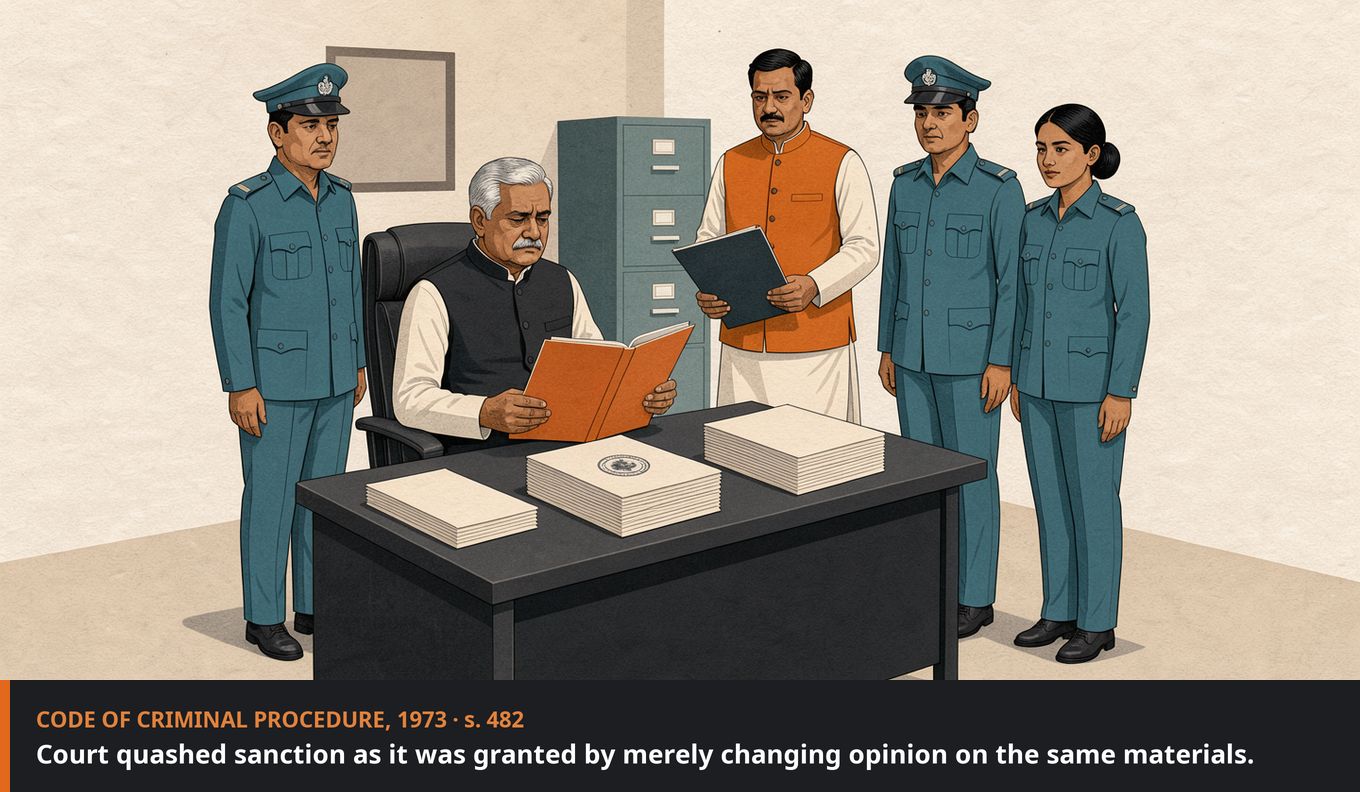
Sanction quashed as change of opinion on same materials; proceedings against two Customs officers dismissed
Facts that mattered
A Bill of Entry declared imported goods as parts of air conditioners when they were actually complete air conditioners, causing a revenue loss of Rs.42,05,597.
Four Customs officers were arrayed as accused for alleged collusion and conspiracy in clearing the misdeclared goods.
The Commissioner of Customs first declined sanction finding no prima facie evidence of criminal conspiracy, but later granted sanction after the Central Vigilance Commission opined in agreement with the CBI without any fresh materials.
The Examiner had recorded that the goods were complete air conditioners but failed to return the Bill of Entry to the Assessment Wing for reassessment.
Legal concepts
Once the sanctioning authority has exercised its statutory power, it cannot review or reconsider the matter on the same materials, and a mere change of opinion without fresh materials is impermissible.
Reaffirmed · para 12
A mere power coupled with a duty to randomly check goods cannot lead to an inference of criminal culpability; a duty lapse may only be proceeded with departmentally.
State Bank of India v. State of Maharashtra, SLP(Crl) No.-006710 - 2026
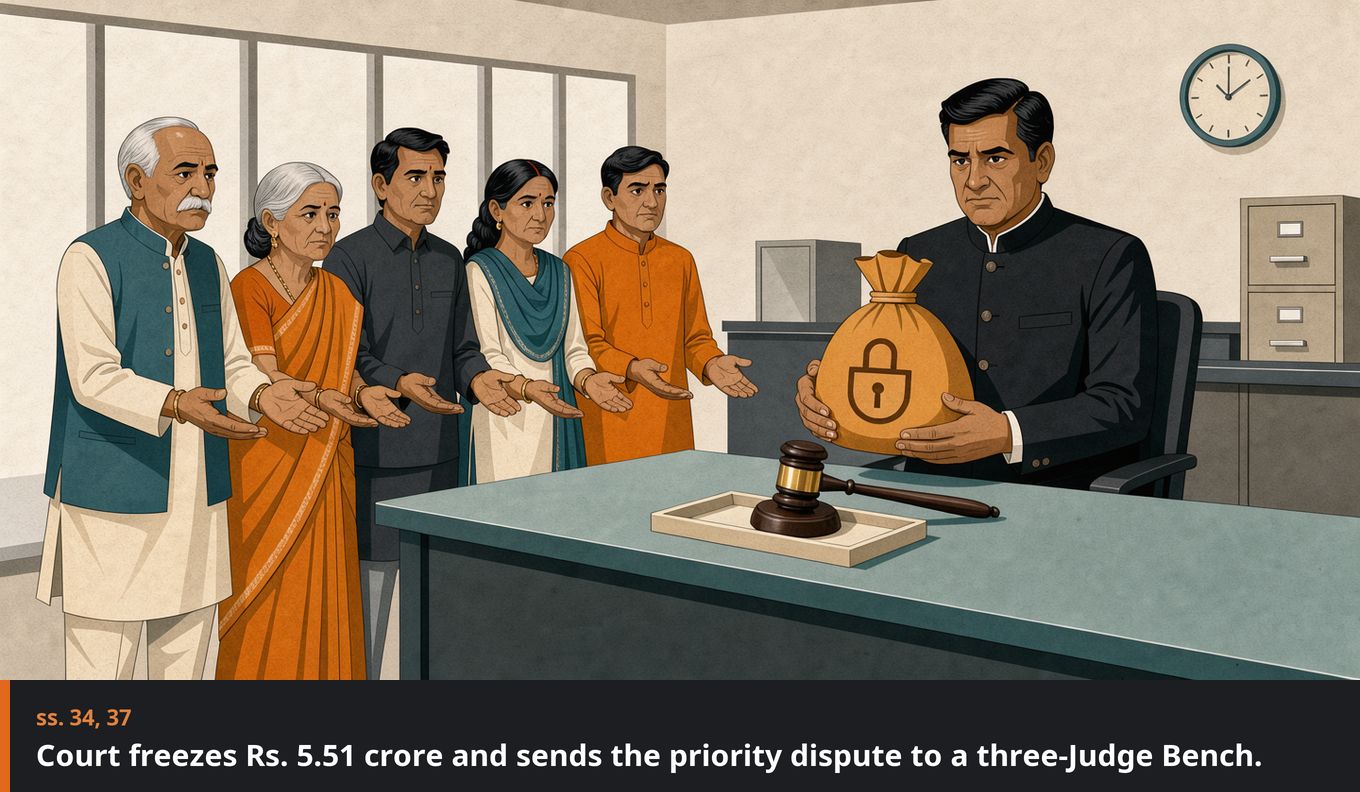
Court stays disbursement of Rs. 5.51 crore, refers SARFAESI-MPID Act conflict to three-Judge Bench
Facts that mattered
The State Bank of India mortgaged properties of a company whose account was later declared an NPA, and it auctioned them under the SARFAESI Act after obtaining permission from the Designated Court under the MPID Act.
Sale proceeds of Rs. 19.43 crore were largely adjusted to the loan account, but Rs. 3.5 crore was retained in an FDR which matured to Rs. 5.51 crore, against which 92 depositors claimed Rs. 4 crore.
The Designated Court and High Court, relying on NSEL, held that MPID Act claims overrode the bank's claim and directed transfer of the amount to the Competent Authority.
The Supreme Court granted interim relief restraining disbursement of Rs. 5,51,59,816 and referred the core questions to a three-Judge Bench.
Legal concepts
Where two enactments contain conflicting non-obstante clauses, the later enactment ordinarily prevails, but a statutory first charge validly created dehors the non-obstante clause will prevail over a mere priority of recovery.
Reaffirmed · para 107 · Jalgaon District Central Coop. Bank Ltd. v. State of Maharashtra, 2025 SCC OnLine SC 2513, para 106
Repayment of secured debt under the SARFAESI Act must be prioritised over recovery of deposits under the MPID Act, which fall in the category of unsecured debts.
Laid down · para 114
The SARFAESI Act is the dominant legislation on 'recovery of dues' since recovery of dues is essential to banking under Entry 45 of List I, so the MPID Act must bow to it.
Laid down · para 124
Whether MPID Act deposits fall within 'all other debts' in Section 26E, and whether harmonious construction and dominant legislation doctrine favour SARFAESI priority, are referred to a three-Judge Bench.
Ramsakhi Gupta v. Icici Lombard General Insurance Co. Ltd., C.A. No.-009051-009051 - 2026
Bench: HON'BLE MR. JUSTICE UJJAL BHUYAN, HON'BLE MR. JUSTICE ATUL S. CHANDURKAR (2 judges). Judgment by HON'BLE MR. JUSTICE UJJAL BHUYAN
Goods stored for a fee are bailment, not trust, so exclusion clause does not bar the stock claim
Facts that mattered
The appellant, proprietor of Nikhra Warehouse, stored farmers' agricultural produce for a fee; the stock was hypothecated to SBI and insured under a Standard Fire and Special Perils Policy.
A hailstorm on 13.03.2007 damaged the warehouse roof and the stored produce; the Tehsildar assessed losses at Rs. 36,83,955 for stock and Rs. 6,41,268 for the building.
The State Commission allowed the complaint in full, but the National Commission set it aside, applying General Exclusion Clause 5 for goods held in trust and restricting the claim to Rs. 1,44,401.
The Supreme Court held the goods were held under bailment, not trust, restoring the stock claim while upholding the surveyor's assessment of building damage at Rs. 1,44,401.
Legal concepts
Coverage provisions of an insurance policy must be read broadly, ambiguity resolved in favour of the insured, and exclusion clauses read narrowly, with the policy read as a whole.
Reaffirmed · para 26
Mere fact that goods belonging to another person are kept in a warehouse's custody does not make them goods held in trust or on commission; the nature of the arrangement must be examined.
Reaffirmed · para 49
Ownership of goods is not determinative of insurable interest; a bailee has an insurable interest in goods entrusted to its custody by reason of possession and responsibilities undertaken.
Laid down · para 52
A surveyor's report is neither conclusive nor binding on the insurer or insured, and may be departed from where more reliable evidence is brought on record.
Reaffirmed · para 60 · National Insurance Co. Ltd. Vs. M/s Hareshwar Enterprises (P) Ltd., (2021) 17 SCC 682, para 59
Union of India v. J. Sekar, C.A. No.-001548-001548 - 2024
Bench: HON'BLE THE CHIEF JUSTICE, HON'BLE MR. JUSTICE JOYMALYA BAGCHI, HON'BLE MRS. JUSTICE V. MOHANA (3 judges). Judgment by HON'BLE THE CHIEF JUSTICE
Adjudicating Authority under PMLA must include Judicial Member for final adjudication under s. 8
Facts that mattered
Income Tax searches on M/s SRS Mining yielded over Rs. 132 crores in cash and 128 kg gold; the CBI registered an FIR and the ED later issued a provisional attachment order under PMLA.
The show-cause notice under Section 8(1) was issued by an Adjudicating Authority consisting only of a Technical Member officiating as Chairperson, with no Judicial Member in office.
The Delhi High Court held in J. Sekar that a sole non-Judicial Member could discharge the functions of the Adjudicating Authority, a view followed by the Calcutta and Telangana High Courts.
The Supreme Court batched these matters with an Article 32 petition challenging the vires of Sections 6(5)(b) and 6(7) of the PMLA.
Legal concepts
The Bench of the Adjudicating Authority that undertakes hearing and final adjudication under Sections 8(2) and 8(3) of the PMLA must necessarily include the Judicial Member, though a single-Member Bench consisting of the Judicial Member alone suffices.
Laid down · para 62
Sections 6(5)(b) and 6(7) of the PMLA are valid and a Bench of the Adjudicating Authority may consist of one or two Members, with or without the Judicial Member, for functions other than final adjudication under Section 8.
Laid down · para 69
There is no legal mandate that only the Judicial Member be appointed as Chairperson of the Adjudicating Authority under the PMLA.
Laid down · para 69
Determinations under Sections 9, 20(4) and 21(4) of the PMLA are ancillary to adjudication under Sections 8(2) and 8(3) and must be assigned to a Bench that includes the Judicial Member.
This digest summarises Supreme Court of India judgments for general information. It is not legal advice and does not create a lawyer-client relationship. Please read the full judgment before relying on it. See also our disclaimer.