Sucheta Dalal v. Union of India, W.P.(C) No.-000185 - 2022
Bench: HON'BLE MR. JUSTICE VIKRAM NATH, HON'BLE MR. JUSTICE APARESH KUMAR SINGH (2 judges). Judgment by HON'BLE MR. JUSTICE VIKRAM NATH
Court declines further directions as measures for recovering unclaimed financial assets substantially address petition
Facts that mattered
A public interest writ petition sought directions for a centralised database of unclaimed bank deposits, insurance proceeds and post-office deposits, and simplified claim procedures for nominees and legal heirs.
Substantial sums had accumulated in DEAF, IEPF and SCWF, attributed to lack of awareness and insistence on succession certificates even where entitlement was undisputed.
During the pendency, respondents established UDGAM portal, an integrated IEPF portal, SEBI's MITRA platform, simplified transmission rules and a nationwide recovery campaign.
The Court found principal concerns substantially addressed and disposed of the petition without further mandatory directions.
Legal concepts
Under Article 32, where substantial corrective measures have been undertaken and effective mechanisms established, the possibility of further administrative improvements cannot by itself justify continuing judicial supervision.
Laid down · para 34
Transfer of unclaimed financial assets to statutory funds does not extinguish the rights of persons lawfully entitled thereto, which retain protection under Article 300A.
Reaffirmed · para 5
Courts should not mandate a particular institutional arrangement where sector-specific mechanisms exist and no demonstrated violation requiring judicial intervention is shown.
Telugu Umadevi Krishnaiah v. the State of Bihar, W.P.(Crl.) No.-000204 - 2023
Bench: HON'BLE MR. JUSTICE DIPANKAR DATTA, HON'BLE MR. JUSTICE SHEEL NAGU (2 judges). Judgment by HON'BLE MR. JUSTICE DIPANKAR DATTA
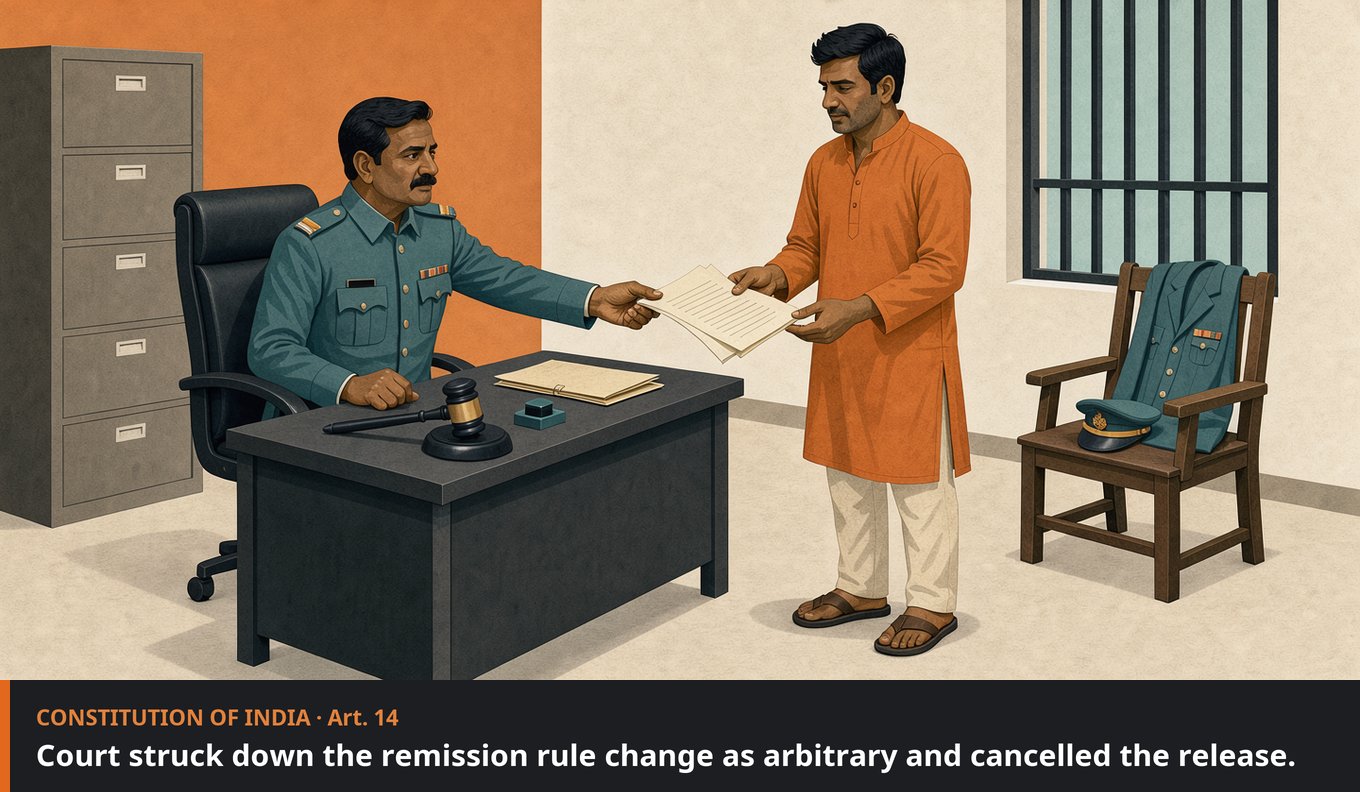
Bihar notification deleting murder-of-public-servant remission bar struck down as arbitrary
Facts that mattered
The fourth respondent, a Bihar MLA, exhorted a mob that murdered an IAS District Collector on duty in 1994; he was convicted under ss. 302 and 109 IPC.
The trial court awarded death, but the High Court altered it to life imprisonment, noting pre-amended Rule 481(i)(a) disqualified him from remission; this Court affirmed.
On 10 April 2023 Bihar deleted "or for murder of a public servant on duty" from Rule 481(i)(a), and released him on 24 April 2023 using a stale 2021 judicial opinion.
The Court found the amendment a sudden, unexplained departure from policy consistently followed since 2002, and the release procedurally and substantively vitiated.
Legal concepts
An identifiable and traceable victim or legal representative must be given notice and a reasonable opportunity to submit a representation before a premature release decision, without any veto over the outcome.
Laid down · para 47
Reliance on a stale, mechanically rendered opinion of the Presiding Judge obtained on an inadmissible earlier application, without a fresh reasoned opinion, vitiates the remission decision under Section 432(2).
Reaffirmed · para 53
A selective, unexplained deletion of a long-standing disqualification from a remission policy, lacking rational nexus with any disclosed public purpose, is manifestly arbitrary and void under Article 14.
Laid down · para 88
Where more than one remission policy applies, the policy most beneficial to the convict generally governs, though the date-of-conviction policy ordinarily prevails.
Reaffirmed · para 35 · State of Haryana v. Jagdish, (2010) 4 SCC 216 (3-judge bench), para 33
State of Punjab v. Neeraj Rana @ Sonu, Crl.A. No.-001735-001737 - 2017
Bench: HON'BLE MR. JUSTICE UJJAL BHUYAN, HON'BLE MR. JUSTICE ATUL S. CHANDURKAR (2 judges). Judgment by HON'BLE MR. JUSTICE ATUL S. CHANDURKAR
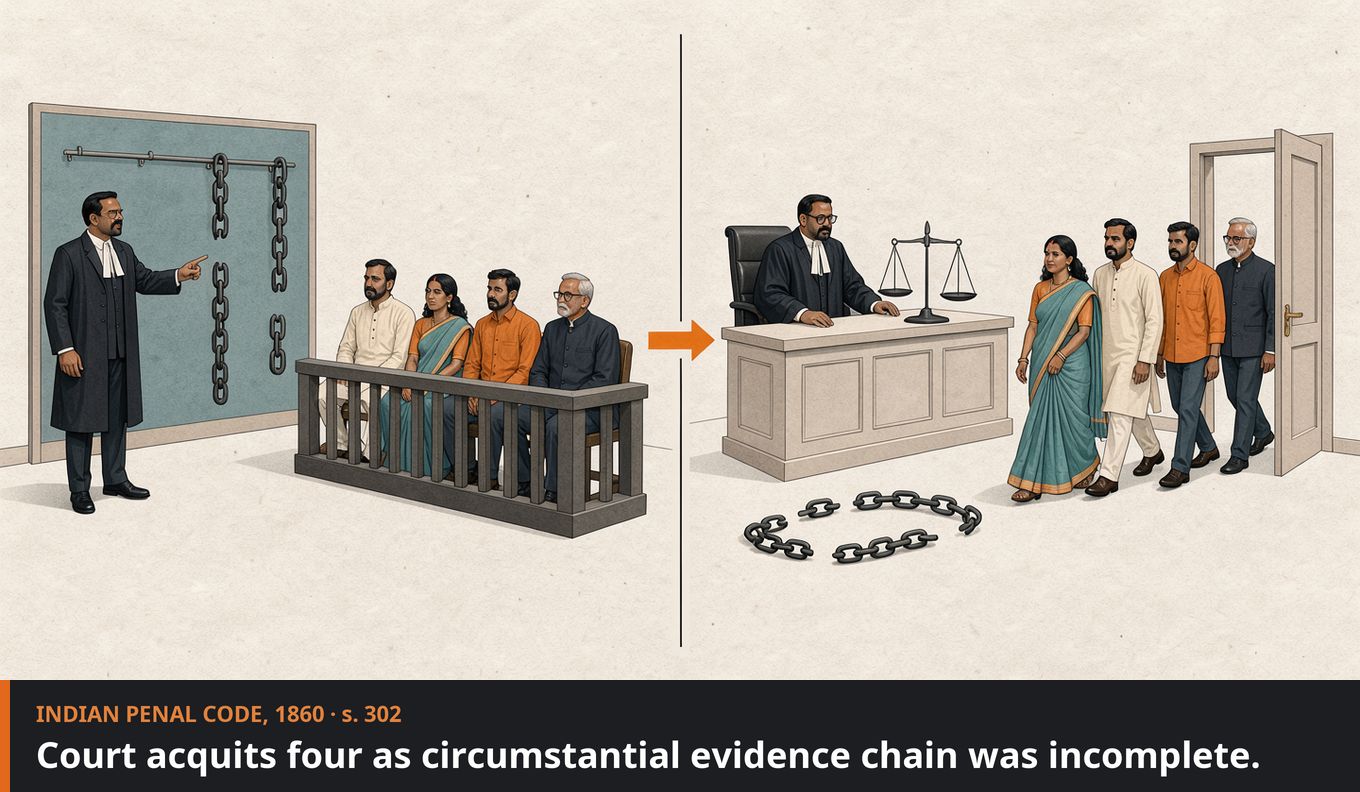
Supreme Court affirms acquittal, holding chain of circumstantial evidence incomplete
Facts that mattered
The informant found his wife lying in a pool of blood with gold ornaments missing; FIR was registered and four accused were arrested based on recoveries.
The Sessions Court convicted all accused under Sections 302 and 382 of the Penal Code and sentenced them to life imprisonment and ten years' rigorous imprisonment.
The High Court set aside the convictions, holding that vital links in the chain of circumstantial evidence were missing and recoveries alone were insufficient.
The Supreme Court noted that except the informant and his father, no other evidence linked the respondents to the crime, and several prosecution witnesses turned hostile.
Legal concepts
In a case based entirely on circumstantial evidence, the chain of events must be complete in all respects so as to lead only to the hypothesis that the accused alone are guilty.
Reaffirmed · para 12
A conclusion of guilt can be recorded only when all circumstances are collectively considered and lead to the irresistible conclusion that the accused alone committed the crime.
Asst. General Manager v. S. Loganathan, C.A. No.-014920-014920 - 2026
Bench: HON'BLE MR. JUSTICE PAMIDIGHANTAM SRI NARASIMHA, HON'BLE MR. JUSTICE ALOK ARADHE (2 judges). Judgment by HON'BLE MR. JUSTICE ALOK ARADHE
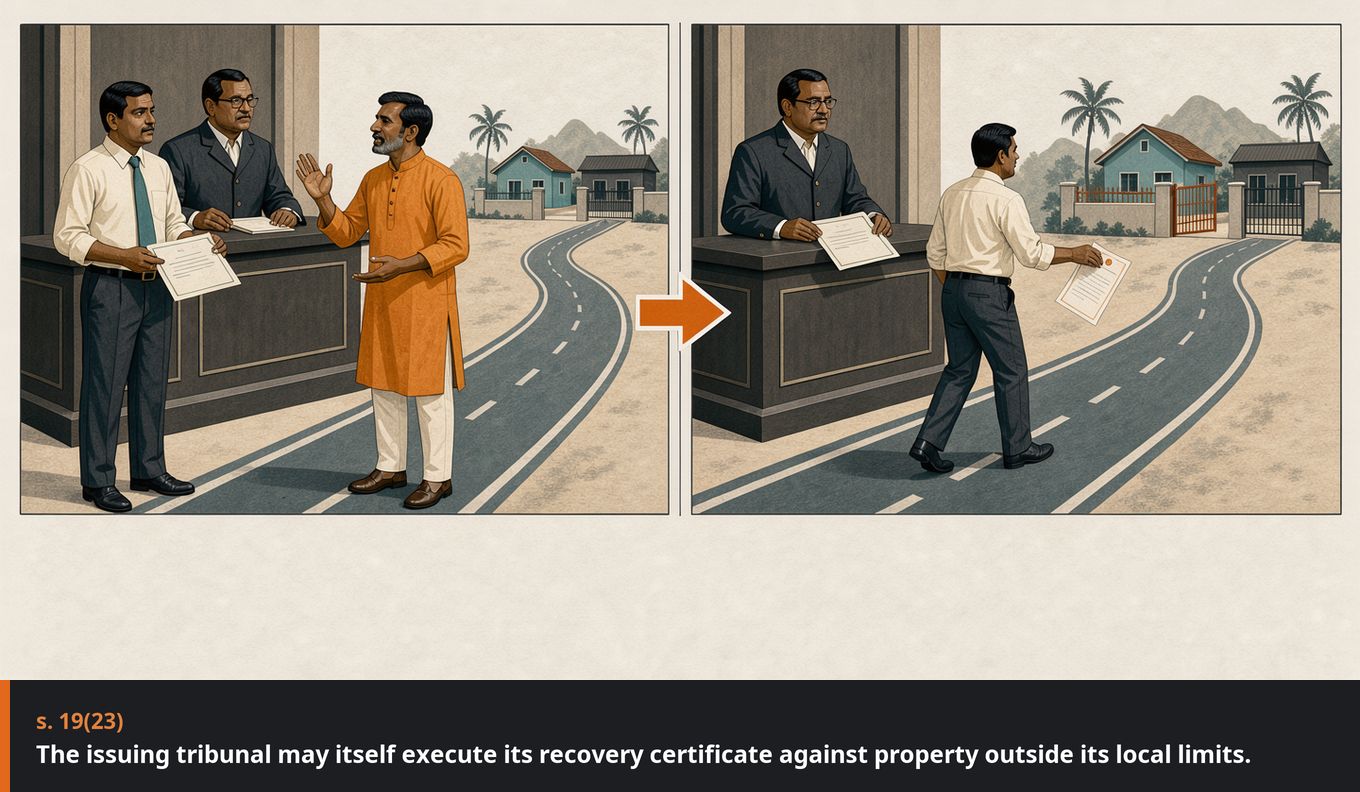
Issuing DRT may execute recovery certificate against property outside its local limits
Facts that mattered
A partnership firm availed credit facilities from the State Bank of India, secured by equitable mortgage over two properties in Tiruchirappalli district, within DRT Madurai's territorial jurisdiction.
On the borrower's application alleging bias, proceedings were transferred from DRT Madurai to DRT-III Chennai, which adjudicated the claim and issued a recovery certificate on 07.01.2022.
The Recovery Officer at Chennai attached both properties at Tiruchirappalli and took possession of one, prompting the borrower to challenge the territorial jurisdiction before the High Court.
The High Court held that DRT Madurai alone could execute the certificate, and the Bank appealed to the Supreme Court.
Legal concepts
The Tribunal which issued a recovery certificate may execute it against property situated outside its local limits, and the word "may" in Section 19(23) confers a judicial discretion to retain execution or transmit the certificate.
Laid down · para 41
The provisions of the Code of Civil Procedure do not apply to execution proceedings under the 1993 Act so as to restrict the powers of the Tribunal.
Laid down · para 26
A Tribunal must apply a structured test and pass a reasoned order when deciding whether to retain or transmit a recovery certificate for execution.
Laid down · para 50
The decisions of the Gujarat and Bombay High Courts holding that transmission under Section 19(23) is discretionary are approved, subject to the parameters laid down.
The State of Uttar Pradesh v. Noida Power Company Limited, C.A. No.-000410 - 2023
Court rejects APTEL's fresh 25-year term for deemed licensee, continues NPCL licence till 09.06.2029
Facts that mattered
NPCL obtained a distribution licence under the 1910 Act on 30.08.1993 for 30 years, expiring 30.08.2023; the 2003 Act came into force on 10.06.2003 during its subsistence.
UPERC's multiple tariff orders recognised NPCL's licence would expire on 30.08.2023, and it approved NPCL's business plan only till that date.
APTEL reset NPCL's tenure by granting a 1-year transitional period from 10.06.2003 and then a fresh 25-year term under s. 15(8), extending expiry to 09.06.2029.
The Electricity (Amendment) Rules, 2023 inserted Rules 4A-4C effective 30.06.2023, which were not examined by APTEL or challenged before the Court.
Legal concepts
The judiciary alone has the exclusive responsibility of authoritatively interpreting legislation; any meaning found by other agencies remains subject to constitutional courts' interpretation.
Laid down · para 21
Subordinate legislation does not determine or control the meaning of the primary statute; it can only supplement or corroborate a meaning the court would find on other interpretative criteria.
Laid down · para 21
Constitutional courts must not adopt the Executive Branch's understanding of a statute uncritically, as this would substitute the rule-making authority for the court and disregard the possibility of the subordinate legislation being ultra vires.
Laid down · para 21
Section 15(8) of the Electricity Act, 2003 cannot be read to mean a licence continues in perpetuity, nor can a deemed licensee claim a fresh 25-year term from the Act's commencement regardless of original licence tenure.
This digest summarises Supreme Court of India judgments for general information. It is not legal advice and does not create a lawyer-client relationship. Please read the full judgment before relying on it. See also our disclaimer.