Constitution of India (9)
D-0089 · 19.11.2026 · s. 34
Poornima Gupta v. Saurav Gupta, CONMT.PET.(C) No.-000738 - 2026
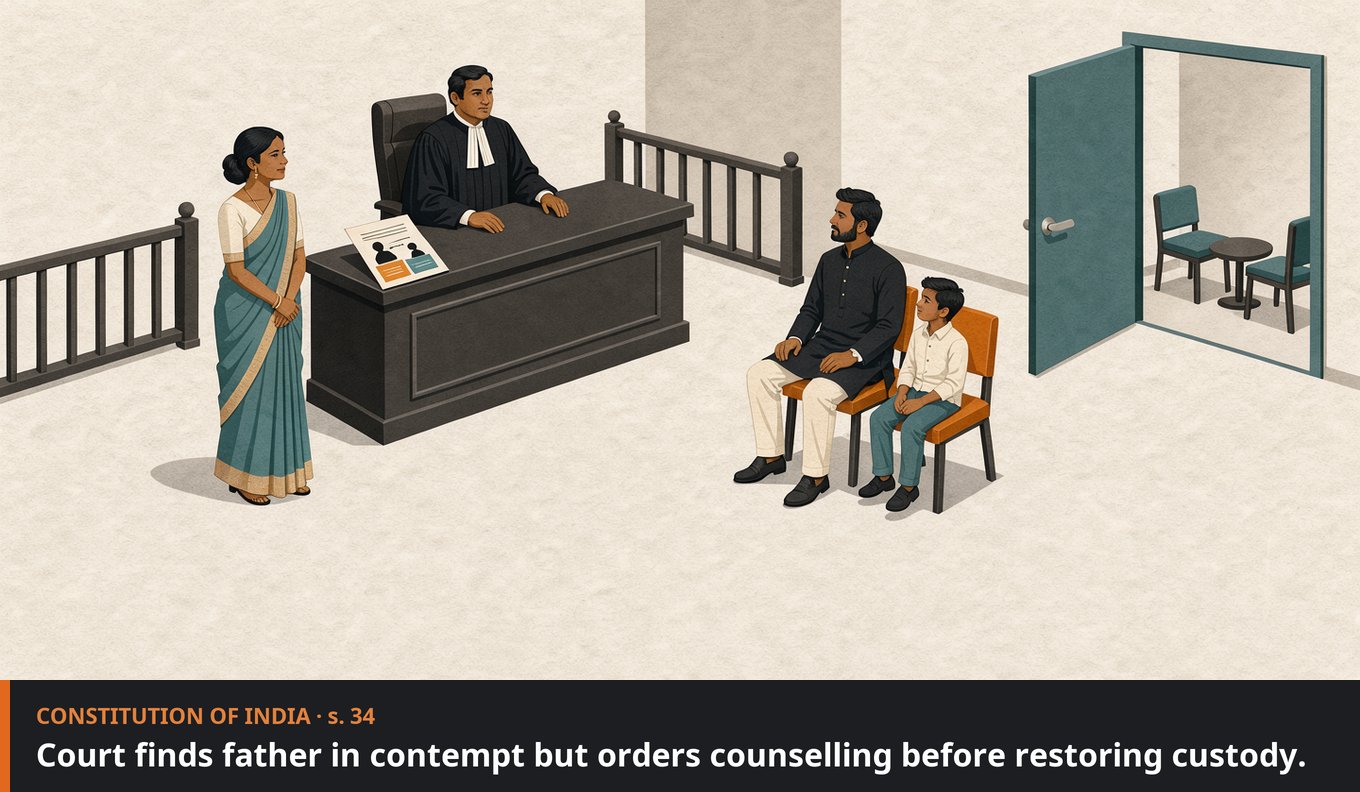
Father in contempt for retaining son; Court orders counselling before restoring custody.
Facts that mattered
- A transfer petition between spouses was resolved by a mutual settlement dated 13 November 2025, recorded in this Court's order dated 12 December 2025.
- The settlement placed custody of the two children with the mother and granted the father visitation twice a year for four days at Dholpur.
- The father took the minor son from his school on 22 July 2026 and retained him in Rajasthan, contrary to the settlement, and did not return him.
- The Court found the father in contempt but declined abrupt restoration of custody, directing counselling of the child by the Family Court, Dholpur.
Legal concepts
A parent who retains custody of a child contrary to a settlement recorded in this Court's order is in clear contempt, though the Court may decline abrupt restoration of custody where it would harm the child.
Laid down · para 14
Where a child's mind appears tutored against the custodial parent, the Court may direct counselling by a child counsellor through the Family Court before restoring custody.
Laid down · para 15
Read the judgment
D-0087 · 19.11.2026 · Art. 136
Helena Anna Maria Lersch v. State of Goa, SLP(Crl) No.-011625 - 2026
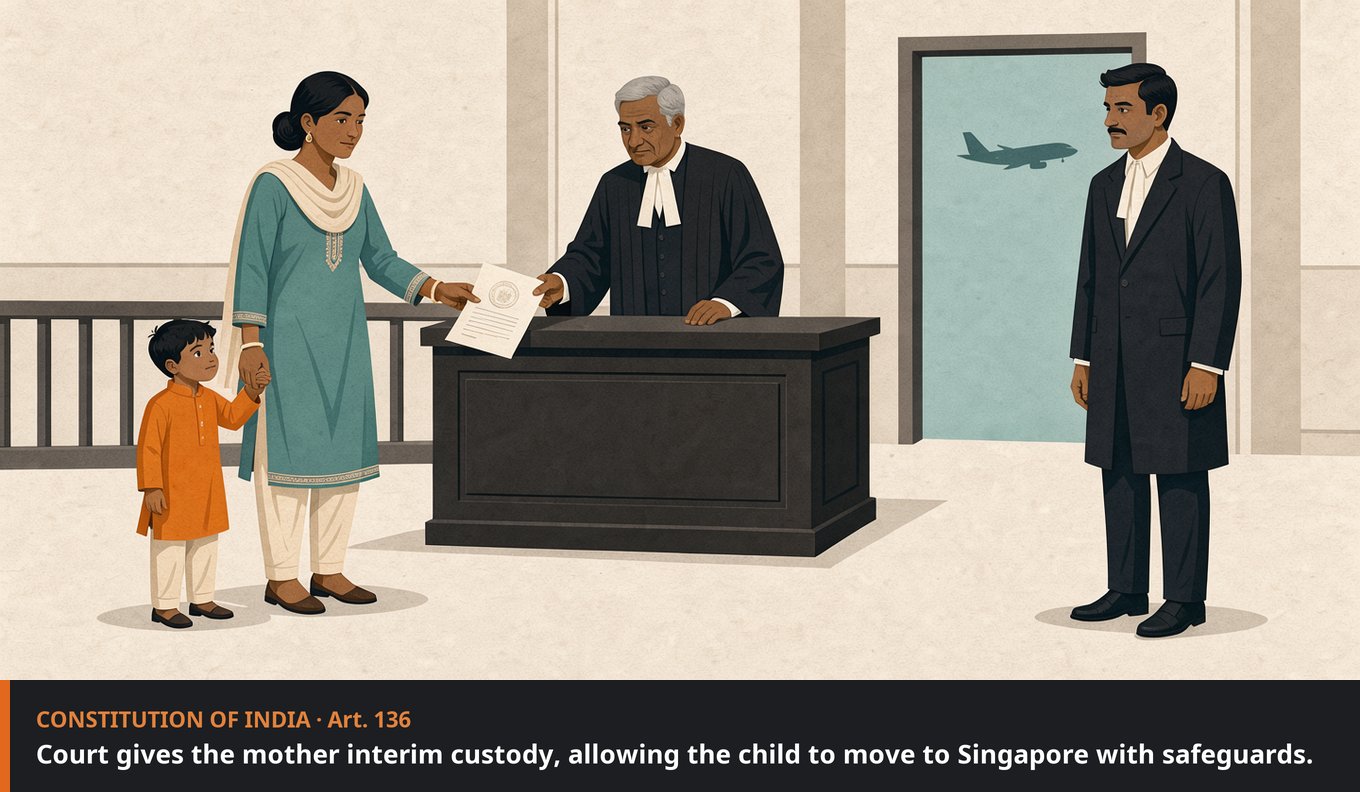
Court grants unwed mother interim custody, allowing child's relocation to Singapore with mirror order safeguards.
Facts that mattered
- An unmarried German mother working in Singapore sought access and interim custody of her four-year-old son, an Indian-resident child, from the father, an Indian lawyer based in Delhi.
- The mother filed habeas corpus proceedings in the Bombay High Court; the father later filed guardianship proceedings in West Bengal, later transferred to the Family Court at Patiala House, New Delhi.
- The Supreme Court directed NIMHANS to assess both parents and the child, which found both parents psychologically fit and equally invested in the child's welfare.
- The Court granted interim custody to the mother, permitting relocation to Singapore subject to a mirror order from a Singapore court and a Rs. one crore security deposit.
Legal concepts
This Court has jurisdiction to decide interim custody in a habeas corpus proceeding in exercise of parens patriae jurisdiction, and procedural or jurisdictional issues must yield to the child's best interests.
Laid down · para 125 · Rajeswari Chandrasekar Ganesh v. State of T.N., (2023) 12 SCC 472, para 46
In a dispute between unwed parents, the mother has a better prima facie claim of custody of a child of tender age, as recognized across legal jurisdictions.
Reaffirmed · para 68 · X1 v. State (NCT of Delhi), (2015) 10 SCC 1, para 66
The child's best interests must be the preeminent consideration in any custody matter, prevailing over all other considerations including parents' rights and jurisdictional issues.
Reaffirmed · para 51 · Sheetal Vasant Thakur v. Chirag Arora, 2026 SCC OnLine SC 1110, para 52
Irreparable harm in a custody dispute must be assessed from the perspective of the child, the most vulnerable party and subject of parens patriae jurisdiction, not the parents.
Laid down · para 75
Read the judgment
D-0085 · 18.11.2026 · Art. 14
Uttar Pradesh Ground Water Department Non Gazetted Employee Association (regd.) v. the Chief Secretary, W.P.(C) No.-001458 - 2020
Bench: HON'BLE MR. JUSTICE DIPANKAR DATTA, HON'BLE MR. JUSTICE SATISH CHANDRA SHARMA (2 judges). Judgment by HON'BLE MR. JUSTICE DIPANKAR DATTA
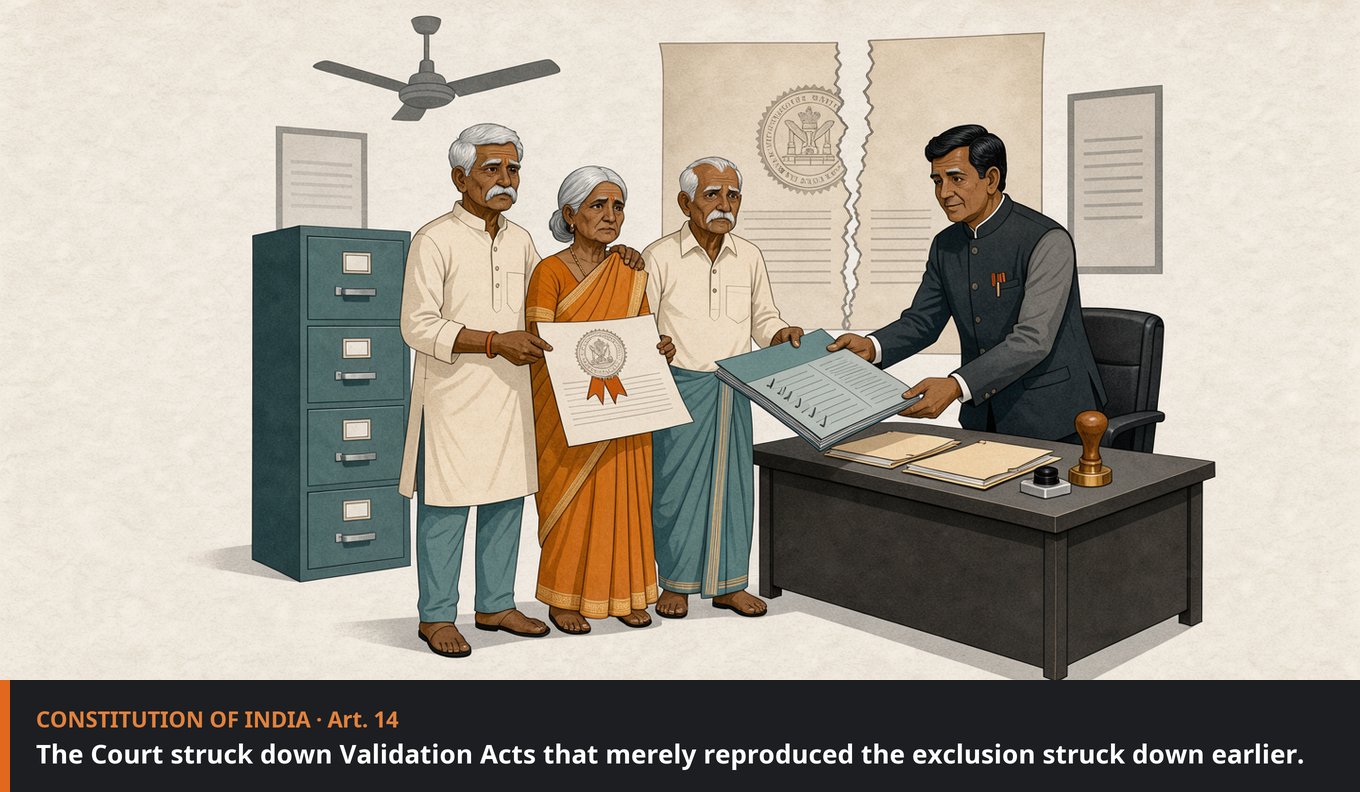
Validation Acts reproducing the exclusion struck down in Prem Singh held constitutionally infirm
Facts that mattered
- Employees of Uttar Pradesh departments, engaged as work-charged, daily-wage or muster-roll staff from the late 1970s and later regularised, claimed that pre-regularisation service count towards pension.
- In Prem Singh, this Court read down Rule 3(8) of the 1961 Rules, holding work-charged service as qualifying service for pension, with arrears restricted to three years; review was dismissed.
- The State responded with a 2020 Ordinance and Validation Act, 2021, then a 2025 Ordinance and Validation Act, 2025, retrospectively excluding non-substantive appointees from pension and validating past denials notwithstanding court judgments.
- The Court examined whether these validating enactments removed the constitutional defect identified in Prem Singh or merely reproduced the same exclusion in new statutory language.
Legal concepts
A validating enactment must be tested not only against general constitutional compliance but also against whether it removes the specific defect identified in the earlier judgment.
Laid down · para 58
The legislature may change the law but may not, under the guise of changing the law, command that a final judicial determination be treated as though it had never been made.
Laid down · para 70 · Madan Mohan Pathak, para 71
Validating enactments that extinguish the operative effect of a final adjudication without removing the legal defect on which it was premised are constitutionally infirm.
Laid down · para 72
Mere non-consideration of an earlier decision does not furnish a sustainable basis for not following its ratio, and per incuriam cannot be invoked on that ground alone.
Laid down · para 109
Read the judgment
D-0082 · 18.11.2026 · Art. 226
In Re: Phalodi Accident v. National Highways Authority of India, SMW(C) No.-000009-000009 - 2025
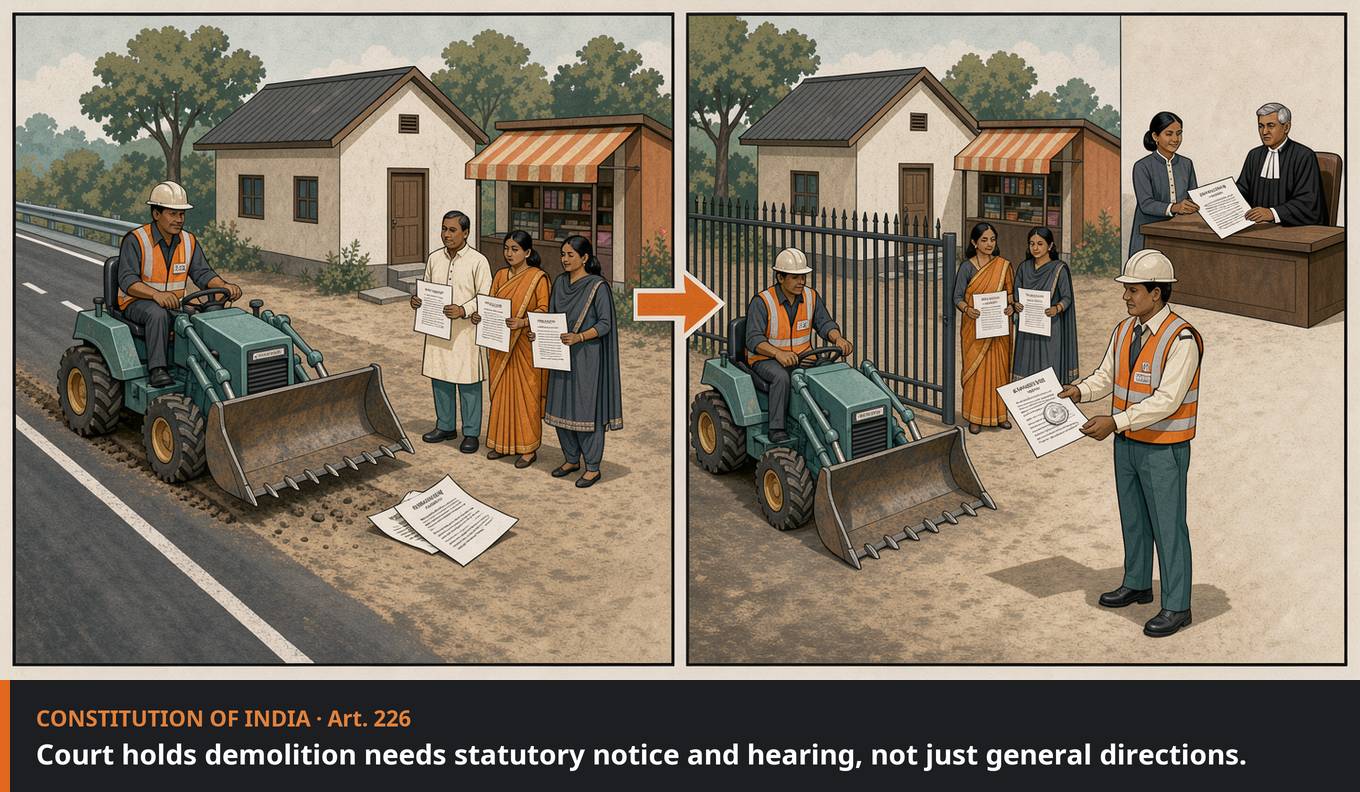
Court clarifies highway encroachment directions do not authorise demolition without statutory procedure
Facts that mattered
- The suo motu proceedings arose from road accidents at Phalodi, Rajasthan, and the Court issued directions on 13.04.2026 requiring removal of unauthorised encroachments from National Highway Right of Way.
- NHAI initiated demolition action against structures alleged to be encroachments, and numerous applicants claimed ownership of privately held land adjoining National Highways.
- Applicants disputed NHAI's demarcation of the Right of Way and contended the directions did not authorise demolition without following the statutory procedure under the 2002 Act.
- The Court had earlier granted interim protection and status quo in several matters pending resolution of these applications.
Legal concepts
A general direction to remove encroachments is not a conclusive adjudication that a particular structure is an unauthorised encroachment, and cannot dispense with the statutory determination required under law.
Laid down · para 15
Section 26 of the Control of National Highways (Land and Traffic) Act, 2002 prescribes the essential procedure of notice, representation and consideration of cause shown, required for compliance with natural justice before removal of unauthorised occupation.
Reaffirmed · para 16 · Gyan Prakash v. Union of India and Others, 2025 SCC OnLine SC 1189, para 16
Individual disputes over ownership, boundaries and Right of Way demarcation arising from highway encroachment removal are to be adjudicated by the jurisdictional High Courts rather than in suo motu Supreme Court proceedings directed at systemic road safety issues.
Laid down · para 18
Read the judgment
D-0077 · 18.11.2026 · Art. 226
Prithviraj S. Singh (deceased) Through Lrs Etc. v. the Secretary, School Education Department, State of Maharashtra, C.A. No.-010193-010194 - 2016
Bench: HON'BLE MR. JUSTICE DIPANKAR DATTA, HON'BLE MR. JUSTICE SHEEL NAGU (2 judges). Judgment by HON'BLE MR. JUSTICE DIPANKAR DATTA
Court awards Rs 10 lakh compensation for termination contrary to a High Court consent order
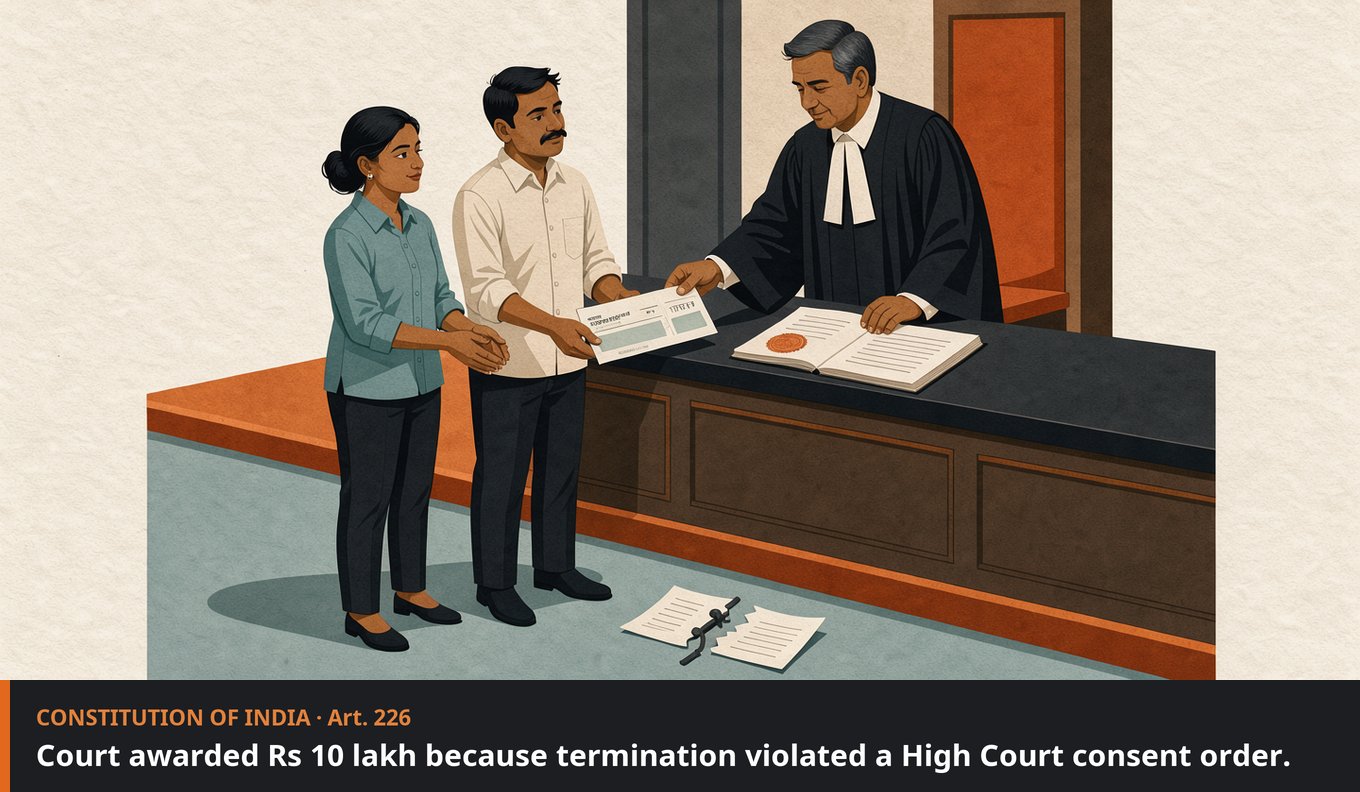
Facts that mattered
- The appellants, a senior clerk and a head clerk, faced departmental proceedings for misappropriation of public money in a private school.
- They objected to inquiry committee members, then abstained from the inquiry, which proceeded ex parte, and they were removed from service without being furnished the inquiry reports.
- The School Tribunal dismissed their appeals; their writ petitions before the High Court rested only on parity with the headmaster and did not plead violation of the consent order.
- The High Court dismissed the writ petitions, holding the headmaster and the appellants did not stand on the same footing.
Legal concepts
A party must plead its case with the averments needed for the relief claimed, and a court is under no obligation to entertain a plea unsupported by such averments in the petition.
Reaffirmed · para 9
An action or order wholly contrary to an express judicial order passed in exercise of competent jurisdiction is a nullity and cannot be accepted.
Reaffirmed · para 11 · Ram Saran Varshney v. State of U.P., (2016) 3 SCC 724, para 11
A High Court cannot grant relief under Article 226 to a litigant who has approached it without pleading an appropriate case for relief.
Reaffirmed · para 11
Read the judgment
D-0073 · 17.11.2026 · Art. 14
Ku. Kiran D/o Purushottam Bhujade v. Sudhir Shikshan Sanstha, C.A. No.-014255-014255 - 2026
Bench: HON'BLE MR. JUSTICE AHSANUDDIN AMANULLAH, HON'BLE MR. JUSTICE MANMOHAN (2 judges). Judgment by HON'BLE MR. JUSTICE MANMOHAN
Supreme Court restores reinstatement, holding familial capture of inquiry panel vitiates termination
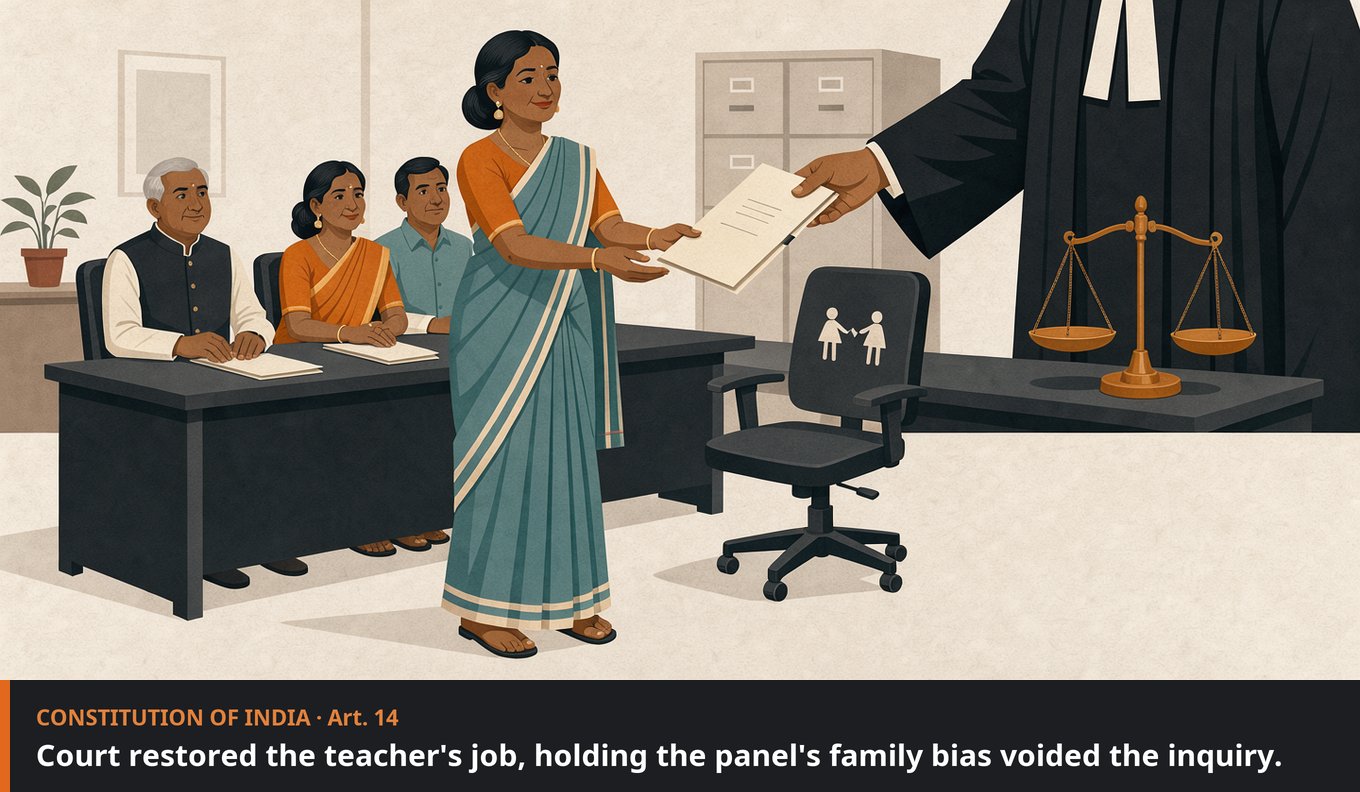
Facts that mattered
- The Appellant, an Assistant Teacher, was terminated on 23rd February 2022 following a departmental inquiry by a three-member Inquiry Committee constituted under Rule 36 of the MEPS Rules.
- The Convenor of the Inquiry Committee, Prakash Masurkar, was the real brother of Rajesh Masurkar, who simultaneously acted as complainant, CEO issuing chargesheets, principal witness on eleven of twenty charges, and signatory of the termination order.
- The School Tribunal quashed the termination and granted reinstatement with full back wages, but the High Court set aside the Tribunal's order and upheld the termination.
- The Appellant raised objection to the Convenor's appointment at every stage, including before the Inquiry Committee, the Tribunal, and in the writ proceedings.
Legal concepts
The test of bias is not proof of actual bias but whether a reasonable likelihood of bias exists in the mind of a reasonable person, as distinguished from a merely fanciful apprehension.
Reaffirmed · para 49
An immediate blood relative of a person who initiates disciplinary action or is directly interested in its outcome is disqualified from acting as an adjudicator; breach of Nemo Judex in Causa Sua is a fundamental jurisdictional defect under Article 14, not a curable procedural irregularity.
Laid down · para 55
Mere compliance with procedural formalities such as multiple hearings, examining witnesses or permitting cross-examination cannot cure a foundational illegality arising from bias in the decision-making process.
Laid down · para 57
The doctrine of necessity does not apply where unrelated members of the Executive Committee were available to be nominated to the Inquiry Committee.
Reaffirmed · para 58 · Krishnadatt Awasthy vs. State of Madhya Pradesh and Ors., (2025) 7 SCC 545, para 41
An alleged waiver of objection to a biased decision-maker must be voluntary, informed and unequivocal to be effective.
Reaffirmed · para 61
Read the judgment
D-0062 · 16.11.2026 · Art. 142
Ankit Saraiya v. Pooja Saraiya, Crl.A. No.-005360-005360 - 2026
Bench: HON'BLE MR. JUSTICE SATISH CHANDRA SHARMA, HON'BLE MR. JUSTICE NONGMEIKAPAM KOTISWAR SINGH (2 judges). Judgment by HON'BLE MR. JUSTICE SATISH CHANDRA SHARMA
Court dissolved marriage under Article 142 giving effect to Rs 75 crore settlement between parties
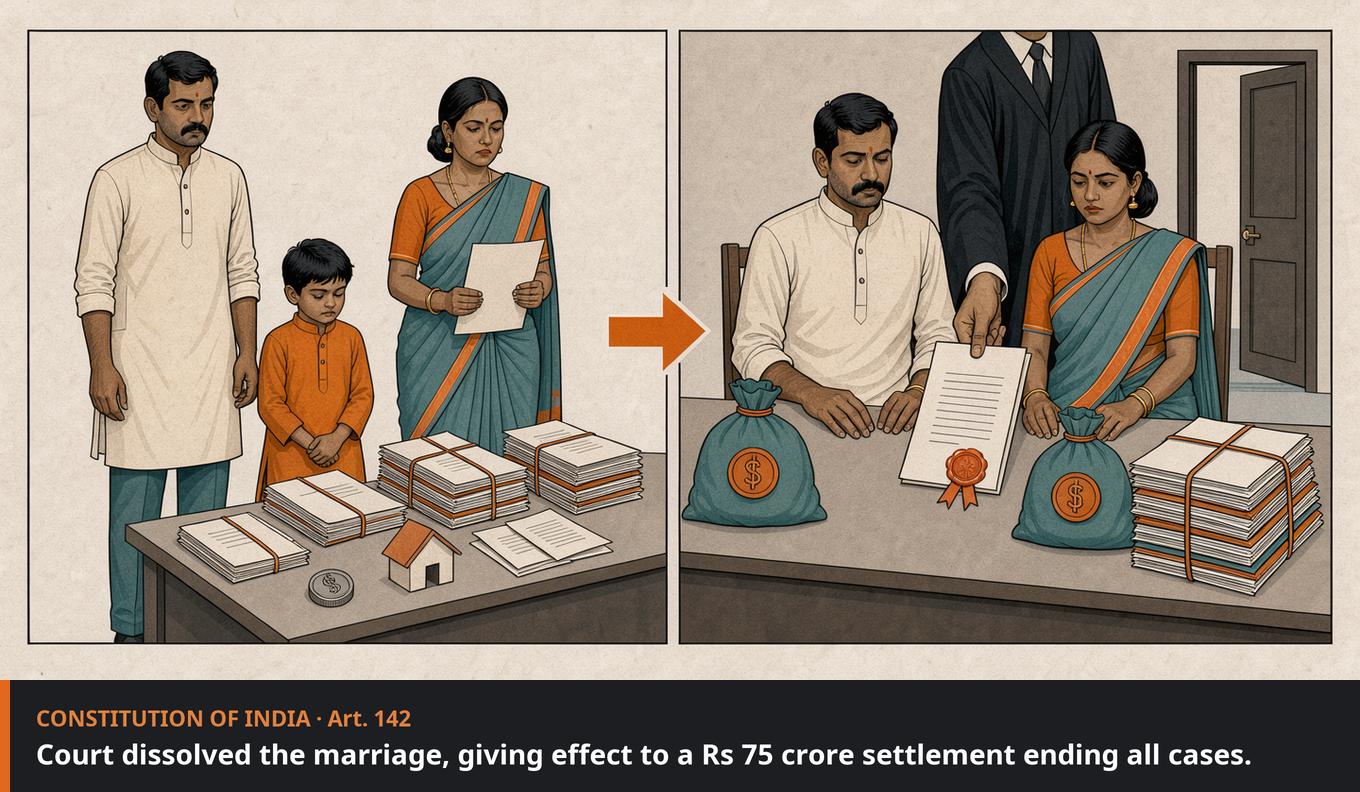
Facts that mattered
- The parties married on 31.01.2013 and a son was born on 08.05.2017; the wife filed proceedings under Section 12 of the DV Act seeking interim monetary relief and alternative accommodation.
- The Trial Court directed payment of Rs. 90,000 per month for the child's maintenance and Rs. 60,000 per month for alternative accommodation, aggregating to Rs. 1,50,000 per month.
- Disputes continued over the shared household, leading to proceedings before the First Appellate Court and the High Court at Calcutta.
- During the appeal, the parties arrived at an amicable settlement providing Rs. 30 crores as permanent alimony to the wife and Rs. 45 crores for the minor child, along with closure of all pending cases.
Legal concepts
Read the judgment
D-0060 · 16.11.2026 · Art. 309
T. Akon Phom v. State of Nagaland, C.A. No.-014203-014203 - 2026
Bench: HON'BLE MR. JUSTICE PRASHANT KUMAR MISHRA, HON'BLE MR. JUSTICE SHREE CHANDRASHEKHAR (2 judges). Judgment by HON'BLE MR. JUSTICE PRASHANT KUMAR MISHRA
Court upholds introduction of written exam in Nagaland Excise Constable recruitment
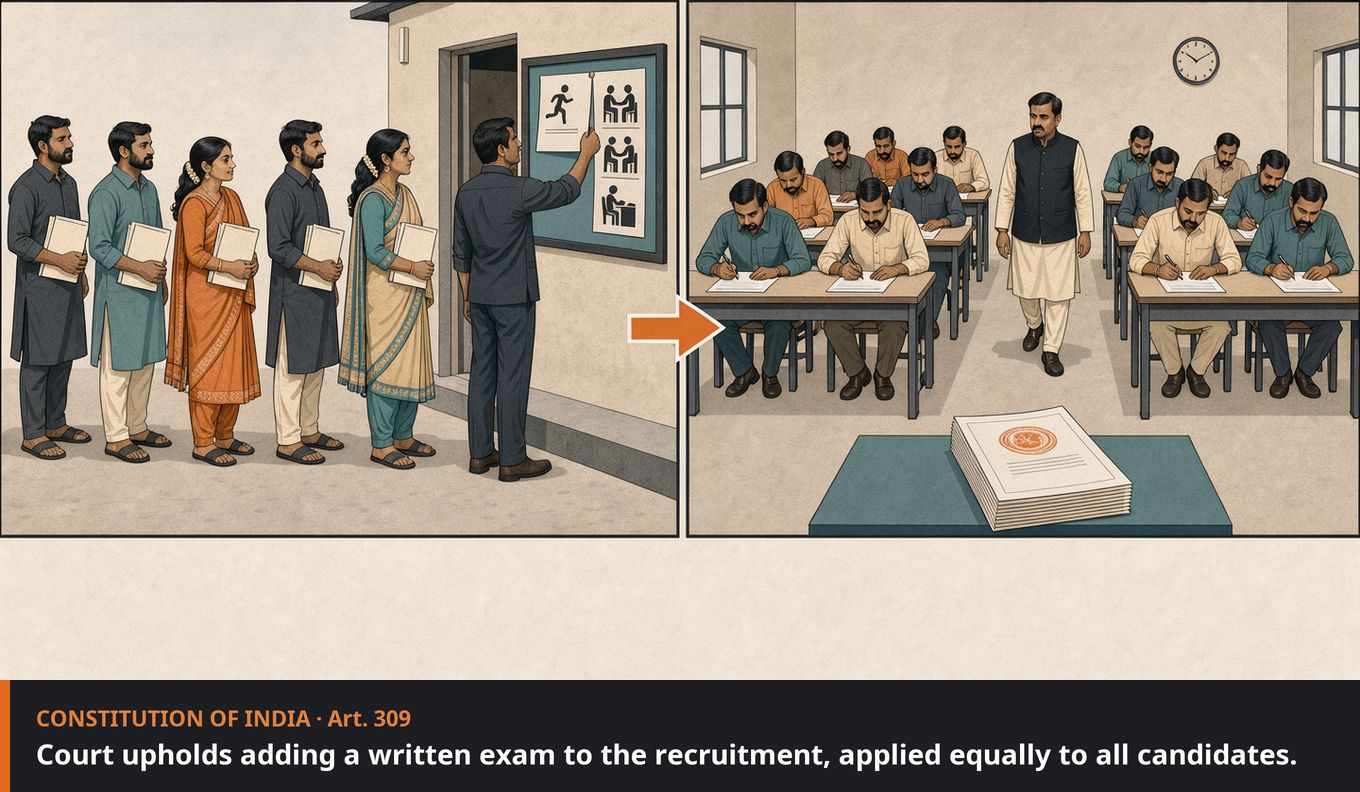
Facts that mattered
- The Department of Excise and Prohibition, Nagaland, advertised 46 Excise Constable posts requiring Class VIII qualification under the 1999 Rules framed under Article 309.
- The original advertisement specified a Physical Test and a Viva-Voce, but a Corrigendum later introduced a written examination of 100 marks after 2,297 candidates cleared the Physical Test.
- The Single Judge quashed the Corrigendum, holding the selection method could not be changed midway, but the Division Bench reversed that decision on the State's appeal.
- The recruitment concluded and a select list of 46 candidates was notified before this Court issued notice, though appointments were yet to be made.
Legal concepts
Where the applicable Rules do not prescribe a detailed selection method, the competent recruiting authority has discretion to devise selection or shortlisting procedures.
Laid down · para 16
Introducing an objective written examination after the original advertisement is not arbitrary where it is widely publicised, applied equally to all candidates, and no prejudice is shown.
Laid down · para 15
A written examination based on the prescribed educational syllabus falls within competitive examination/selection under the Rules, so the provision requiring consultation to adopt a different method is not attracted.
Reaffirmed · para 12
Read the judgment
D-0059 · 16.11.2026 · Art. 21
Devilal Gond v. State of Chhattisgarh, Crl.A. No.-005358-005358 - 2026
Bench: HON'BLE MR. JUSTICE SANJAY KUMAR, HON'BLE MR. JUSTICE SANJEEV SACHDEVA (2 judges). Judgment by HON'BLE MR. JUSTICE SANJEEV SACHDEVA
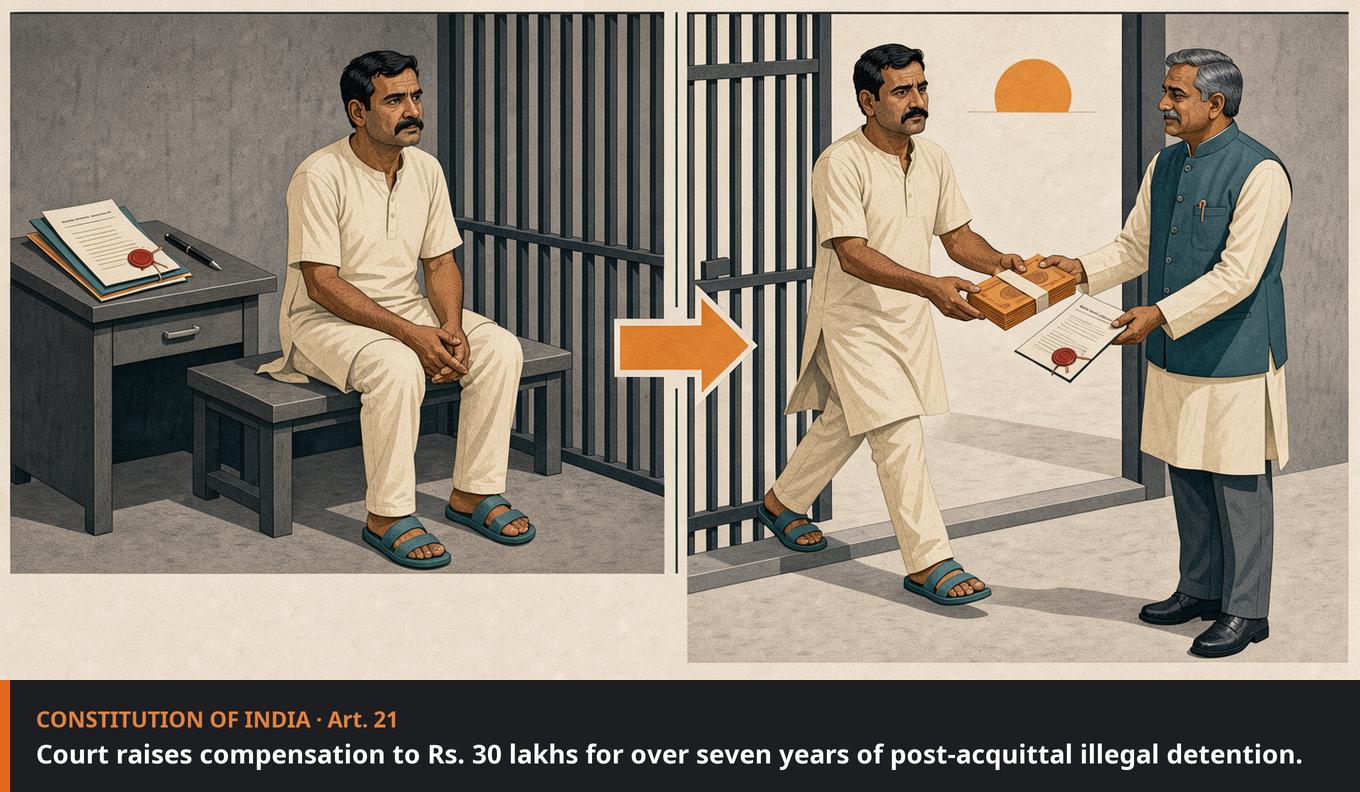
Supreme Court enhances compensation to Rs. 30 lakhs for over seven years of post-acquittal illegal detention
Facts that mattered
- Appellant was arrested in 2012 for murder, convicted in 2013 and sentenced to life imprisonment by the Sessions Court.
- The High Court acquitted him on 20.01.2018, and the acquittal became final as the State did not challenge it, but the order was not communicated to the jail.
- He remained in custody for over 7 years after acquittal and was released only on 19.05.2025 after a records-verification exercise revealed the error.
- The High Court awarded only Rs. 2,00,000 compensation for the illegal detention, which the appellant challenged as inadequate.
Legal concepts
Award of compensation under Articles 32 and 226 for contravention of fundamental rights is a public law remedy based on strict liability, to which sovereign immunity does not apply.
Reaffirmed · para 15 · Nilabati Behera v. State of Orissa, (1993) 2 SCC 746, para 13
In assessing compensation for violation of fundamental rights, the emphasis must be on the compensatory rather than the punitive element.
Reaffirmed · para 33
Compensation for wrongful incarceration must be meaningful and proportionate to the harm, enabling the victim to rebuild his life rather than being merely symbolic or nominal.
Laid down · para 52
Read the judgment
Code of Civil Procedure, 1908 (4)
D-0086 · 19.11.2026 · O. 7 r. 11
Subhasindu Das v. Bacchu Ranjan Das, C.A. No.-000841-000842 - 2023
Bench: HON'BLE MR. JUSTICE VIKRAM NATH, HON'BLE MR. JUSTICE R. MAHADEVAN, HON'BLE MR. JUSTICE APARESH KUMAR SINGH (3 judges). Judgment by HON'BLE MR. JUSTICE VIKRAM NATH
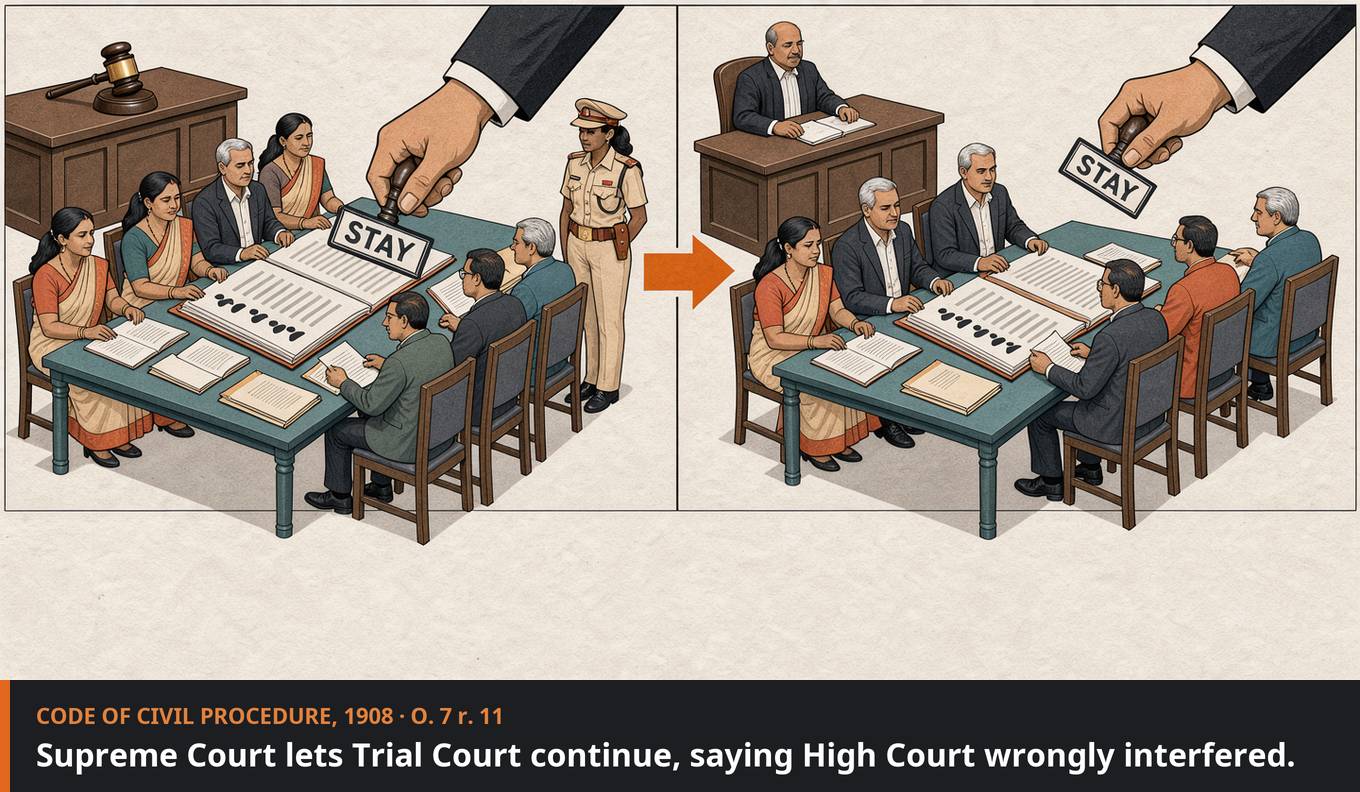
Supreme Court sets aside High Court's interim interference with Trial Court's management and impleadment orders
Facts that mattered
- The appellants sued under Section 92 CPC for removal of office bearers and a scheme to manage Sri Guru Sangha, a charitable society with its Ashram at Kolkata.
- The Trial Court removed Special Officer Banani Ghosh after considering her written explanation and constituted a 13-member ad hoc committee on a joint application of the parties.
- The High Court stayed the Trial Court's order and later set aside its rejection of impleadment applications, holding the suit was representative in nature.
- The Supreme Court stayed the High Court's orders and permitted the Trial Court to continue with the suit.
Legal concepts
Supervisory jurisdiction under Article 227 is not meant to correct every error of fact or law or to substitute the High Court's conclusions for those of the subordinate court; interference is warranted only for patent jurisdictional error, perversity or grave miscarriage of justice.
Reaffirmed · para 8
A suit under Section 92 of the CPC is representative in nature, but that does not confer an automatic right of impleadment upon every member; the applicant must show that presence is necessary or proper under Order I Rule 10(2).
Laid down · para 9
The representative nature of a suit cannot by itself dispense with the requirements of Order I Rule 10(2) of the CPC, and the High Court must identify perversity or legal infirmity before setting aside a reasoned rejection of impleadment.
Laid down · para 10
Read the judgment
D-0080 · 18.11.2026 · O. 7 r. 11
Ashok Kumar v. Central Bank of India, C.A. No.-014308-014308 - 2026
Bench: HON'BLE MR. JUSTICE DIPANKAR DATTA, HON'BLE MR. JUSTICE SHEEL NAGU (2 judges). Judgment by HON'BLE MR. JUSTICE DIPANKAR DATTA
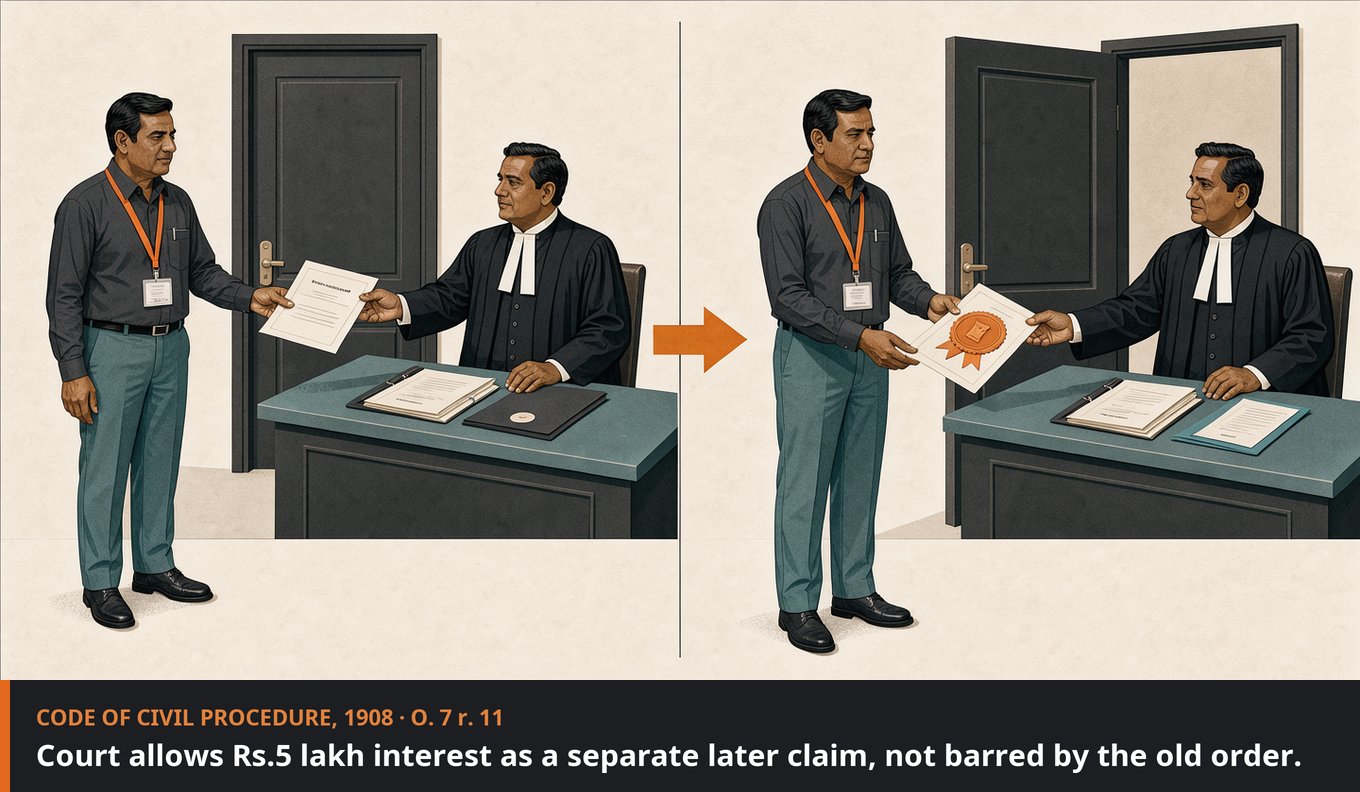
Court allows Rs.5 lakh to employee, holding interest claim was a separate subsequent cause of action
Facts that mattered
- Kumar, a bank employee, was acquitted in 1983 of defalcation charges; the acquittal attained finality in 1991 when the High Court dismissed appeals against it.
- The High Court quashed the departmental enquiry in 2007 and ordered reinstatement with consequential benefits; that order attained finality when the Bank's SLP was dismissed in 2011.
- Kumar was paid over Rs.42 lakh in 2011 but later sought 18% interest on delayed salary, first by a fresh writ petition dismissed in 2023, then by a miscellaneous application in the earlier writ petition filed in 2024.
- The Single Judge and Division Bench dismissed the miscellaneous application, holding it barred by constructive res judicata and finality of the 2007 order.
Legal concepts
A miscellaneous application in a finally decided writ petition is not an independent proceeding; it has a narrow scope, is procedural not substantive, and cannot be used to agitate a subsequent or independent cause of action.
Laid down · para 21
Res judicata and the bar of Order II Rule 2 CPC apply only to a claim that could have been raised when the earlier proceeding was instituted, and a claim based on a subsequent cause of action cannot be barred by a judgment on a prior cause of action.
Laid down · para 20
Interest is a restitution for delay pendente lite and during appeals, a distinct cause of action arising subsequently, and it is not a penalty but a normal accretion on capital.
Reaffirmed · para 23 · Alok Shanker Pandey v. Union of India, (2007) 3 SCC 545, para 23
The technical plea of constructive res judicata should not stand in the way of a litigant where relief is otherwise due, in view of the rule that an act of court should harm no litigant.
Reaffirmed · para 25
Read the judgment
D-0079 · 18.11.2026 · O. 20 r. 12
Bharat Bhushan Jain (dead) Thr. Lrs. v. M/s Goodyear India Ltd ., C.A. No.-009668-009669 - 2013
Bench: HON'BLE MR. JUSTICE PRASHANT KUMAR MISHRA, HON'BLE MR. JUSTICE SHREE CHANDRASHEKHAR (2 judges). Judgment by HON'BLE MR. JUSTICE PRASHANT KUMAR MISHRA
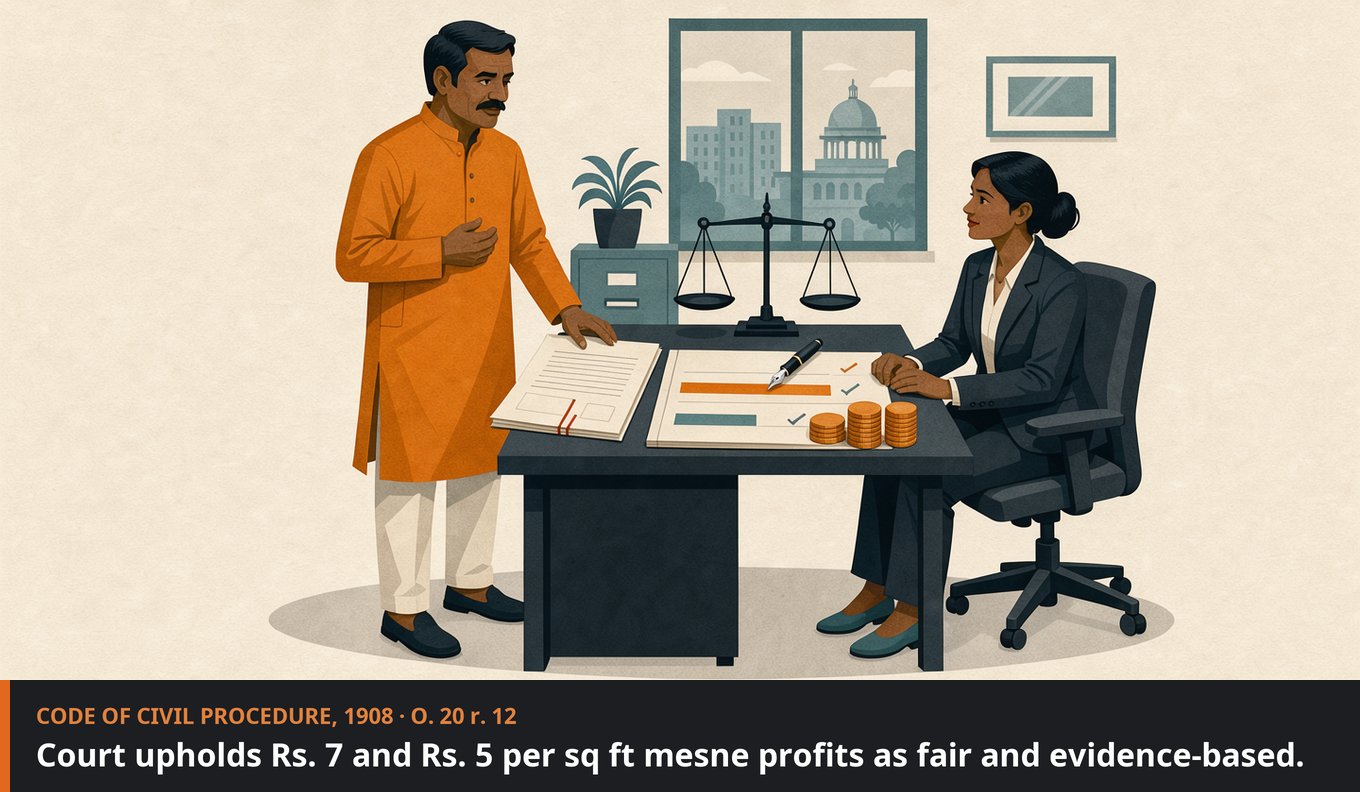
Supreme Court upholds High Court's mesne profits rate of Rs. 7 and Rs. 5 per sq ft as fair and evidence-based.
Facts that mattered
- The suit premises at Ansari Road, Daryaganj, New Delhi were let to Goodyear India Ltd., with tenancy terminated w.e.f. midnight of 31.12.1989; the decree for possession attained finality in 2001.
- The Trial Court passed a preliminary decree under Order XX Rule 12 CPC directing separate inquiry into mesne profits, later fixing Rs. 22/sq ft (ground floor) and Rs. 11/sq ft (mezzanine) with 15% interest.
- The First Appellate Court set aside the Trial Court's rate as speculative, limiting mesne profits to the admitted rent, but overlooked an admission by the tenant's own witness DW-1 about prevailing locality rent of Rs. 5-8 per sq ft.
- The High Court found this omission a substantial question of law, fixing Rs. 7/sq ft (ground) and Rs. 5/sq ft (mezzanine) with 7.5% simple interest; the Supreme Court dismissed appeals against that determination.
Legal concepts
Mesne profits are compensatory in nature, intended to recompense the true owner for loss caused by continued wrongful occupation, and their assessment is not governed by any rigid formula.
Reaffirmed · para 10 · Martin and Harris Private Limited and Another vs. Rajendra Mehta and Others, (2022) 8 SCC 527, para 10
Determination of mesne profits is essentially an appreciation of evidence and does not warrant appellate interference unless manifestly arbitrary, unsupported by the record, or based on erroneous application of law.
Reaffirmed · para 10 · Martin and Harris Private Limited and Another vs. Rajendra Mehta and Others, (2022) 8 SCC 527, para 10
Interest forms an integral component of mesne profits, compensating the owner for deprivation of beneficial enjoyment of the property during wrongful occupation.
Reaffirmed · para 16
Omission by an appellate court to consider a material piece of evidence having direct bearing on mesne profits determination gives rise to a substantial question of law warranting interference.
Laid down · para 13
Read the judgment
D-0067 · 16.11.2026 · s. 34
Kamal Gupta v. Nisha Gupta, C.A. No.-014206-014207 - 2026
Bench: HON'BLE MR. JUSTICE PRASHANT KUMAR MISHRA, HON'BLE MR. JUSTICE SHREE CHANDRASHEKHAR (2 judges). Judgment by HON'BLE MR. JUSTICE PRASHANT KUMAR MISHRA
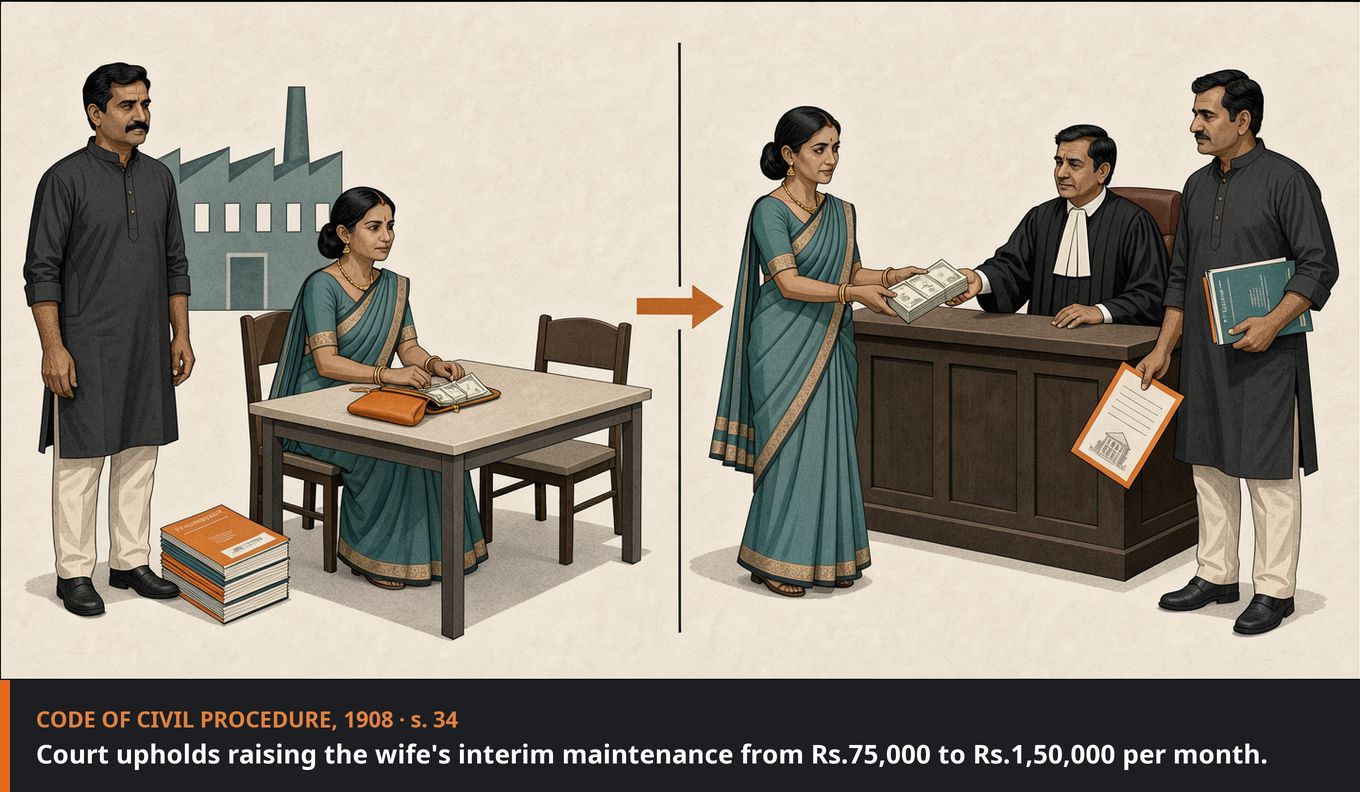
Supreme Court upholds High Court's enhancement of interim maintenance to Rs.1.5 lakh per month.
Facts that mattered
- The Family Court granted the wife interim maintenance of Rs.75,000 per month against the husband.
- The High Court dismissed the husband's appeal but enhanced interim maintenance to Rs.1,50,000 per month on the wife's cross-appeal.
- The husband runs a partnership firm manufacturing auto cables with Rs.6.6 crore annual turnover, holds seven bank accounts, and gifted a flat to his brother.
- The Supreme Court found the High Court's enhancement neither perverse nor unreasonable and dismissed the appeals.
Legal concepts
Financial affidavits must be filed by both parties in maintenance matters as mandated by this Court.
Reaffirmed · para 5 · Rajnesh vs. Neha and Another, (2021) 2 SCC 324, para 5
Read the judgment
Code of Criminal Procedure, 1973 (3)
D-0075 · 17.11.2026 · s. 389
State of U.P v. Mohammad Azam Khan, Crl.A. No.-005376-005378 - 2026
Bench: HON'BLE MR. JUSTICE DIPANKAR DATTA, HON'BLE MR. JUSTICE SHEEL NAGU (2 judges). Judgment by HON'BLE MR. JUSTICE DIPANKAR DATTA
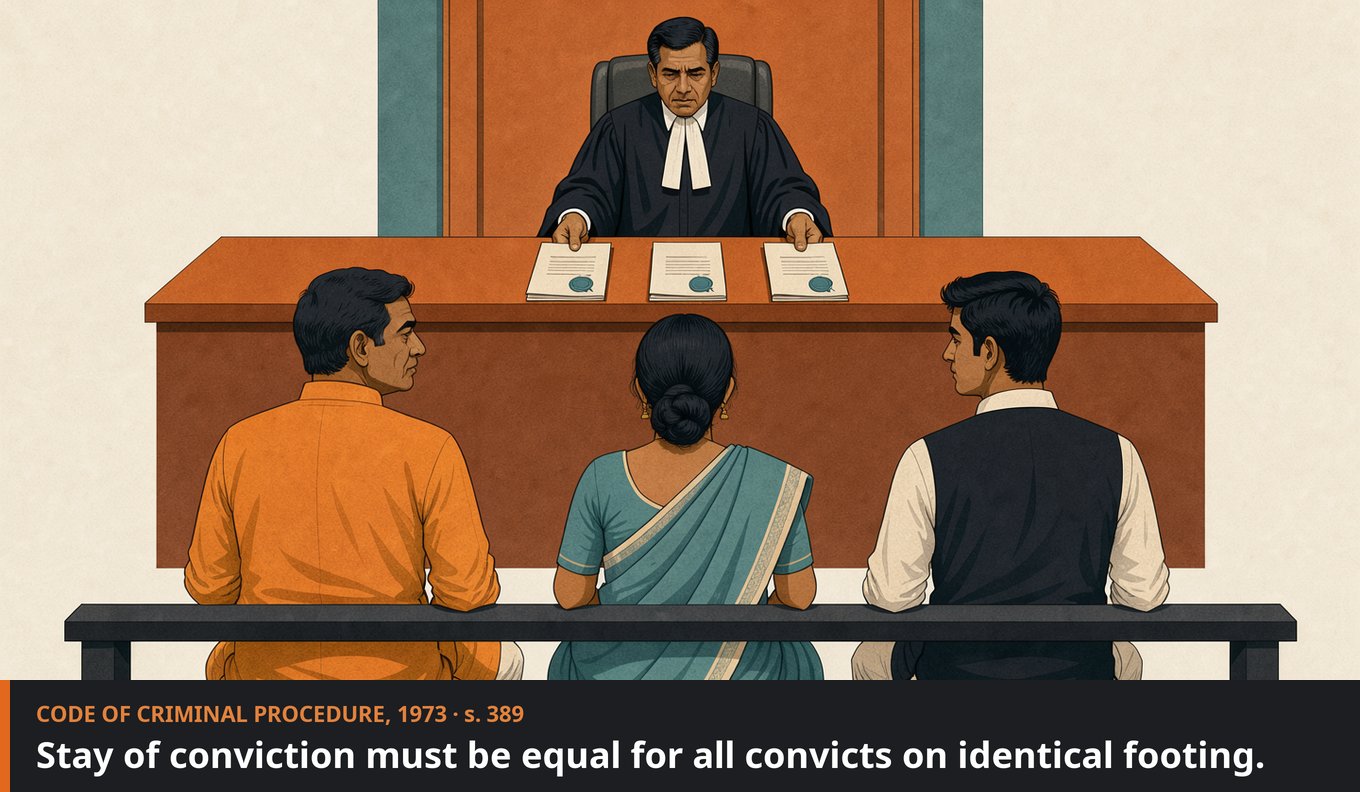
Stay of conviction extended to co-convicts on identical footing, upholding parity under Article 14
Facts that mattered
- Three family members were convicted by a trial court on 18 October 2023 for criminal conspiracy involving two conflicting birth certificates, affirmed on appeal on 23 December 2023.
- The High Court suspended all three sentences and enlarged all three on bail, but stayed only Mohammad Azam Khan's conviction, rejecting stay applications of his son and wife.
- The State challenged the stay of conviction, while the son and wife challenged denial of stay of conviction, all under Article 136.
- The High Court recorded no coherent reason distinguishing the patriarch's case from those of the co-convicts convicted under the identical conspiracy charge.
Legal concepts
Where several convicts stand on the same evidentiary footing, an order granting stay of conviction to one while denying it to others must identify and expressly state the distinguishing feature; an order silent on that point is by itself arbitrary.
Laid down · para 19
Stay of conviction is an exceptional remedy requiring distinct, compelling judicial justification, qualitatively different from mere suspension of sentence.
Reaffirmed · para 9 · Ravikant S. Patil v. Sarvabhouma S. Bagali, (2007) 1 SCC 673, para 21
A stay of conviction cannot be anchored purely on political expediency, electoral ambitions, or the exigencies of upcoming election campaigns.
Laid down · para 23
Judicial discretion under Section 389(1) must balance the grave and irreversible consequences of conviction for the convict against the sanctity that must attach to a conviction until it is set aside.
Reaffirmed · para 22 · Afjal Ansari v. State of U.P., (2024) 2 SCC 187, para 21
Read the judgment
D-0071 · 17.11.2026 · s. 197
Ashok v. Mahesh, Crl.A. No.-005370-005371 - 2026
Bench: HON'BLE MR. JUSTICE K.V. VISWANATHAN, HON'BLE MR. JUSTICE ARUN PALLI (2 judges). Judgment by HON'BLE MR. JUSTICE K.V. VISWANATHAN
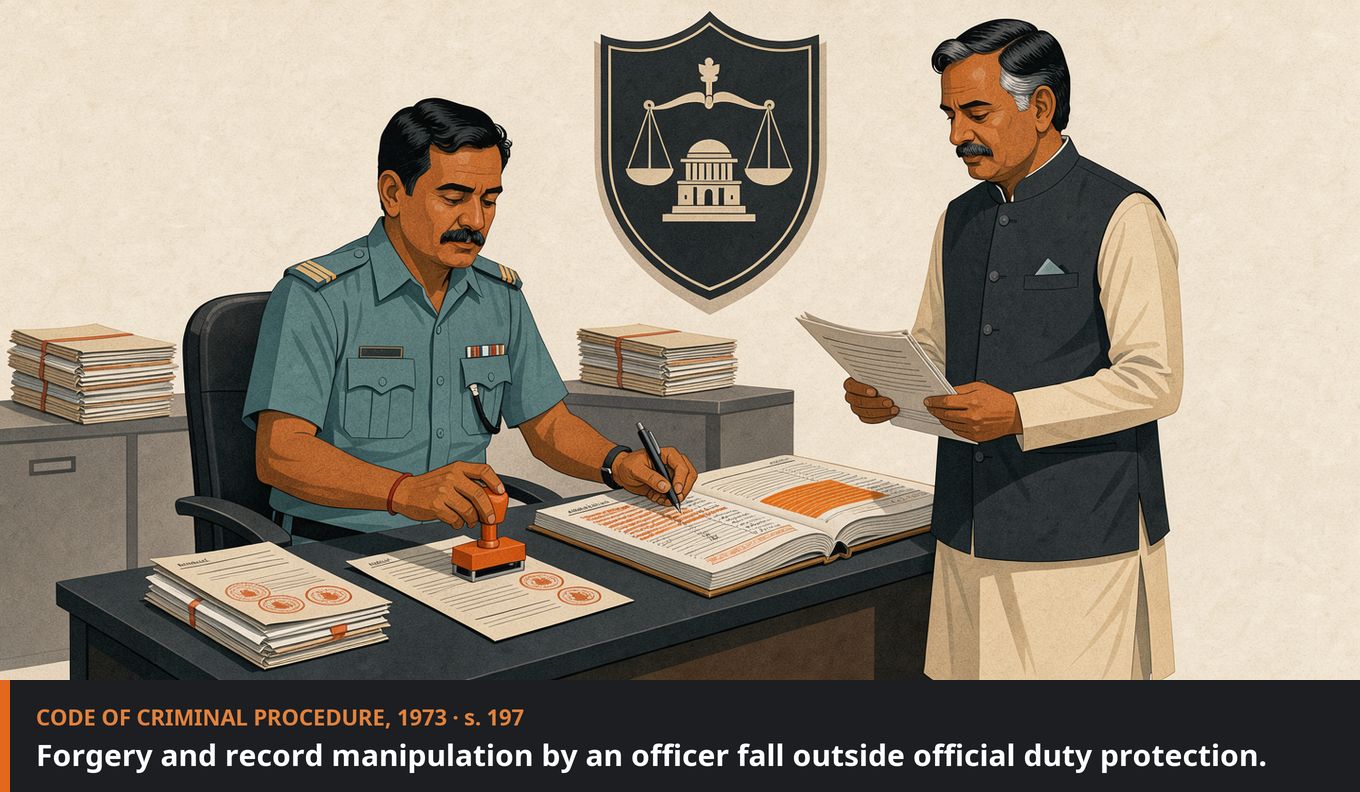
Forgery and record manipulation by public servant fall outside Section 197 CrPC sanction protection
Facts that mattered
- The High Court quashed proceedings against a City Survey Officer, holding sanction under Section 197 CrPC was needed before a Section 156(3) investigation against a public servant.
- The complainant alleged the officer colluded to mutate land records based on a forged application, removing a charitable trust's name from property records.
- Chargesheets were filed for forgery, cheating and criminal conspiracy under the IPC arising from two FIRs registered on Magistrate's directions.
- The Supreme Court held the alleged acts of forgery and record manipulation were not in discharge of official duty, so sanction was not required.
Legal concepts
Section 197 CrPC protection applies only where the act complained of has a reasonable connection with the discharge of official duty, judged by the quality of the act rather than the mere opportunity furnished by office.
Reaffirmed · para 33 · Om Prakash Yadav vs. Niranjan Kumar Upadhyay and Others, 2024 SCC OnLine SC 3726, para 33
Acts of preparing forged documents, fabricating records and conspiring to cheat cannot form part of discharge of official duty and fall outside the protective umbrella of Section 197 CrPC.
Laid down · para 34
Where the acts complained of are not in discharge of official duty, prior sanction under Section 197 CrPC and the Maharashtra Amendment to Section 156(3) CrPC are not attracted.
Laid down · para 35
Read the judgment
D-0066 · 16.11.2026 · s. 162
Naresh v. State of Haryana, Crl.A. No.-001137-001138 - 2014
Bench: HON'BLE MR. JUSTICE SATISH CHANDRA SHARMA, HON'BLE MR. JUSTICE NONGMEIKAPAM KOTISWAR SINGH (2 judges). Judgment by HON'BLE MR. JUSTICE SATISH CHANDRA SHARMA
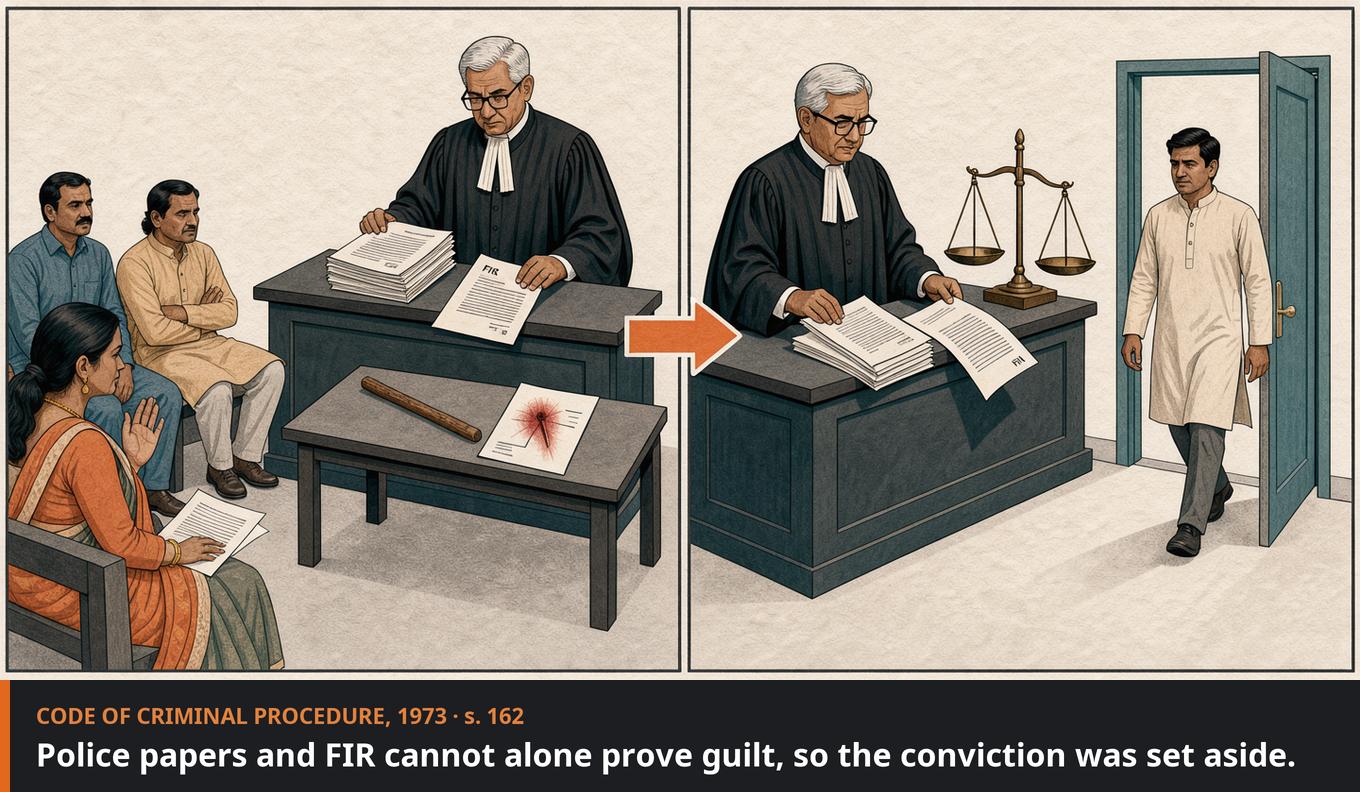
Conviction set aside as FIR and police statements were wrongly used as substantive evidence
Facts that mattered
- Two widows, Suman and Shakuntla, were found dead in village Ranila, Haryana, on the night of 17.04.2011, with fatal incised wounds caused by a sharp-edged weapon.
- Every private witness who could have spoken to the occurrence, including the informant and the child son of the deceased, turned hostile and disowned their police statements.
- The appellant's first disclosure led to recovery of a danda, which could not have caused the fatal incised wounds; a second disclosure after the post-mortem led to a gandasi.
- The High Court acquitted co-accused Subhash but upheld the appellant's conviction solely because his name figured in the FIR and police statements.
Legal concepts
Statements made to a police officer during investigation cannot be used for any purpose at trial except to contradict the witness, and are not substantive evidence of the facts narrated.
Reaffirmed · para 31 · Tahsildar Singh & Anr. v. State of U.P., AIR 1959 SC 1012, para 31
A proved contradiction only impeaches the credit of a witness; it does not make the previous statement evidence of the facts stated therein.
Reaffirmed · para 33 · Alauddin & Ors. v. State of Assam & Anr., para 33
Section 27 of the Evidence Act permits proof only of so much of the accused's information as relates distinctly to the fact thereby discovered, not the past history of the object produced.
Reaffirmed · para 48
In circumstantial evidence cases, the circumstances must be fully established, consistent only with guilt, conclusive, excluding every other hypothesis, forming a complete chain.
Reaffirmed · para 67 · Sharad Birdhichand Sarda v. State of Maharashtra, (1984) 4 SCC 116, para 67
Where similar or identical evidence is led against two accused ascribing them the same role, the court cannot convict one and acquit the other; the principle of parity governs.
Reaffirmed · para 72
Read the judgment
Arbitration and Conciliation Act, 1996 (3)
D-0088 · 18.11.2026 · s. 30
Neycer (india) Ltd. v. Gmb Ceramics Ltd., C.A. No.-005937-005938 - 2021
Bench: HON'BLE MR. JUSTICE DIPANKAR DATTA, HON'BLE MR. JUSTICE SATISH CHANDRA SHARMA (2 judges). Judgment by HON'BLE MR. JUSTICE DIPANKAR DATTA
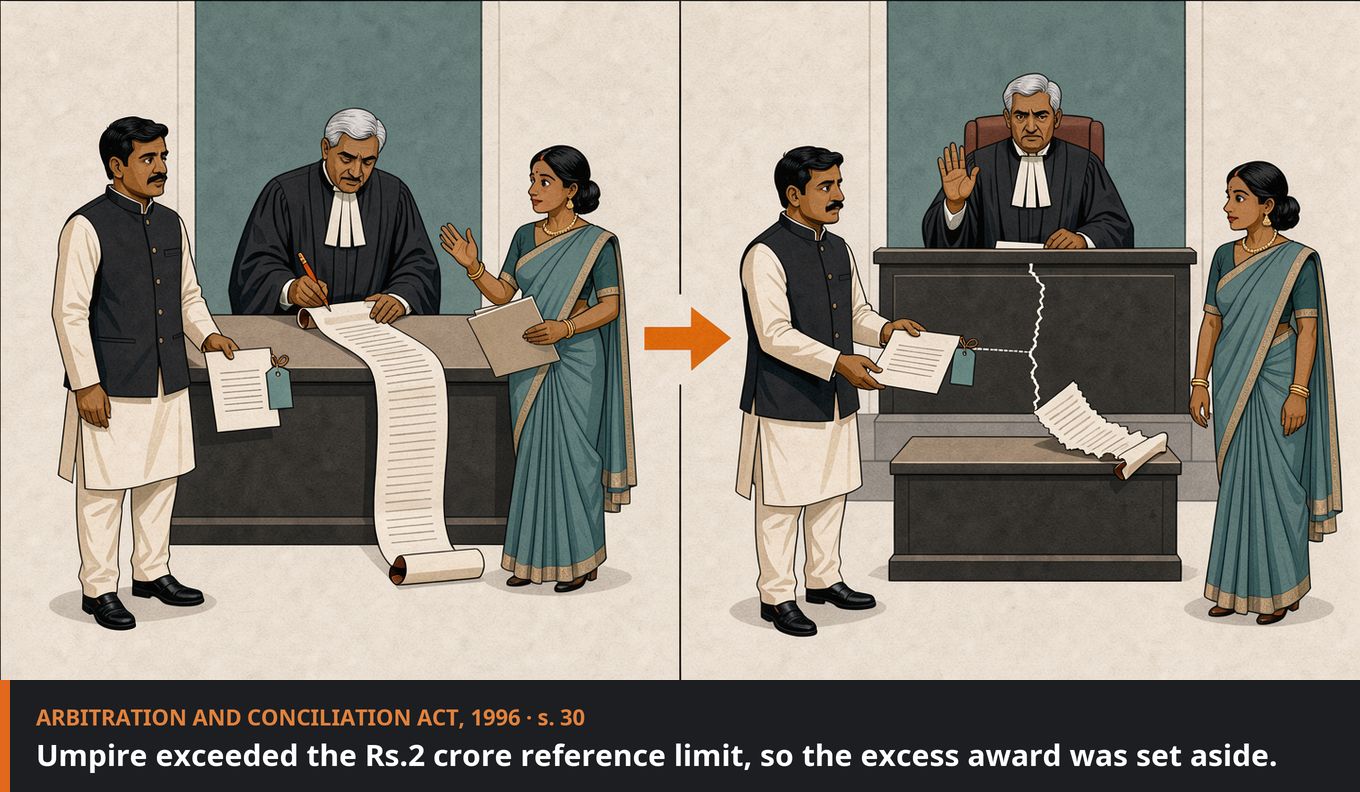
Umpire exceeded jurisdiction; award restored to Rs.2 crore reference limit
Facts that mattered
- GMB's pre-reference correspondence quantified its project cost overrun claim at Rs.2,00,00,000/- and its arbitrator nomination defined the reference to that sum alone.
- The Umpire awarded Rs.11,69,62,910/- with 15% interest, and the Division Bench restored this award in full, reversing the Single Judge's restriction to Rs.2 crore.
- The Single Judge had set aside the Schedule 'C' award for brand-name damages as speculative, based on a 1990 estimate when actual audited expenditure was available.
- The Court found the Umpire exceeded jurisdiction by entertaining claims beyond Rs.2 crore and could not construe Clause 20 as making Neycer an insurer of GMB's project.
Legal concepts
An error within jurisdiction cannot be interfered with unless erroneous and apparent on the face of the award, whereas an error in excess of jurisdiction going to the root of the arbitrator's authority can be set aside.
Reaffirmed · para 6
A dispute as to the jurisdiction of the umpire or the scope of the submission lies outside the award and must be determined by the Court on an objective examination of the documents constituting the reference.
Laid down · para 7
Contesting claims on merits without prejudice to a pleaded jurisdictional objection does not amount to waiver or confer jurisdiction by acquiescence.
Laid down · para 13
Where claims under different schedules are distinct and severable, the valid portion of an award can be sustained after severing the invalid excess.
Reaffirmed · para 27
Read the judgment
D-0076 · 18.11.2026 · ss. 34, 37
M/s Marino Dredgeco Limited v. the Board of Trustees of the Port of Kolkata, C.A. No.-014303-014303 - 2026
Bench: HON'BLE MR. JUSTICE J.B. PARDIWALA, HON'BLE MR. JUSTICE K. VINOD CHANDRAN (2 judges). Judgment by HON'BLE MR. JUSTICE K. VINOD CHANDRAN
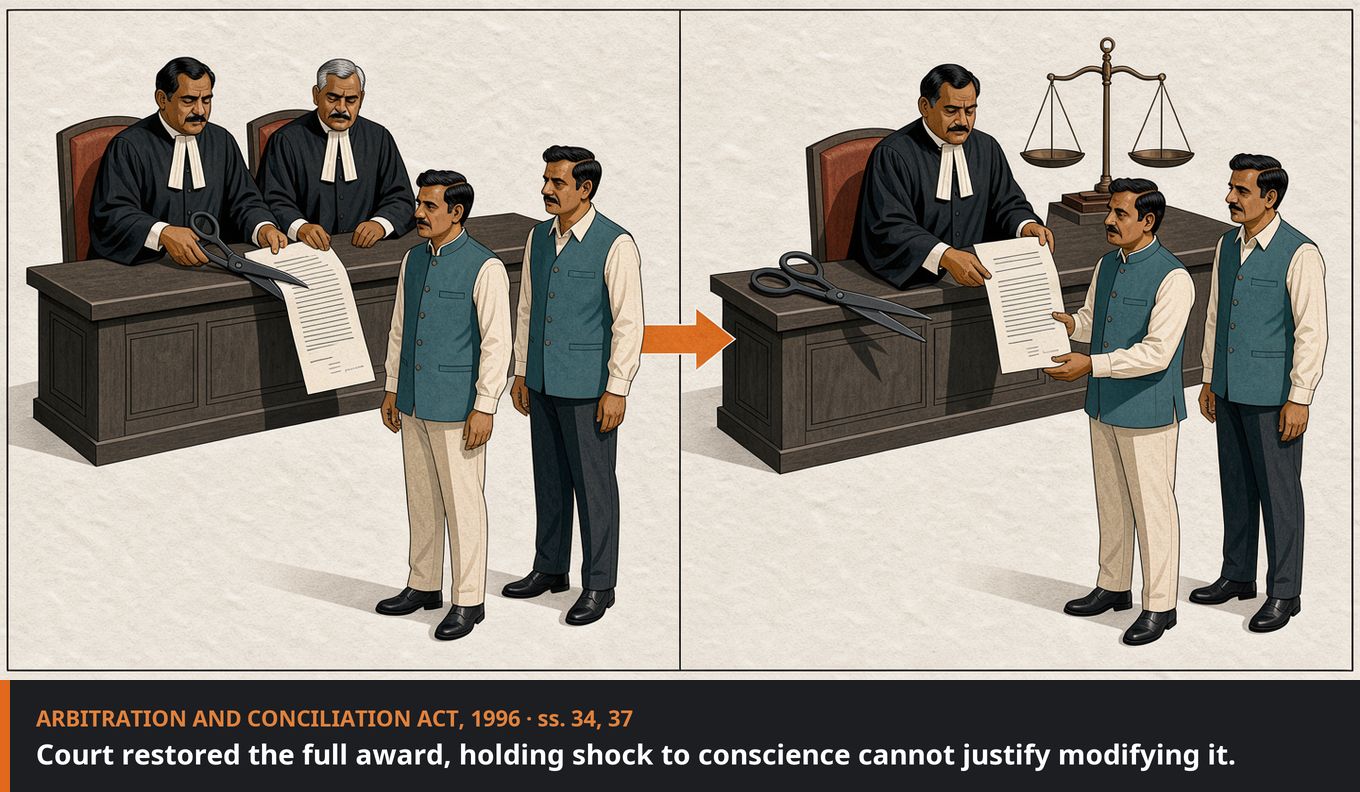
Court restores arbitral award, holding shock to conscience cannot justify Section 37 modification
Facts that mattered
- The Port Trust of Kolkata awarded a contract for dredging a channel and basin at Sagar Island; additional work was entrusted due to siltation, force majeure, and mismatch of soil data supplied by the Port Trust.
- The Arbitrator quantified amounts for the additional work based on measurements and invoices; the Single Judge under Section 34 affirmed the award.
- The Division Bench under Section 37 modified the award to 50% and reduced interest to 6%, holding that additional work claims exceeding 70% of the original contract shocked the conscience of the Court.
- The Supreme Court restored the award, finding the modification outside Section 37 jurisdiction since the award was based on adequate evidence and not perverse.
Legal concepts
An award cannot be modified under Section 37 merely because the court's conscience is shocked by the size of the claim, absent a substantive reason showing conflict with basic notions of morality or justice.
Laid down · para 8 · Somdatt Builders–NCC–NEC (JV) v. National Highways Authority of India & Ors., (2025) 6 SCC 757, para 10
Parties to arbitration must be treated equally, and no special treatment or adverse inference can be drawn merely because the award debtor is a government entity.
Reaffirmed · para 13
An award may be set aside in part only where the valid and invalid portions are legally and practically separable, not inter-dependent or intrinsically intertwined.
Reaffirmed · para 11
Re-examining measurements and invoices under Section 37 would amount to adjudication on the merits, prohibited under the Arbitration and Conciliation Act, 1996.
Laid down · para 12
Read the judgment
D-0074 · 16.11.2026 · ss. 34, 37
Rajasthan Rajya Vidyut Utpadan Nigam Limited, v. Parsa Kente Collieries Limited, SLP(C) No.-032968 - 2026
Bench: HON'BLE MR. JUSTICE SATISH CHANDRA SHARMA, HON'BLE MR. JUSTICE NONGMEIKAPAM KOTISWAR SINGH (2 judges). Judgment by HON'BLE MR. JUSTICE SATISH CHANDRA SHARMA
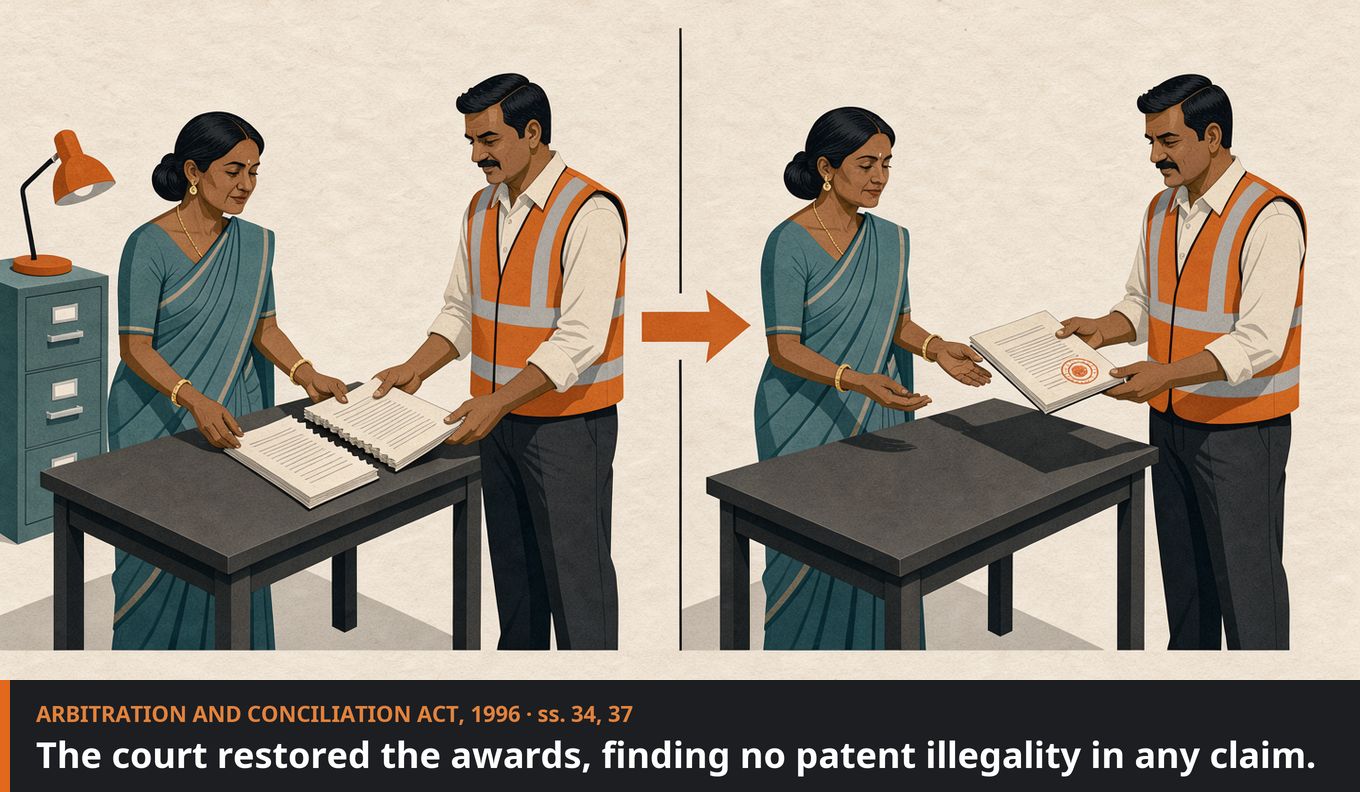
Supreme Court upholds restored arbitral awards, finding no patent illegality in any claim
Facts that mattered
- RVUNL and PKCL entered a Coal Mining and Delivery Agreement for the Parsa East and Kanta Basan coal block, later continued under the Coal Mines (Special Provisions) Act, 2015.
- PKCL invoked arbitration raising nine claims; the sole arbitrator passed an Award on 15.01.2021 and an Additional Award on 05.07.2021 allowing most claims.
- The Commercial Court set aside both awards in their entirety, holding it lacked power to modify, though it upheld findings on some claims.
- The High Court under Section 37 restored both awards; the Supreme Court examined each claim and found no patent illegality or perversity, dismissing the SLP.
Legal concepts
Article 136 is a discretionary and exceptional jurisdiction to be exercised sparingly where exceptional circumstances exist, as an award attains finality at the Section 37 stage.
Reaffirmed · para 10 · DMRC Ltd. v. Delhi Airport Metro Express (P) Ltd., (2024) 6 SCC 357, para 7
Patent illegality goes to the root of the matter and appears on the face of the award; it does not extend to an error in appreciating evidence or a different construction of the contract.
Reaffirmed · para 49
An award is perverse only where a finding is based on no evidence, based on irrelevant material, or ignores vital evidence.
Reaffirmed · para 49
The Section 37 court is confined to the grounds available under Section 34 and cannot undertake an independent assessment of the merits of the award.
Reaffirmed · para 49
Read the judgment
Insolvency and Bankruptcy Code, 2016 (2)
D-0068 · 16.11.2026 · s. 9
M/s. Ganesh Benzoplast Ltd. v. the State Trading Corporation of India, C.A. No.-003097 - 2026
Bench: HON'BLE MR. JUSTICE SANJAY KUMAR, HON'BLE MR. JUSTICE SANJEEV SACHDEVA (2 judges). Judgment by HON'BLE MR. JUSTICE SANJAY KUMAR
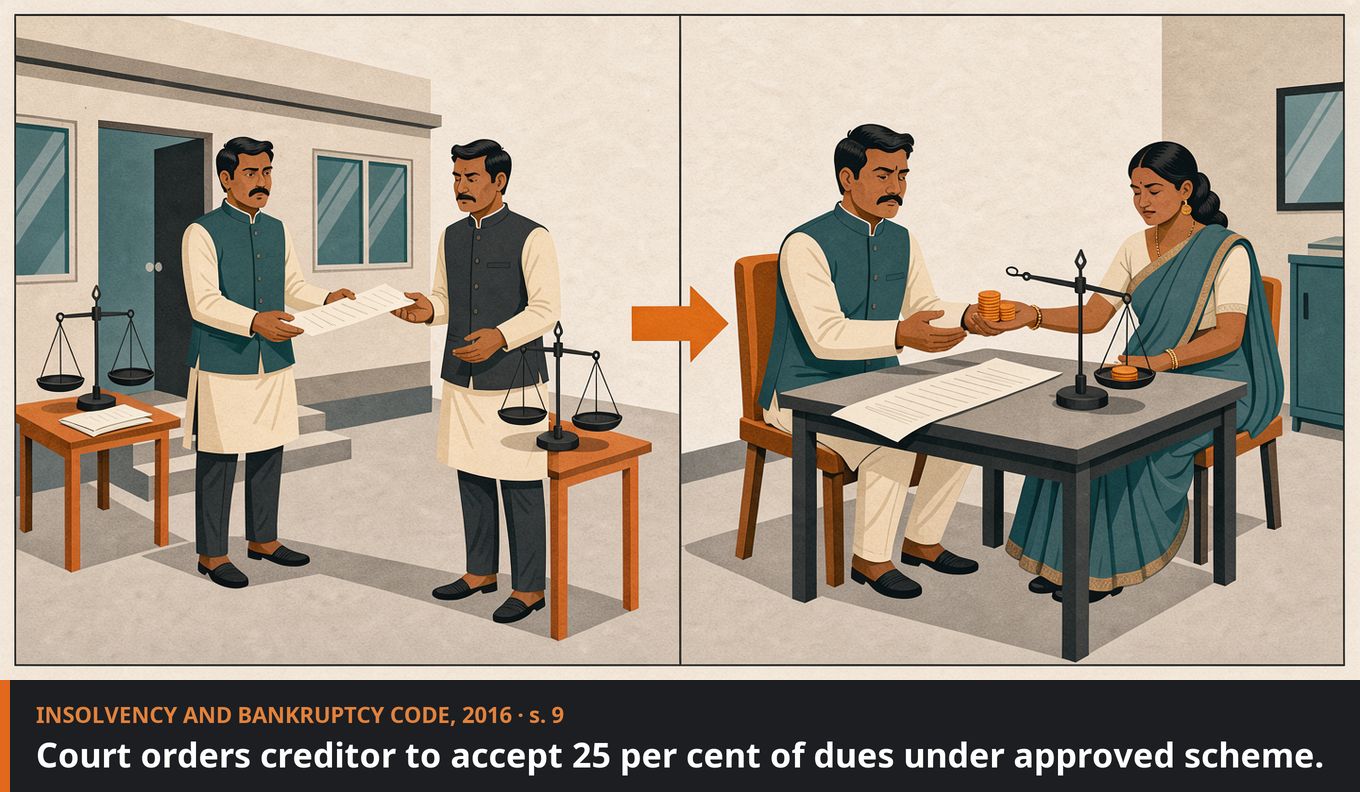
Supreme Court restores NCLAT order directing 25% payment under rehabilitation scheme
Facts that mattered
- STC filed a Section 9 IBC petition against Ganesh Benzoplast; the NCLT instead directed payment of 25% of principal dues (₹2,18,88,421) and disposed of the petition.
- An approved rehabilitation scheme scaled down unsecured liabilities to 25% of principal dues, but STC was listed only as a contingent liability, not among the 191 unsecured creditors.
- STC never challenged its categorization as contingent liability despite publication of the DRS and its approval by the Delhi High Court.
- The NCLAT restored the company petition for fresh adjudication; the Supreme Court set aside that order and restored the NCLT's original order.
Legal concepts
Once a rehabilitation scheme is approved by the BIFR, it binds unsecured creditors, who cannot refuse the scaled-down value of their dues as that would render the scheme unworkable.
Reaffirmed · para 12 · Modi Rubber Limited vs. Continental Carbon India Limited, (2023) 17 SCC 263, para 12
A creditor not part of the approved scheme would still have to settle for the scaled-down value of dues, as other creditors were treated similarly under the scheme.
Reaffirmed · para 13 · Fertilizer Corporation of India Limited and others vs. Coromandel Sacks Private Limited, (2024) 8 SCC 172, para 13
The option under a rehabilitation scheme clause permitting unsecured creditors to wait till the scheme works itself out or seven years and then agitate full dues is not valid.
Laid down · para 14
A contingent liability shown in a rehabilitation scheme attains the status of unsecured creditor only upon crystallization of dues, and the IBC does not provide for such crystallization.
Laid down · para 16
Read the judgment
D-0053 · 16.11.2026 · ss. 61, 62
Lulu Inernational Shopping Malls Private Limited v. Gorinka Pratyusha, C.A. No.-003110-003111 - 2026
Bench: HON'BLE MR. JUSTICE SANJAY KUMAR, HON'BLE MR. JUSTICE SANJEEV SACHDEVA (2 judges). Judgment by HON'BLE MR. JUSTICE SANJAY KUMAR
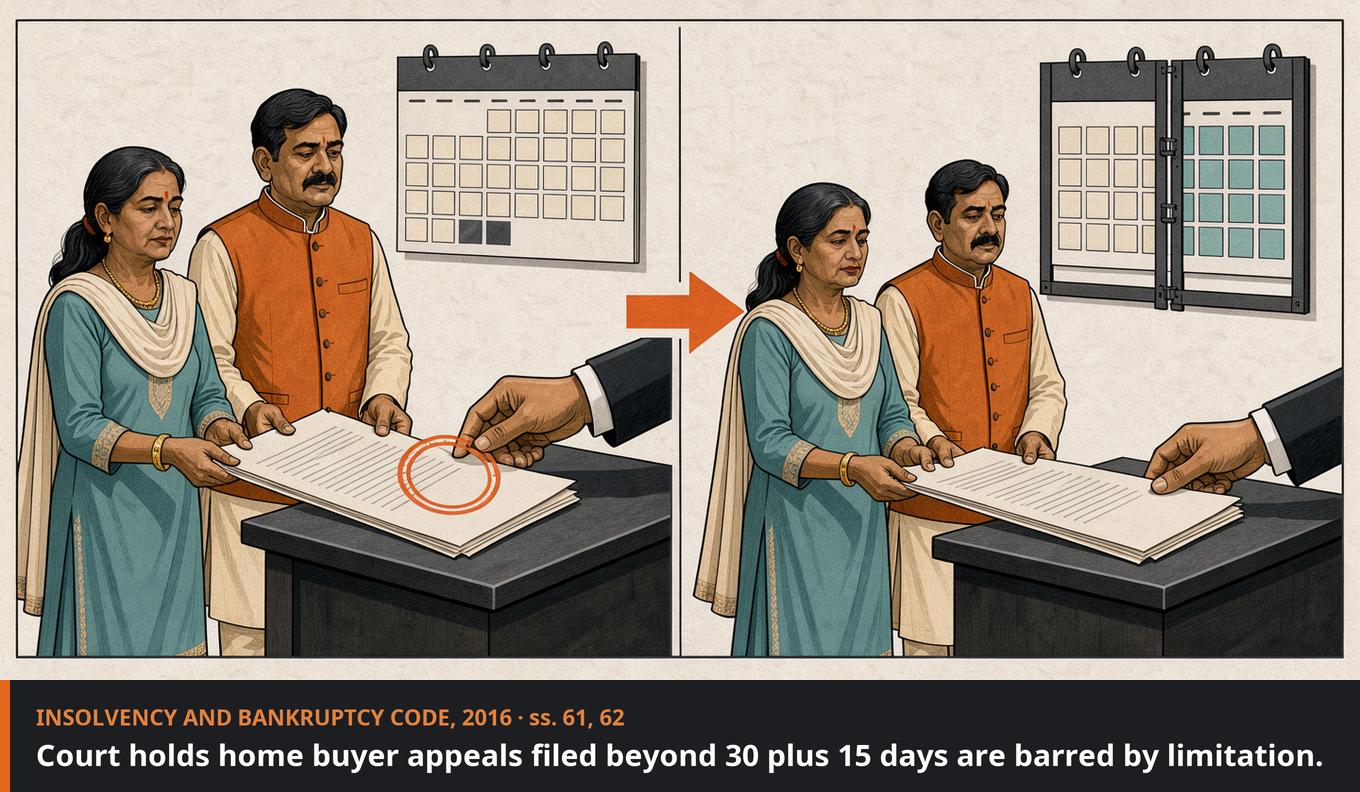
Supreme Court sets aside NCLAT condonation of delay, dismissing home buyer appeals as barred by limitation
Facts that mattered
- The NCLT Hyderabad approved a resolution plan for Manjeera Retail Holdings, with the appellant as successful resolution applicant, investing Rs. 271.52 crore in implementation.
- Home buyers Gorinka Pratyusha and the Kalluris appealed against plan approval, claiming their payments were wrongly recorded as advances rather than financial creditor claims.
- Their appeals were filed on the 46th day, beyond the 30-day period plus 15-day extension under Section 61(2) of the IBC, yet the NCLAT condoned delay applying Section 4 of the Limitation Act because the last day fell on a second Saturday.
- The NCLAT dismissed the appellant's recall applications, wrongly observing that Tata Steel Ltd. was decided after its condonation order, though it in fact predated it.
Legal concepts
The expression 'prescribed period' in Section 4 of the Limitation Act means only the period of limitation, so exclusion of court-closure days is unavailable for the discretionary extension period beyond it.
Reaffirmed · para 7 · Tata Steel Ltd. vs. Raj Kumar Banerjee and others, (2025) 9 SCC 483, para 7
Though the NCLAT has no review power under the IBC, it can recall its orders in exercise of inherent jurisdiction under Rule 11 of the NCLAT Rules on sufficient grounds.
Reaffirmed · para 10 · Union Bank of India (erstwhile Corporation Bank) vs. Dinkar T Venkatasubramanian and others, (2024) 248 Comp Cas 108 (NCLAT) (5-judge bench), para 10
A court or tribunal possesses ancillary and incidental powers necessary to discharge its functions and, absent a statutory provision, may recall its orders in appropriate cases.
Reaffirmed · para 11 · Greater Noida Industrial Development Authority vs. Prabhjit Singh Soni and another, (2024) 243 Comp Cas 452 (SC) (3-judge bench), para 11
When the Supreme Court clarifies the legal position on a statutory provision, that becomes the law of the land and earlier contrary orders are not saved unless they have attained finality.
Laid down · para 9
Read the judgment
Service law (3)
D-0065 · 16.11.2026 · Art. 226
Sumit Kumar v. Union of India, C.A. No.-014244-014245 - 2026
Bench: HON'BLE MR. JUSTICE SATISH CHANDRA SHARMA, HON'BLE MR. JUSTICE NONGMEIKAPAM KOTISWAR SINGH (2 judges). Judgment by HON'BLE MR. JUSTICE SATISH CHANDRA SHARMA
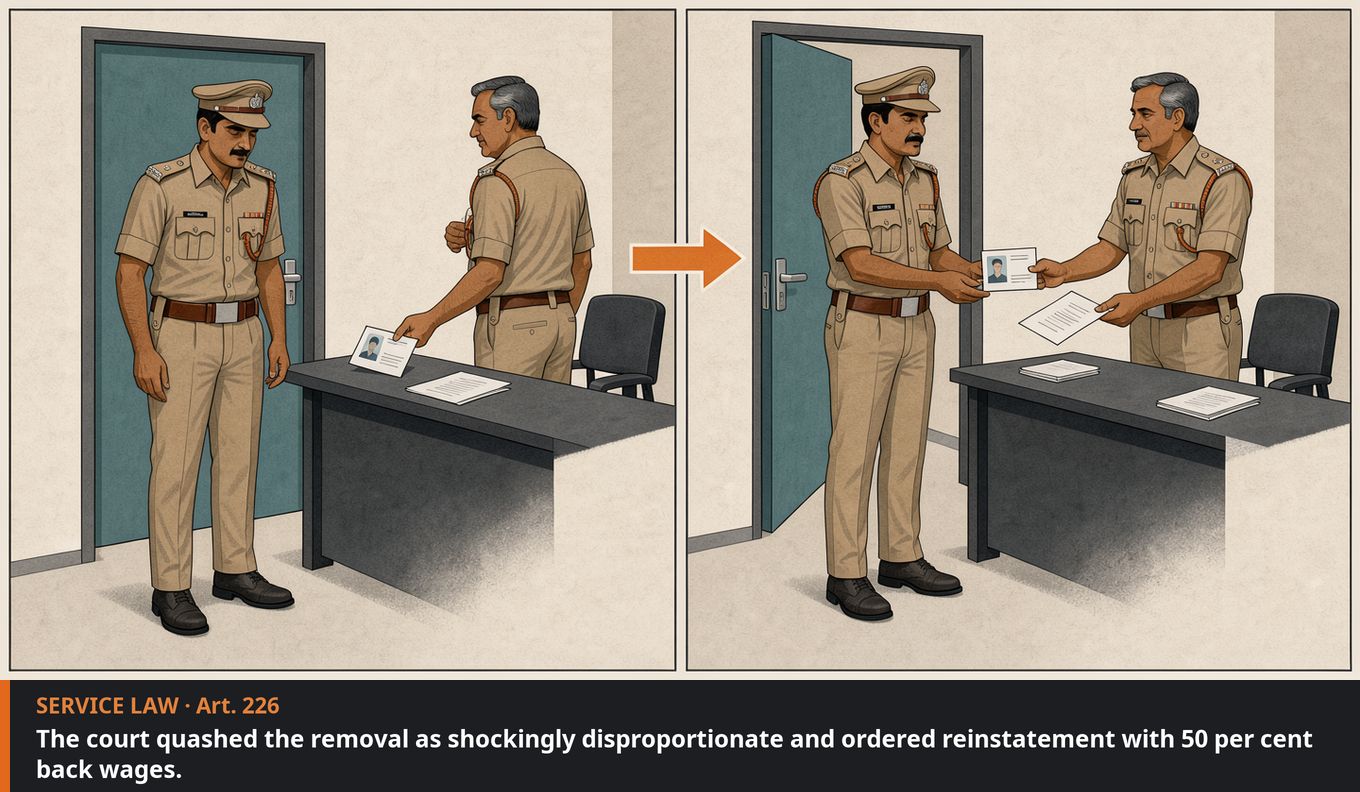
Supreme Court quashes removal of CISF constable as shockingly disproportionate, orders reinstatement
Facts that mattered
- The appellant, a CISF constable, sought leave to care for his wife suffering pregnancy complications and miscarriage; his further leave request was declined and he tendered a conditional resignation on 06.12.2017 under mental stress.
- He was charged under Rule 36 of the CISF Rules, 2001 with disobeying an order to appear, intimidating the administration through relatives circulating a video, and a history of five minor penalties.
- His requests for Hindi translations of English documents and for a defence assistant were rejected; translations were supplied only after prosecution evidence and his own examination had closed.
- The Inquiry Officer found all charges proved and he was removed from service; the High Court upheld the penalty, but the Supreme Court quashed it and ordered reinstatement with 50% back wages.
Legal concepts
A punishment so disproportionate to the misconduct proved as to shock the conscience of the Court is arbitrary and offends Article 14, justifying interference.
Reaffirmed · para 13 · Bhagat Ram v. State of Himachal Pradesh & Ors., (1983) 2 SCC 442, para 13
Interference in disciplinary matters is warranted where proceedings violate natural justice or statutory rules, findings are unsupported by evidence, or the conclusion is one no reasonable person could reach.
Reaffirmed · para 12 · State of Andhra Pradesh & Ors. v. S. Sree Rama Rao, 1963 SCC OnLine SC 6, para 11
Previous misconduct for which an employee has already faced disciplinary action cannot itself be treated as fresh misconduct, though past record may be considered in fixing penalty for independently established misconduct.
Laid down · para 20
The sentence must suit the offence and the offender; it should not be vindictive, unduly harsh, or so disproportionate as to shock the conscience.
Reaffirmed · para 24 · Ranjit Thakur v. Union of India, para 24
Read the judgment
D-0061 · 16.11.2026 · s. 378
Delhi Development Authority v. Rajender Kumar Sharma, C.A. No.-014204-014204 - 2026
Bench: HON'BLE MR. JUSTICE PRASHANT KUMAR MISHRA, HON'BLE MR. JUSTICE SHREE CHANDRASHEKHAR (2 judges). Judgment by HON'BLE MR. JUSTICE PRASHANT KUMAR MISHRA
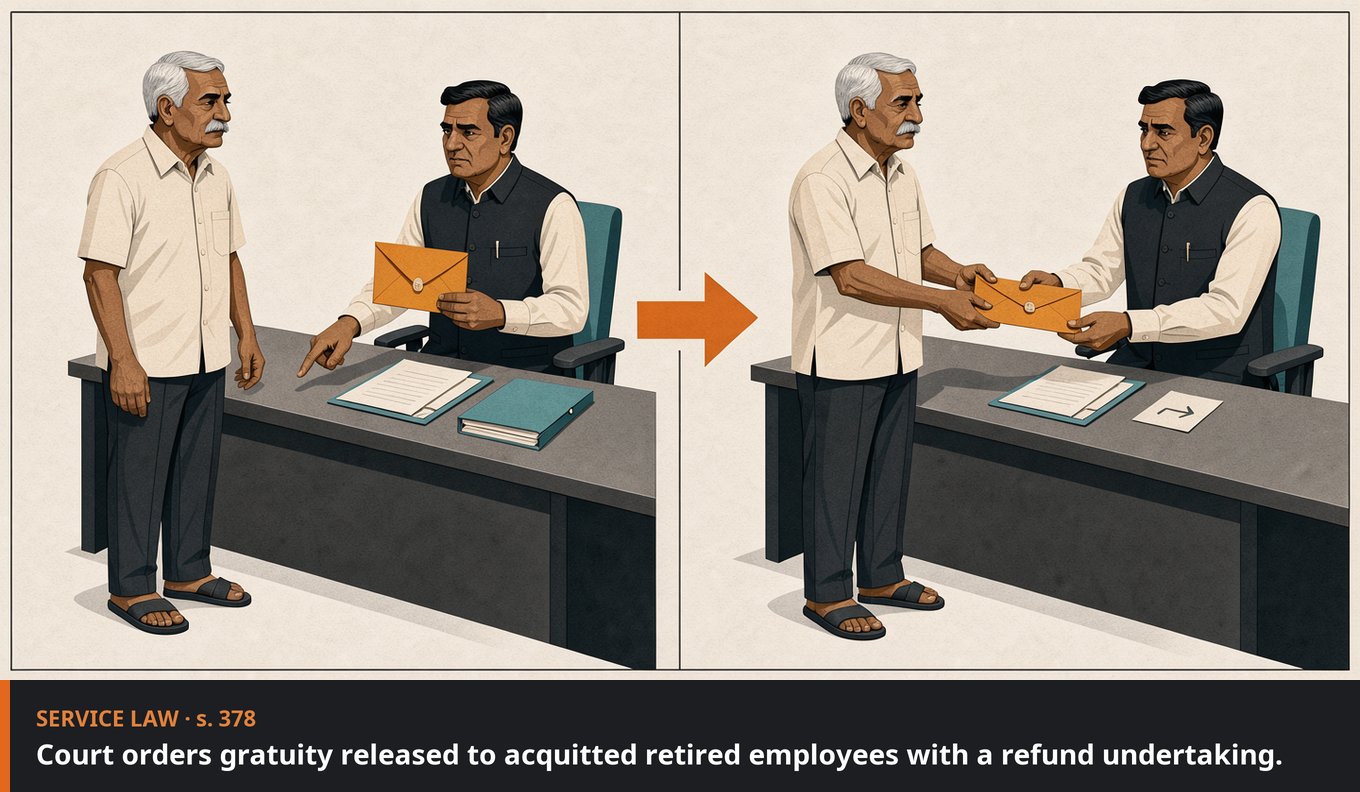
Gratuity of acquitted retired employees must be released subject to refund undertaking
Facts that mattered
- The respondents were acquitted by a Special Judge in 2017 in a corruption case, but the State filed a Section 378 CrPC leave petition before the High Court, which remains pending since 2017.
- The Authority withheld the respondents' gratuity under Rule 69(1)(c) of the CCS (Pension) Rules, 1972, citing the pendency of the criminal proceedings.
- The Tribunal directed release of gratuity with interest subject to an undertaking to refund if the pending proceedings concluded against the respondents, relying on Kishan Lal Taneja.
- The High Court affirmed the Tribunal's orders, and the Authority's challenge that Kishan Lal Taneja was per incuriam was rejected.
Legal concepts
Mere pendency of a Section 378 CrPC application against an acquittal, with no stay of the trial court's judgment, cannot justify withholding terminal dues of retired employees after long years of service.
Reaffirmed · para 11 · Kishan Lal Taneja vs. Government of NCT Delhi and Ors., para 8
Requiring a refund undertaking balances safeguarding public funds against a retired employee's right to terminal benefits earned over decades of service.
Laid down · para 13
Where the trial has concluded with a final order of acquittal, the statutory embargo on paying gratuity under Rule 69(1)(c) no longer applies, and the acquittal holds the field until disturbed in appeal.
Laid down · para 12
Read the judgment
D-0058 · 16.11.2026 · Art. 226
Mithilesh Kumar Pathak v. Union of India, C.A. No.-004411-004411 - 2011
Bench: HON'BLE MR. JUSTICE SATISH CHANDRA SHARMA, HON'BLE MR. JUSTICE NONGMEIKAPAM KOTISWAR SINGH (2 judges). Judgment by HON'BLE MR. JUSTICE SATISH CHANDRA SHARMA
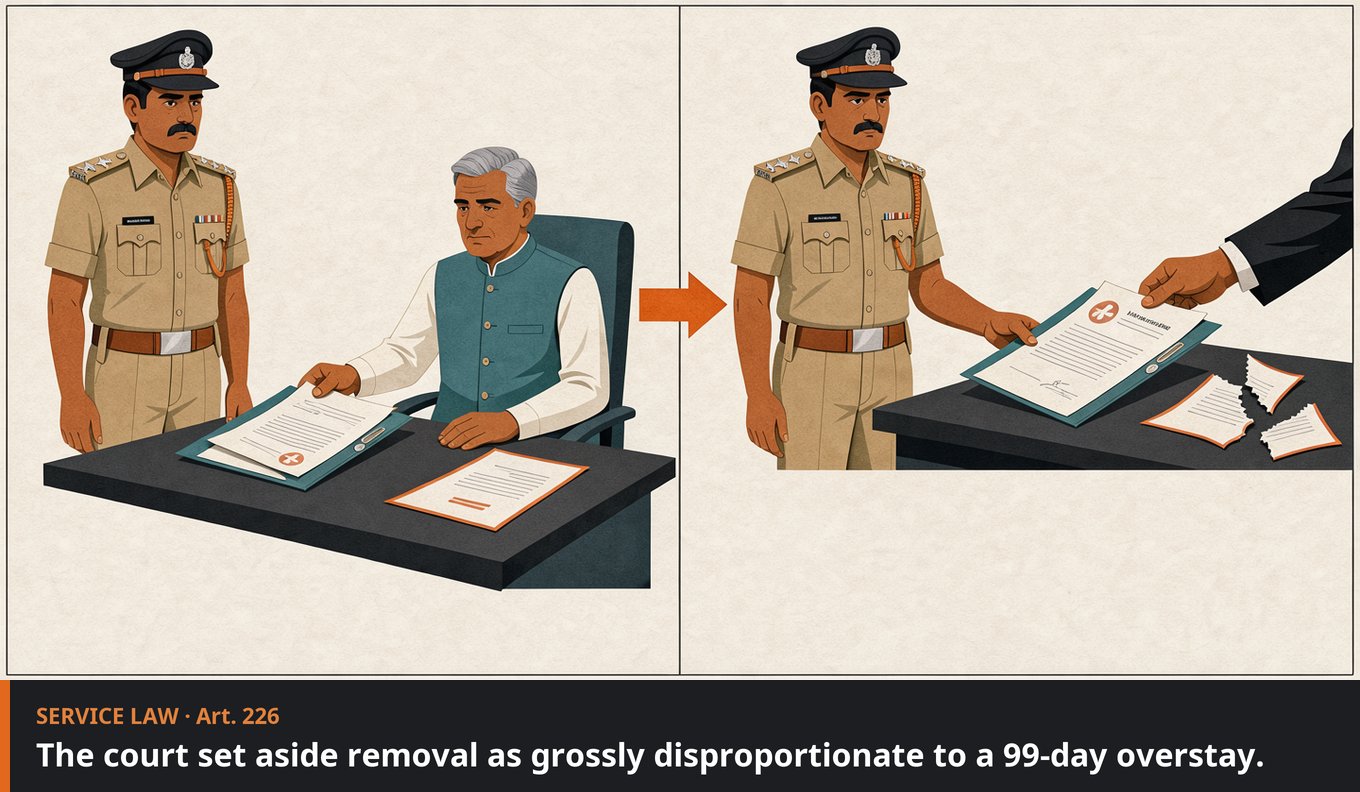
Removal of constable for 99-day overstay set aside as grossly disproportionate
Facts that mattered
- The appellant, a CRPF constable, took casual leave for his wife's illness but overstayed by 99 days, failing to respond to two registered letters directing him to report for duty.
- He produced medical documents showing treatment for infective hepatitis, but the Enquiry Officer disbelieved them because they lacked an outpatient number and appeared written with the same pen.
- The Enquiry Officer inferred fabrication without verifying with the treating doctor or medical establishment, and removal from service was imposed.
- The Division Bench restored the removal, holding the Single Judge had reappreciated evidence, but the Supreme Court found the rejection of medical documents rested on conjecture.
Legal concepts
High Court may interfere in disciplinary matters only where natural justice is violated, statutory rules breached, extraneous considerations influenced the decision, or the conclusion is wholly arbitrary and capricious.
Reaffirmed · para 8 · State of Andhra Pradesh & Ors. v. S. Sree Rama Rao, 1963 SCC OnLine SC 6, para 8
Disciplinary and appellate authorities are fact-finding bodies with exclusive power to consider evidence; courts cannot normally substitute their own conclusion on penalty unless it shocks the conscience.
Reaffirmed · para 9
Unauthorised absence and wilful absence are not necessarily synonymous; the circumstances of absence, the explanation furnished, and supporting material must be considered before determining the nature and gravity of misconduct.
Laid down · para 10
The punishment imposed must satisfy the requirement of proportionality to the magnitude and gravity of the misconduct, even for members of a disciplined force.
Reaffirmed · para 13
Read the judgment
Other (5)
D-0084 · 19.11.2026 · s. 34
The Gem & Jewellery Export Promotion Cou v. State of Maharashtra ., C.A. No.-001889-001889 - 2015
Bench: HON'BLE MR. JUSTICE S.V.N. BHATTI, HON'BLE MR. JUSTICE N.V. ANJARIA (2 judges). Judgment by HON'BLE MR. JUSTICE S.V.N. BHATTI
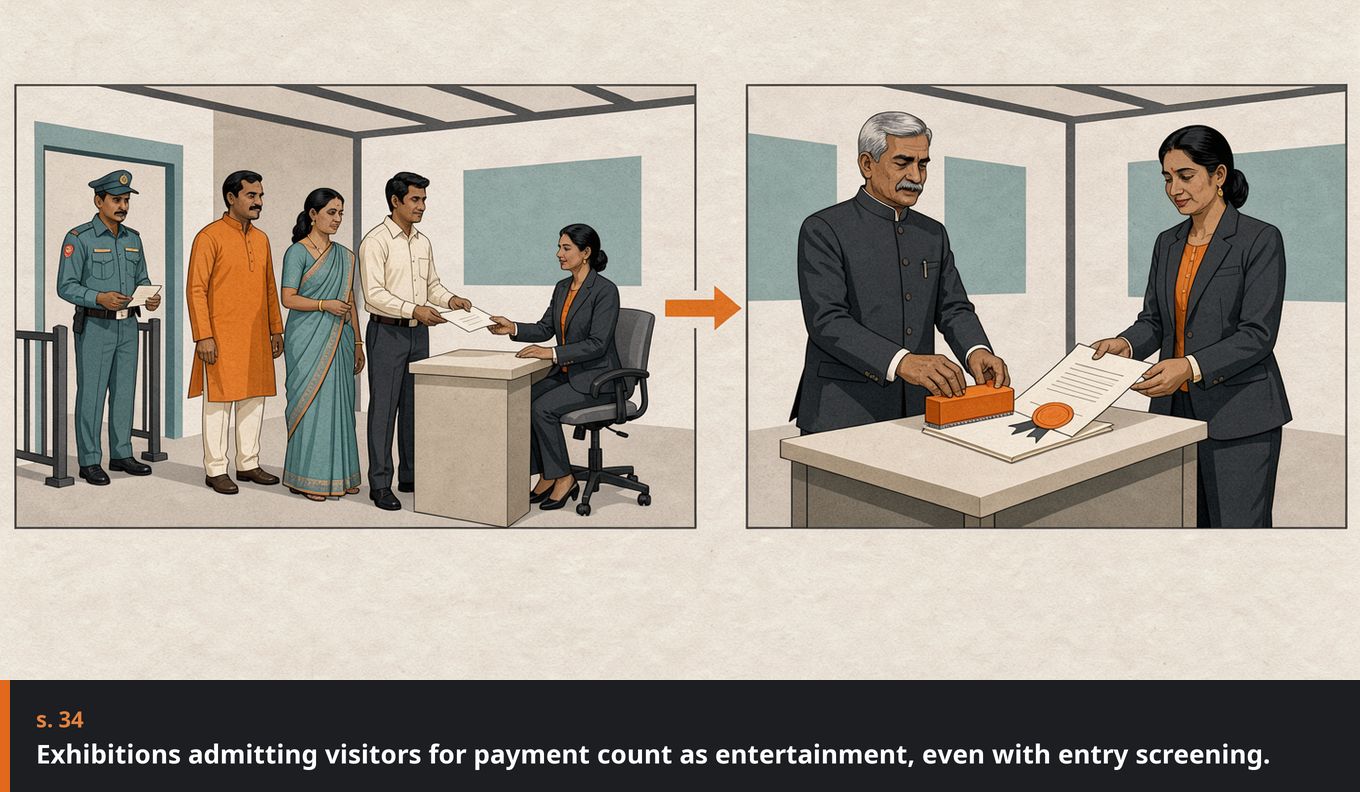
Trade exhibitions admitting visitors on payment are entertainment exigible to duty under the 1923 Act
Facts that mattered
- The Appellant, a Section 25 company, organises the IIJS and IIJS Signature trade exhibitions in Mumbai and deposited entertainment duty under protest to obtain a Collector's NOC.
- The Additional Collector assessed liability of Rs. 97,09,500 for IIJS 2011, and the Divisional Commissioner on appeal reduced it to Rs. 45,40,125 while holding the trade show taxable under Section 2(a) of the Act, 1923.
- The Bombay High Court dismissed the Appellant's writ seeking a declaration that business-to-business exhibitions are not entertainment, prompting the present appeal.
- Entry to the exhibitions is on payment of an entry fee after scrutiny of trade credentials, and the general public and individual consumers are barred from registering.
Legal concepts
An exhibition to which persons are admitted for payment falls within the inclusive definition of entertainment, and a screening or application procedure for entry does not take it outside that definition.
Reaffirmed · para 20 · M/s Geeta Enterprises & Ors. v. State of U.P. & Ors., (1983) 4 SCC 202, para 11
Where a definition clause uses the word includes, the definition is enumerative but not exhaustive, and the defined term retains its ordinary meaning while its scope is extended.
Reaffirmed · para 17 · Bharat Coop. Bank (Mumbai) Ltd. v. Coop. Bank Employees Union, (2007) 4 SCC 685, para 17
An interpretation clause which extends the meaning of a word does not take away its ordinary, popular and natural sense, and is not to be taken as strictly defining the term under all circumstances.
Reaffirmed · para 18 · Forest Range Officer & Ors. v. P. Mohammed Ali & Ors., para 18
Read the judgment
D-0083 · 18.11.2026 · s. 29
Power Grid Corporation of India Limited v. Tangedco, C.A. No.-014780-014781 - 2025
Bench: HON'BLE MR. JUSTICE J.B. PARDIWALA, HON'BLE MR. JUSTICE K. VINOD CHANDRAN (2 judges). Judgment by HON'BLE MR. JUSTICE K. VINOD CHANDRAN
Supreme Court restores CERC order, holding LILOs used in transmission and tariff claim sustainable

Facts that mattered
- PGCIL, the Central Transmission Utility, commissioned two LILOs on the Tuticorin JV-Madurai 400kV line at Tuticorin Pooling Station on 04.01.2015 and 08.01.2015, part of the transmission scheme approved in the 30th Standing Committee Meeting and the Bulk Power Transmission Agreement.
- The generating company, Coastal Energen (now Moxie Power), delayed constructing its dedicated transmission line to the Tuticorin Pooling Station until 27.10.2016, while upstream lines to Salem and Madhugiri were commissioned only later.
- CERC accepted the COD and cast transmission charges on the generating company till DTL commissioning; APTEL set this aside, holding the LILOs were not put to beneficial use since upstream lines were not operational.
- The Supreme Court found power was necessarily diverted through the LILOs to the Pooling Station and restored the CERC order, allowing PGCIL's non-PoC tariff claim for 04.01.2015 to 27.10.2016.
Legal concepts
Regulation 4(3)(ii) of the Tariff Regulations applies only where regular service of a transmission element is prevented by delay in commissioning the generating station or the upstream or downstream transmission system, not attributable to the transmission licensee.
Laid down · para 40
COD of a transmission element is the date declared by the transmission licensee after successful trial operation and issue of the RLDC certificate, so no redetermination under Regulation 4(3)(ii) is warranted where regular service was not prevented.
Reaffirmed · para 41
CERC may impose liability on a defaulting party under Section 79(1) even in the absence of a regulation framed under Section 178, provided the levy is reasonable.
Reaffirmed · para 45 · Energy Watchdog v. Central Electricity Regulatory Commission and Ors. Etc., (2017) 14 SCC 80, para 45
Decisions of the Standing Committee taken under Section 29(4) of the Electricity Act in furtherance of grid stability and coordinated transmission planning have legal sanctity and bind all stakeholders.
Reaffirmed · para 47
Read the judgment
D-0072 · 17.11.2026 · s. 34
Har Parsad Gaur v. State(nct of Delhi), Crl.A. No.-000571-000571 - 2015
Bench: HON'BLE MR. JUSTICE UJJAL BHUYAN, HON'BLE MR. JUSTICE ATUL S. CHANDURKAR (2 judges). Judgment by HON'BLE MR. JUSTICE UJJAL BHUYAN
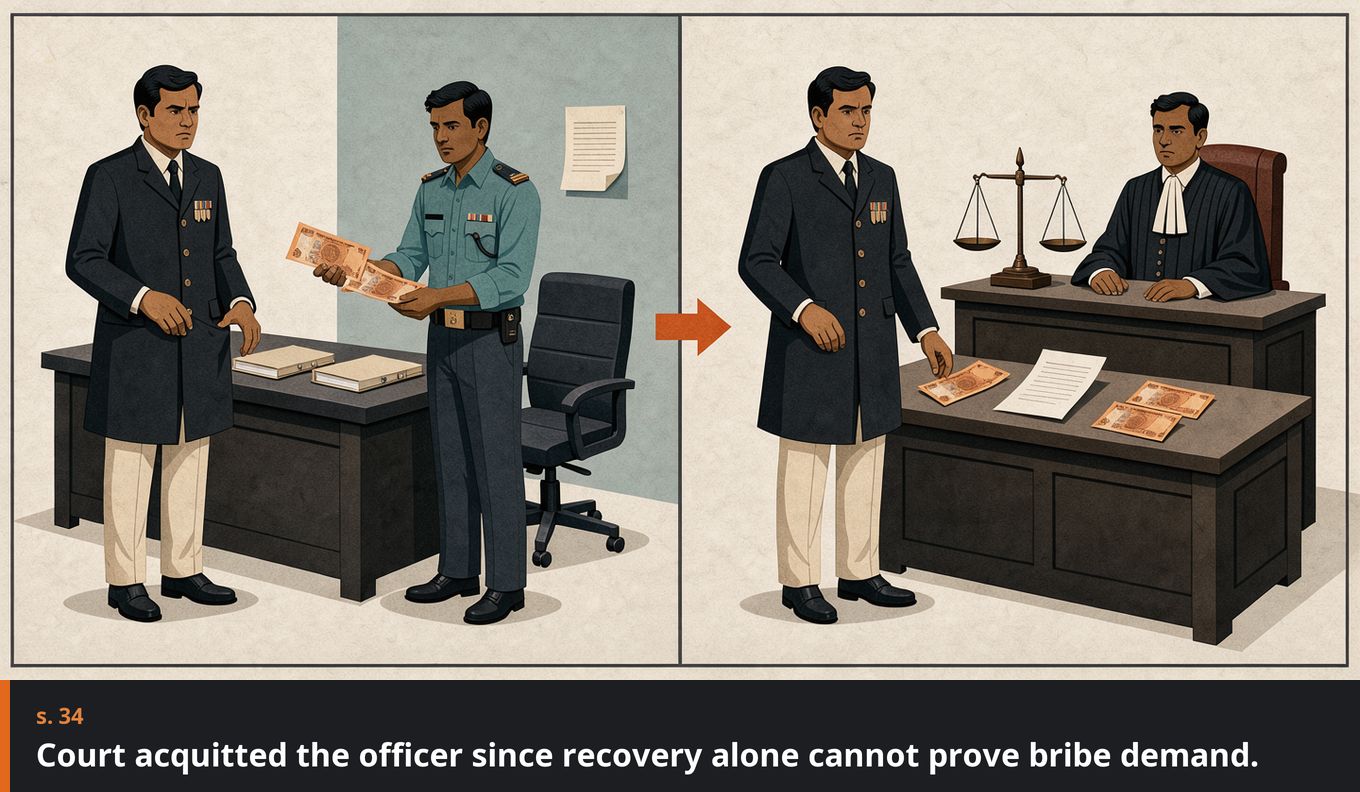
Acquittal as no proof of bribe demand; Section 20 presumption cannot rest on recovery alone
Facts that mattered
- The appellant, a Tehsildar, was convicted under Sections 7 and 13(1)(d) of the Prevention of Corruption Act for demanding and accepting a Rs. 1,000 bribe from a labour-court decree holder.
- The complainant and the panch witness both died before their depositions could be recorded, leaving only the trap officer's testimony about what the panch witness relayed to him.
- Tainted currency notes were recovered from the appellant's coat pocket and chemical washes turned pink, but official records showed the recovery cheques had already been dispatched on 28.12.2002.
- The High Court upheld conviction relying on the Section 20 presumption, reducing sentence from two years to one year, and the appellant appealed to the Supreme Court.
Legal concepts
Proof of demand of illegal gratification is the sine qua non for an offence under Sections 7 and 13(1)(d)(i) and (ii) of the PC Act; mere recovery of tainted money without proof of demand cannot sustain conviction.
Reaffirmed · para 32 · P. Satyanarayana Murthy Vs. State of A.P., (2015) 10 SCC 152, para 32
The presumption under Section 20 of the PC Act can be invoked only when the two basic facts of demand and acceptance of gratification are proved beyond reasonable doubt.
Reaffirmed · para 34
Hearsay testimony of a trap officer relaying what a deceased panch witness told him is inadmissible and cannot establish demand for and voluntary acceptance of illegal gratification.
Laid down · para 42
To rebut the Section 20 presumption the accused need only establish his defence on the touchstone of preponderance of probabilities, unlike the prosecution's burden of proof beyond reasonable doubt.
Reaffirmed · para 47
Read the judgment
D-0064 · 16.11.2026 · s. 74
M/s Sterling and Wilson Pvt Ltd v. Union of India, C.A. No.-014228-014228 - 2026
Bench: HON'BLE MR. JUSTICE SANJAY KUMAR, HON'BLE MR. JUSTICE SANJEEV SACHDEVA (2 judges). Judgment by HON'BLE MR. JUSTICE SANJAY KUMAR
Solar power generating systems held movable, not works contract; 70:30 ratio not mandatory for pre-2019 supplies

Facts that mattered
- The appellant supplied and installed Solar Power Generating Systems on turnkey EPC contracts during 01.07.2017 to 31.12.2018, paying 5% CGST treating the system as goods under Serial No. 234.
- CGST authorities demanded tax applying the 70:30 ratio (5% on 70%, 18% on 30%) for that period relying on Circular No. 163/19/2021-GST, imposing penalty and invoking Section 74 extended limitation.
- The Bombay High Court dismissed the writ petition on the ground of alternate remedy without examining the merits.
- The Court found the SPG system detachable from its civil foundation and held it was not immovable property, so the transaction was not a works contract.
Legal concepts
The 70:30 valuation ratio introduced from 01.01.2019 was only an option available to assessees for earlier periods through Circular No. 163/19/2021-GST, not a mandate compulsorily applicable to all past transactions.
Laid down · para 33
Every composite supply under Section 2(30) is not a works contract under Section 2(119); the contract must relate to activity pertaining to immovable property as an end product.
Reaffirmed · para 36
Extended limitation under Section 74 cannot be invoked where foundational facts showing fraud, wilful misstatement or suppression are not evident from the notice itself.
Reaffirmed · para 34 · M/s Tata Steel Limited vs. Union of India, through the Secretary, Ministry of Finance, and others, 2026 (8) TMI 1587 (SC), para 34
Affixation of an object to something embedded in the earth does not per se make the object immovable property; the tests of annexation, object, intendment, functionality, permanency and marketability apply.
Reaffirmed · para 36
Read the judgment
D-0057 · 16.11.2026 · s. 34
State of Kerala . v. P.krishna Pillai ., C.A. No.-010198-010198 - 2010
Bench: HON'BLE MR. JUSTICE PAMIDIGHANTAM SRI NARASIMHA, HON'BLE MR. JUSTICE ALOK ARADHE (2 judges). Judgment by HON'BLE MR. JUSTICE PAMIDIGHANTAM SRI NARASIMHA
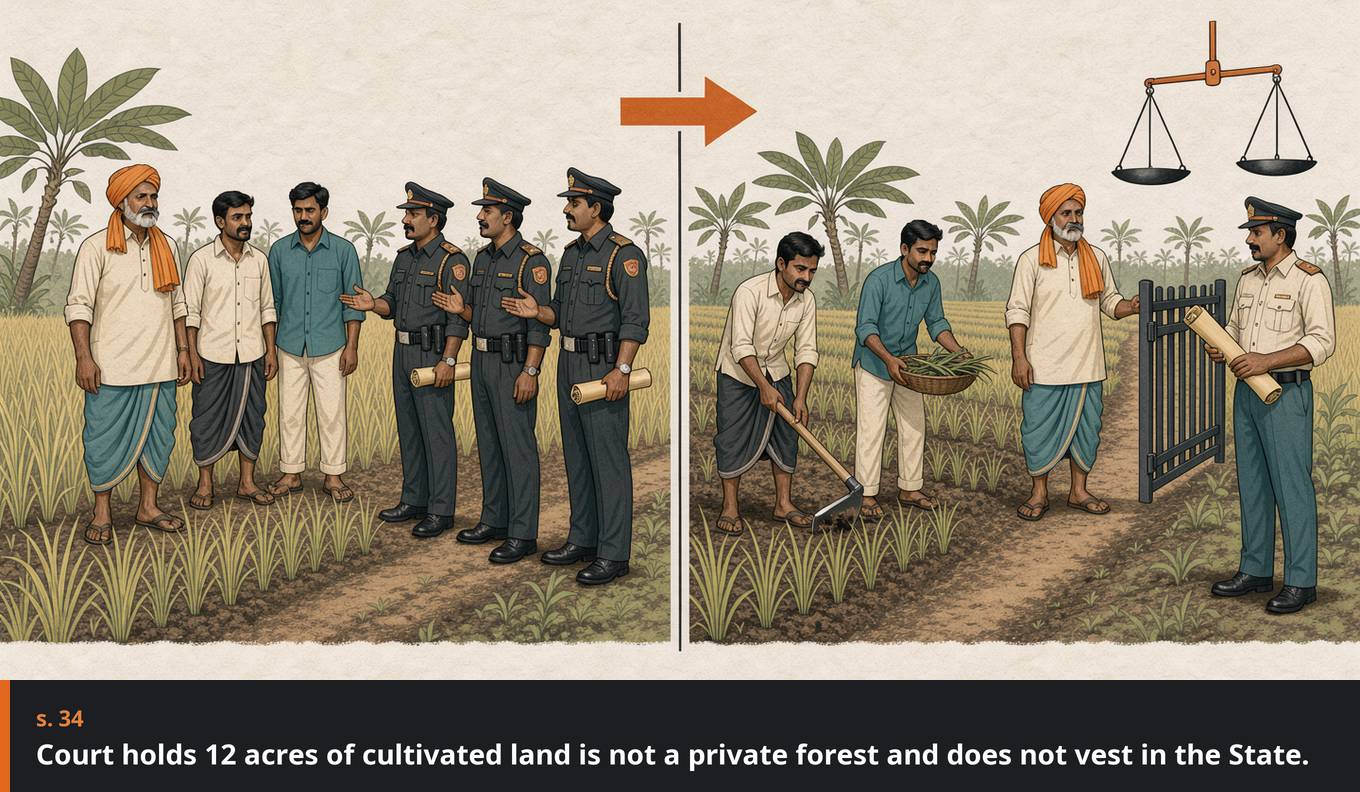
Supreme Court upholds finding that 12 acres in Malappuram is not a private forest vesting in the State
Facts that mattered
- The respondents' father held the 12-acre subject land in cultivating possession, growing paddy and tapioca, until his death in 1976.
- Forest officials obstructed agricultural operations in 1988, and the respondents applied under Section 8 of the Kerala Private Forests (Vesting and Assignment) Act, 1971 for a declaration that the land is not a private forest.
- The Forest Tribunal and the High Court both held the land was not a private forest on the appointed day, 10.05.1971, and did not vest in the Government.
- Before this Court the State produced for the first time a 1900 notification under the Madras Forest Act, 1882, which had never been filed before the Tribunal or the High Court.
Legal concepts
Vesting of private forests in the Government under Section 3(1) of the Kerala Private Forests (Vesting and Assignment) Act, 1971 is automatic from the appointed day and does not depend on demarcation of boundaries or issuance of a notification under Rule 2A of the Rules.
Laid down · para 19
In a proceeding under Section 8 of the Act, the burden of proving that land is not a private forest lies on the person asserting it, but the standard of proof is only preponderance of probabilities.
Reaffirmed · para 21 · Kunjanam Antony v. State of Kerala, (2003) 3 SCC 221, para 21
Additional evidence may be admitted at the appellate stage only if the party proves that despite due diligence it could not be produced earlier; it cannot be used to fill up lacunae or set up a new case.
Reaffirmed · para 24
The word 'forest' means a large tract of uncultivated land covered with trees and underwood, excluding lands on which human skill and labour have been spent for agricultural operations.
Reaffirmed · para 23 · Bhavani Tea and Produce Co. Ltd. v. State of Kerala, (1991) 2 SCC 463, para 23
Read the judgment