Constitution of India (4)
D-0110 · 26.11.2026 · Art. 21
3S and Our Health Society v. Union of India, MA-001177 - 2025
Court directs FSSAI to adopt interpretive warning labels with pictograms as nutrients-of-concern labelling
Facts that mattered
- A non-profit organisation filed a writ petition seeking mandatory front-of-package nutrition labelling (FoPNL) to curb consumption of foods high in saturated fat, sugar and salt linked to non-communicable diseases.
- FSSAI's 2022 draft amendment proposed a star-rating Indian Nutrition Rating format, but over 14,000 public comments and stakeholder consultations showed no consensus, with consumers favouring warning labels.
- The Court directed FSSAI's Expert Committee to report on the comments; the Committee recommended interpretive warning labels over non-interpretive formats.
- FSSAI later proposed a label restating daily limits for added fat, added sugar and salt from the Dietary Guidelines for Indians, 2024, which the Court found would undermine the FoPNL's purpose.
Legal concepts
Introducing an interpretive front-of-package nutrition labelling framework is a reasonable measure through which the fundamental rights to health, food and informed choice under Article 21 can be secured.
Laid down · para 111
Because the interpretive FoPNL is a measure through which fundamental rights find expression, a concomitant duty is enjoined upon the State to ensure the framework is not only proposed but also capable of appropriate and effective implementation.
Laid down · para 112
The right to health, and the right to choice and information, cannot be made subject to a consumer's literacy, language or means, and the FoPNL must be designed so that it serves every consumer alike.
Laid down · para 157
FSSAI should adopt total sugars and saturated fat, along with salt, as the nutrients-of-concern for the FoPNL rather than added sugar and added fat.
Laid down · para 141
Read the judgment
D-0108 · 26.11.2026 · Art. 227
M/s. Fenkin Infotech Llp v. Aniruddh Nikhil Makhecha, C.A. No.-014734-014734 - 2026
Bench: HON'BLE MR. JUSTICE PAMIDIGHANTAM SRI NARASIMHA, HON'BLE MR. JUSTICE ALOK ARADHE (2 judges). Judgment by HON'BLE MR. JUSTICE ALOK ARADHE
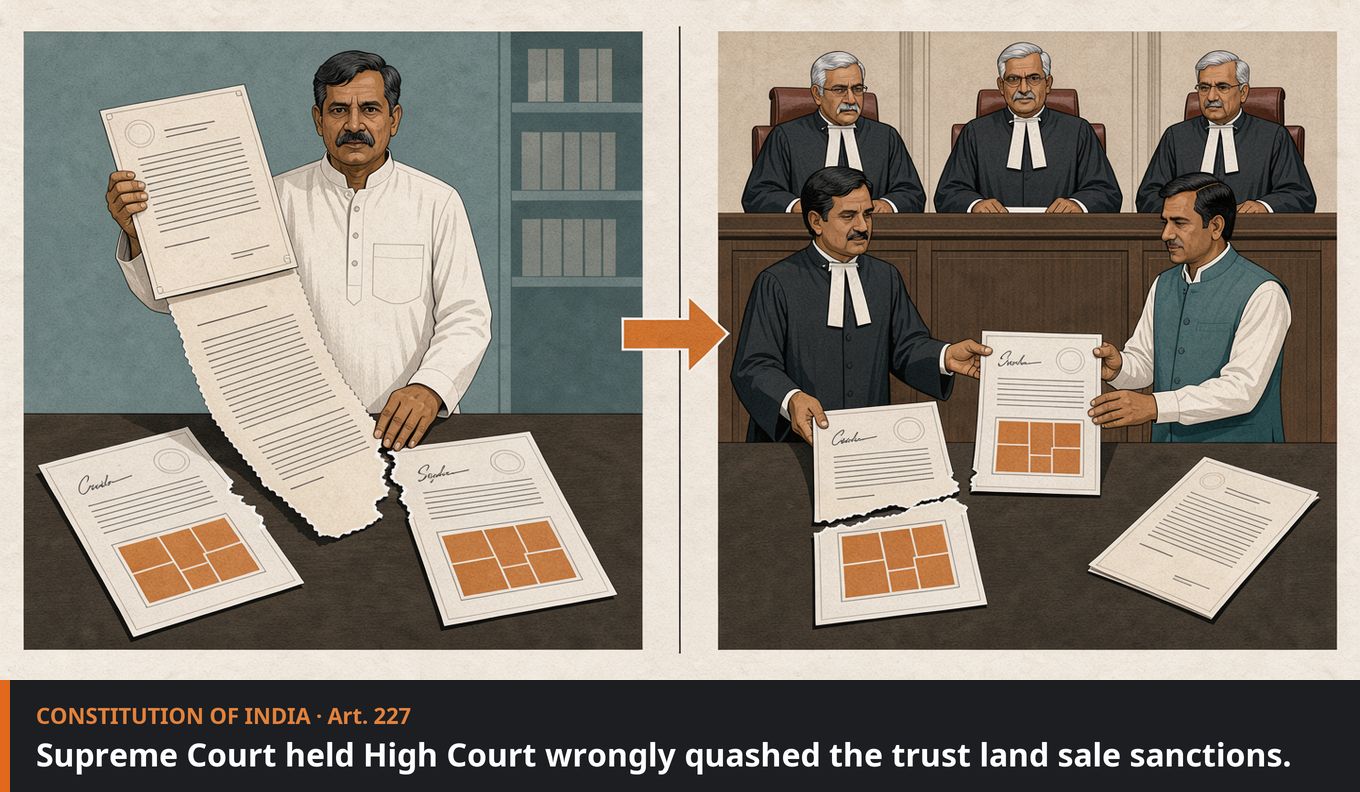
Supreme Court restores Charity Commissioner's sale sanctions, holding High Court exceeded Article 227 jurisdiction
Facts that mattered
- A public trust resolved to sell two parcels of land at villages Vadavali and Owale, citing hilly marshy terrain, encroachments, litigation and meagre income, and invited bids through public notices in two newspapers.
- The purchaser was the highest bidder for both lands; the Charity Commissioner obtained a second valuation and accorded sanction under Section 36(1)(a) with conditions securing the sale proceeds for the trust's objects.
- A registered conveyance deed was executed for the Vadavali land, and the purchaser later transferred the reserved portion to the Corporation against TDR.
- A former trustee filed writ petitions under Article 227 about seven months after the notices; the High Court quashed the sanctions, annulled the conveyance deed and remitted the proceedings for fresh consideration.
Legal concepts
A reasoned decision taken on elaborate consideration of relevant facts by a subordinate authority cannot be interfered with in exercise of supervisory jurisdiction under Article 227, which is not appellate jurisdiction.
Reaffirmed · para 30 · Garment Craft, (2022) 4 SCC 181, para 29
After execution of a conveyance deed, sanction under Section 36(2) of the Maharashtra Public Trusts Act cannot be revoked except on the ground of fraud practised on the Charity Commissioner.
Reaffirmed · para 33
While granting sanction under Section 36(1)(a), the Charity Commissioner must consider the three classic requirements of interest, benefit and protection of the trust and be objectively satisfied of necessity to dispose of the property.
Reaffirmed · para 28 · Cyrus Rustom Patel v. Charity Commissioner, Maharashtra State and Others, (2018) 14 SCC 761, para 20
Section 36 does not contemplate a trial; the Charity Commissioner is required to arrive at his satisfaction on the material placed before him.
Laid down · para 31
Read the judgment
D-0101 · 25.11.2026 · Art. 226
Ajit Patel v. Evita Co-Operative Housing Society Ltd., C.A. No.-014683-014683 - 2026
Bench: HON'BLE MR. JUSTICE VIKRAM NATH, HON'BLE MR. JUSTICE SANDEEP MEHTA, HON'BLE MR. JUSTICE APARESH KUMAR SINGH (3 judges). Judgment by HON'BLE MR. JUSTICE VIKRAM NATH
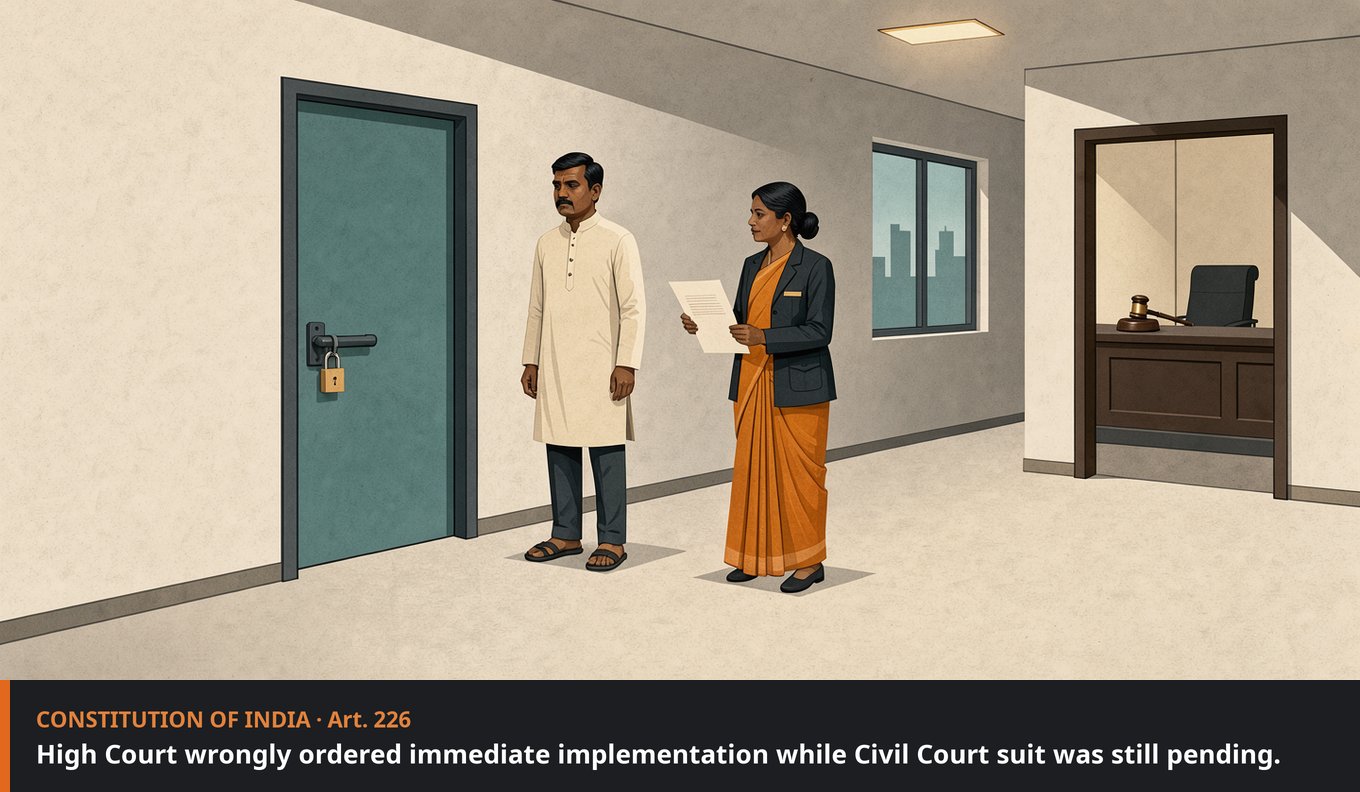
High Court erred in Article 226 directing implementation of order pending before Civil Court
Facts that mattered
- The appellant purchased four flats in the Evita high-rise under registered agreements, claiming the corresponding terrace areas were conveyed to him as an integrated arrangement.
- The Society alleged the terrace was a fire refuge area under the Fire NOC and could not be sold, and complained of encroachment by the appellant.
- The MCGM issued a notice and speaking order directing removal of alleged unauthorised works, which the appellant challenged in a pending Civil Court suit.
- The High Court, in a writ petition, directed the Corporation to immediately implement its order and opened the common terrace door, prompting this appeal.
Legal concepts
A Court examining a lis under Article 226 is not obliged to entertain a challenge involving seriously disputed factual aspects, which may more appropriately be examined by the competent Civil Court or prescribed statutory authority.
Reaffirmed · para 25
Once a party has availed the jurisdiction of the Civil Court by challenging a statutory order, a High Court direction requiring implementation of that order would adversely bear on the pending suit, virtually making the remedy redundant.
Laid down · para 26
Mandatory directions for immediate implementation of a statutory order have the effect of pre-empting adjudication of seriously disputed questions of fact overlapping with issues pending before the Civil Court, prejudicing the pending suit.
Laid down · para 28
Read the judgment
D-0093 · 20.11.2026 · Art. 131
State of Tamil Nadu v. State of Karnataka, MA-002445 - 2026
Bench: HON'BLE MR. JUSTICE VIKRAM NATH, HON'BLE MR. JUSTICE APARESH KUMAR SINGH (2 judges). Judgment by HON'BLE MR. JUSTICE VIKRAM NATH
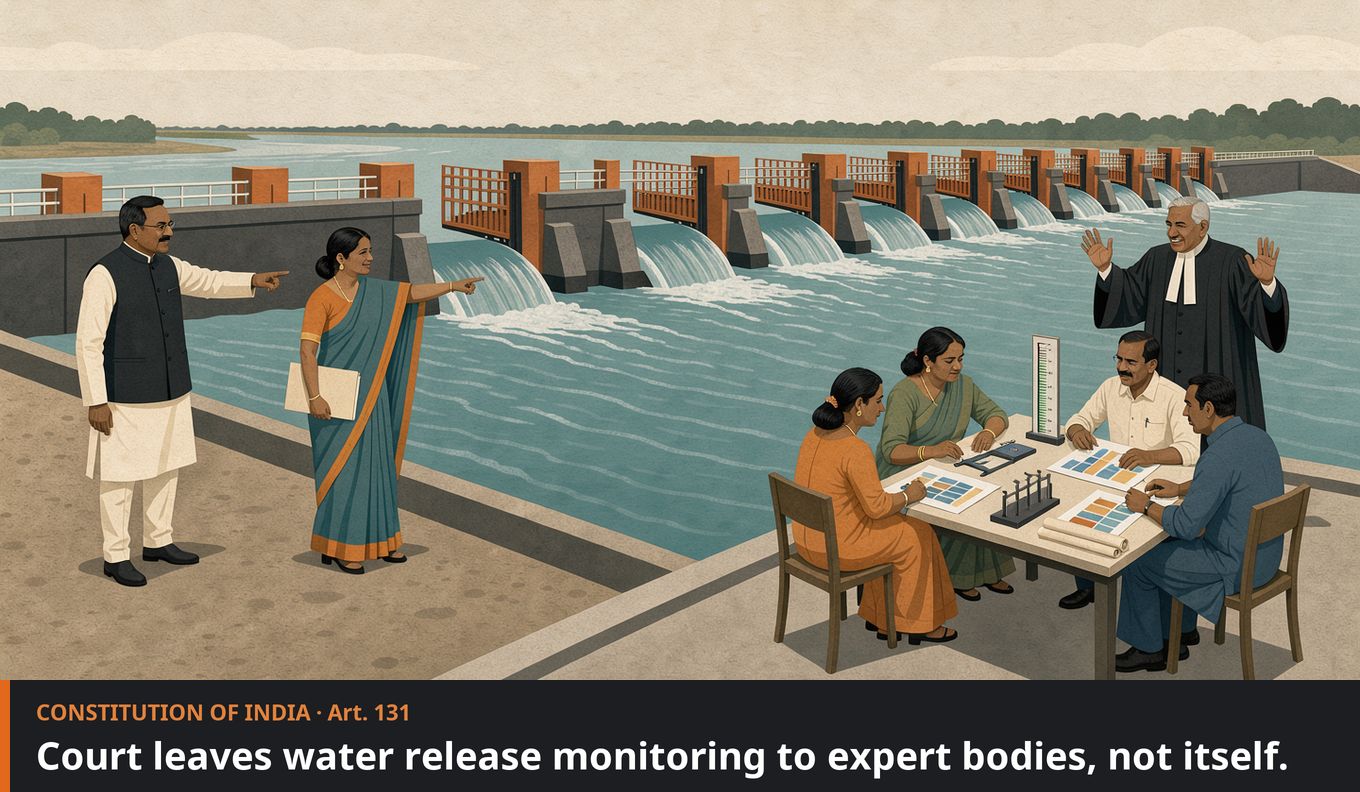
Court declines to monitor Cauvery releases, leaving oversight to CWMA and CWRC
Facts that mattered
- The Cauvery water-sharing dispute among Karnataka, Kerala, Tamil Nadu and Puducherry was adjudicated by the Supreme Court in 2018, modifying the Tribunal's 2007 award.
- The Union of India notified the Cauvery Water Management Scheme in 2018, establishing the CWMA and CWRC to oversee implementation of the water-sharing arrangements.
- Tamil Nadu sought directions against Karnataka for alleged shortfall in water releases at Billigundulu during the 2026-27 irrigation year, citing CWMA decisions.
- Karnataka stated it complied with CWMA directions, and the CWMA recorded in its 58th meeting that there was no backlog shortfall.
Legal concepts
The Supreme Court should not assume the role of monitoring and enforcing a release schedule, a function entrusted to expert bodies constituted under a court-approved scheme.
Laid down · para 13
Assessment of distress and quantification of shortfall across an inter-State river basin fall within the domain of the expert regulatory bodies, not the Court.
Laid down · para 21
The scope of a tribunal's award should not be enlarged by entertaining claims of a person who was not a party to the original proceedings before the tribunal.
Laid down · para 28
Read the judgment
Code of Criminal Procedure, 1973 (5)
D-0109 · 26.11.2026 · s. 482
P. Kathirvel v. State, Crl.A. No.-001192-001192 - 2021
Bench: HON'BLE MR. JUSTICE J.B. PARDIWALA, HON'BLE MR. JUSTICE K. VINOD CHANDRAN (2 judges). Judgment by HON'BLE MR. JUSTICE K. VINOD CHANDRAN
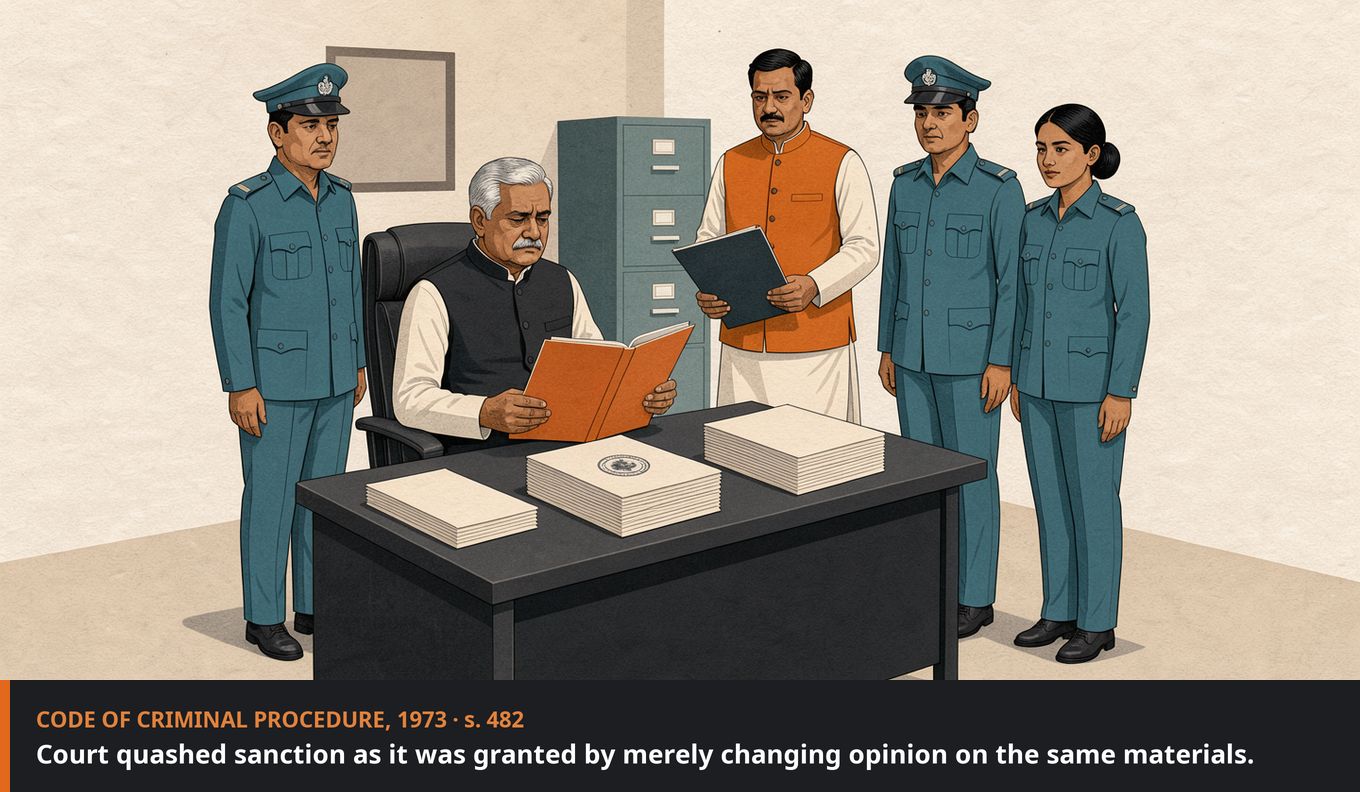
Sanction quashed as change of opinion on same materials; proceedings against two Customs officers dismissed
Facts that mattered
- A Bill of Entry declared imported goods as parts of air conditioners when they were actually complete air conditioners, causing a revenue loss of Rs.42,05,597.
- Four Customs officers were arrayed as accused for alleged collusion and conspiracy in clearing the misdeclared goods.
- The Commissioner of Customs first declined sanction finding no prima facie evidence of criminal conspiracy, but later granted sanction after the Central Vigilance Commission opined in agreement with the CBI without any fresh materials.
- The Examiner had recorded that the goods were complete air conditioners but failed to return the Bill of Entry to the Assessment Wing for reassessment.
Legal concepts
Once the sanctioning authority has exercised its statutory power, it cannot review or reconsider the matter on the same materials, and a mere change of opinion without fresh materials is impermissible.
Reaffirmed · para 12
A mere power coupled with a duty to randomly check goods cannot lead to an inference of criminal culpability; a duty lapse may only be proceeded with departmentally.
Laid down · para 23
Read the judgment
D-0104 · 25.11.2026 · s. 34
Subodh Agarwal v. State of Rajasthan, Crl.A. No.-005568-005568 - 2026
Bench: HON'BLE MR. JUSTICE DIPANKAR DATTA, HON'BLE MR. JUSTICE SHEEL NAGU (2 judges). Judgment by HON'BLE MR. JUSTICE DIPANKAR DATTA
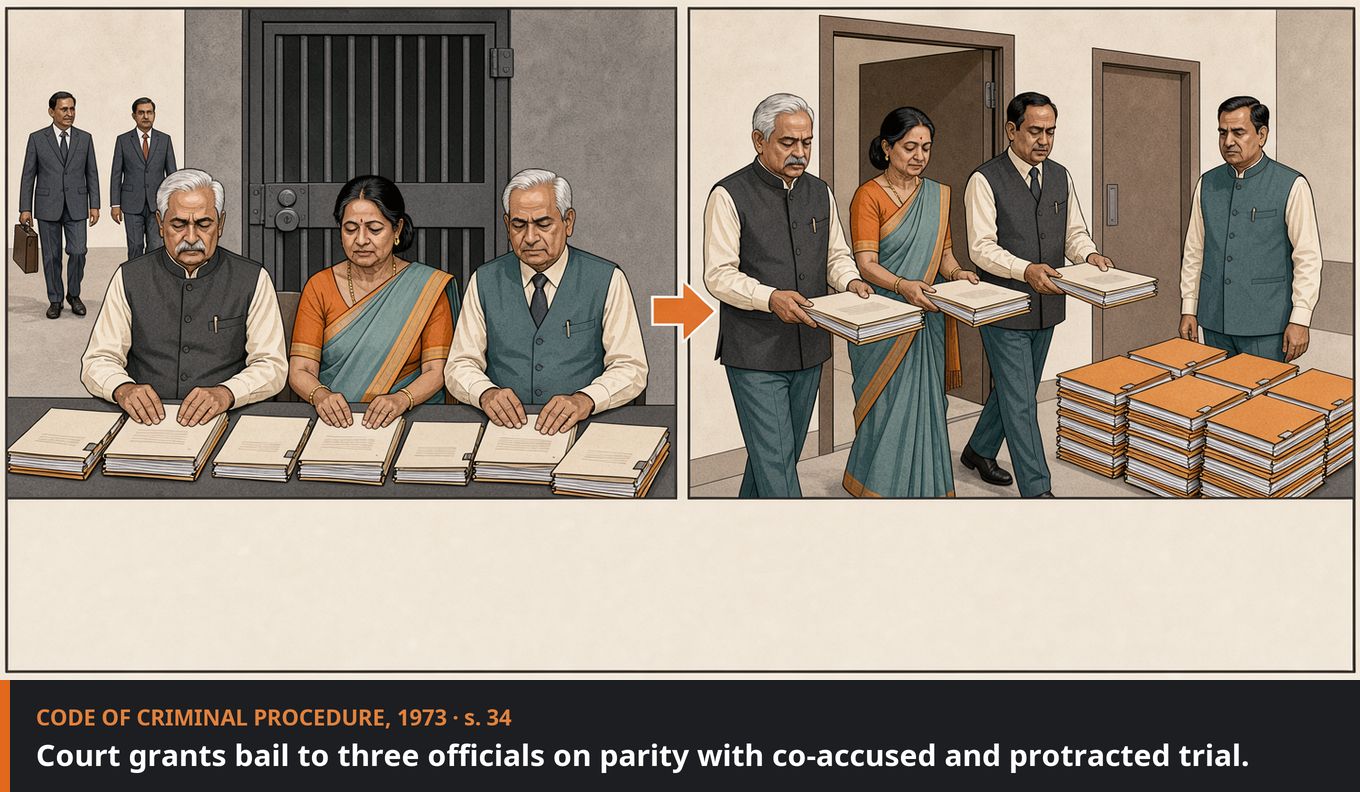
Court grants bail to three PHED officials citing parity with co-accused and protracted trial.
Facts that mattered
- Allegations of large-scale financial impropriety arose from execution of the Jal Jeevan Mission in Rajasthan under a common FIR.
- Two private firms allegedly used forged work-experience certificates to secure about 104 tenders worth Rs. 979.45 crore.
- The appellants, senior PHED officials, were accused of abusing their positions on evaluation and finance committees to facilitate these awards.
- Chargesheets were filed, and several co-accused including the principal political executive had already been granted bail.
Legal concepts
Pre-trial incarceration cannot masquerade as punitive detention, and the severity of allegations cannot serve as an absolute embargo on bail.
Reaffirmed · para 9 · 2026 SCC OnLine SC 2022, para 9
Parity among co-accused in the same conspiracy warrants similar bail terms, especially where others have already been released.
Reaffirmed · para 11
Where investigation is concluded and trial is protracted with voluminous records and many witnesses, continued pre-trial custody serves no purpose.
Laid down · para 10
Read the judgment
D-0103 · 25.11.2026 · s. 43D(5)
Pawankumar Fakirchand Uike v. State of Maharashtra, Crl.A. No.-005571-005571 - 2026
Bench: HON'BLE MR. JUSTICE DIPANKAR DATTA, HON'BLE MR. JUSTICE SHEEL NAGU (2 judges). Judgment by HON'BLE MR. JUSTICE DIPANKAR DATTA
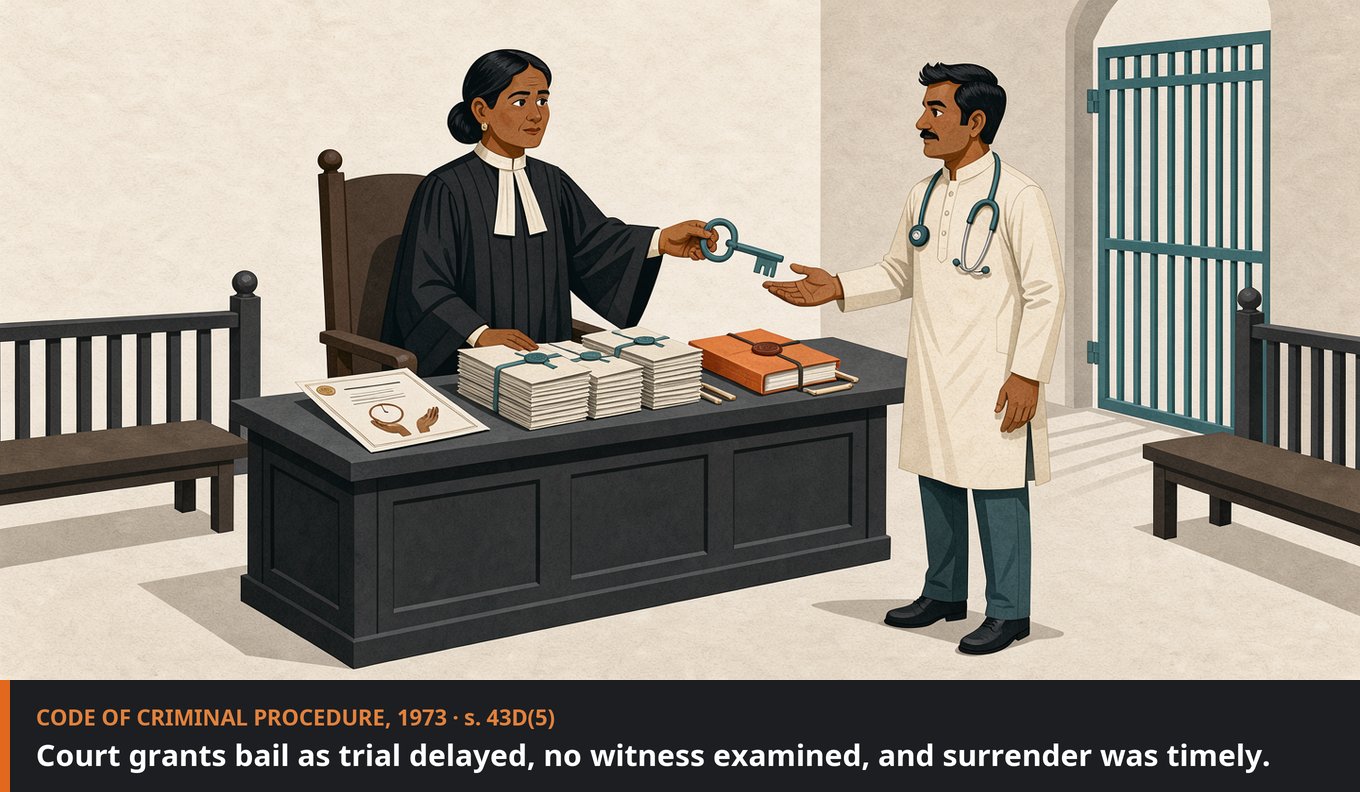
Supreme Court grants bail under UAPA citing trial delay, custody period and High Court's error on surrender
Facts that mattered
- The appellant, a doctor, was arrested in July 2022 in a Naxal-affected forest area after a cloth banner hailing the Naxal movement was seized from him and his co-accused.
- A chargesheet was filed in January 2023 and the case committed to the Sessions Court; the co-accused were granted bail by the High Court in January 2024.
- The High Court rejected his bail in July 2026, attributing trial delay to him and finding he failed to surrender within the stipulated time after temporary bail.
- The custody certificate showed he surrendered on 24th October 2025 per the temporary bail terms, charges were framed only in July 2026, and none of the 39 witnesses had been examined.
Legal concepts
The bail bar under Section 43D(5) of the UAPA does not do away with a Constitutional Court's discretionary power to grant bail on grounds of violation of fundamental rights, particularly where there is undue delay in completion of the trial.
Reaffirmed · para 14
The statutory bar on bail under the UAPA comes into operation when perusal of the material collected against the accused leads the Court to believe the allegations are prima facie true.
Reaffirmed · para 13
A High Court errs grossly in rejecting bail on the ground of belated surrender when the custody certificate on record shows the accused surrendered within the terms of the temporary bail order.
Laid down · para 17
Read the judgment
D-0102 · 25.11.2026 · s. 389
State of Karnataka v. Vinay Rajashekharappa Kulkarni, Crl.A. No.-005556-005556 - 2026
Bench: HON'BLE MR. JUSTICE PRASHANT KUMAR MISHRA, HON'BLE MR. JUSTICE SHREE CHANDRASHEKHAR (2 judges). Judgment by HON'BLE MR. JUSTICE SHREE CHANDRASHEKHAR
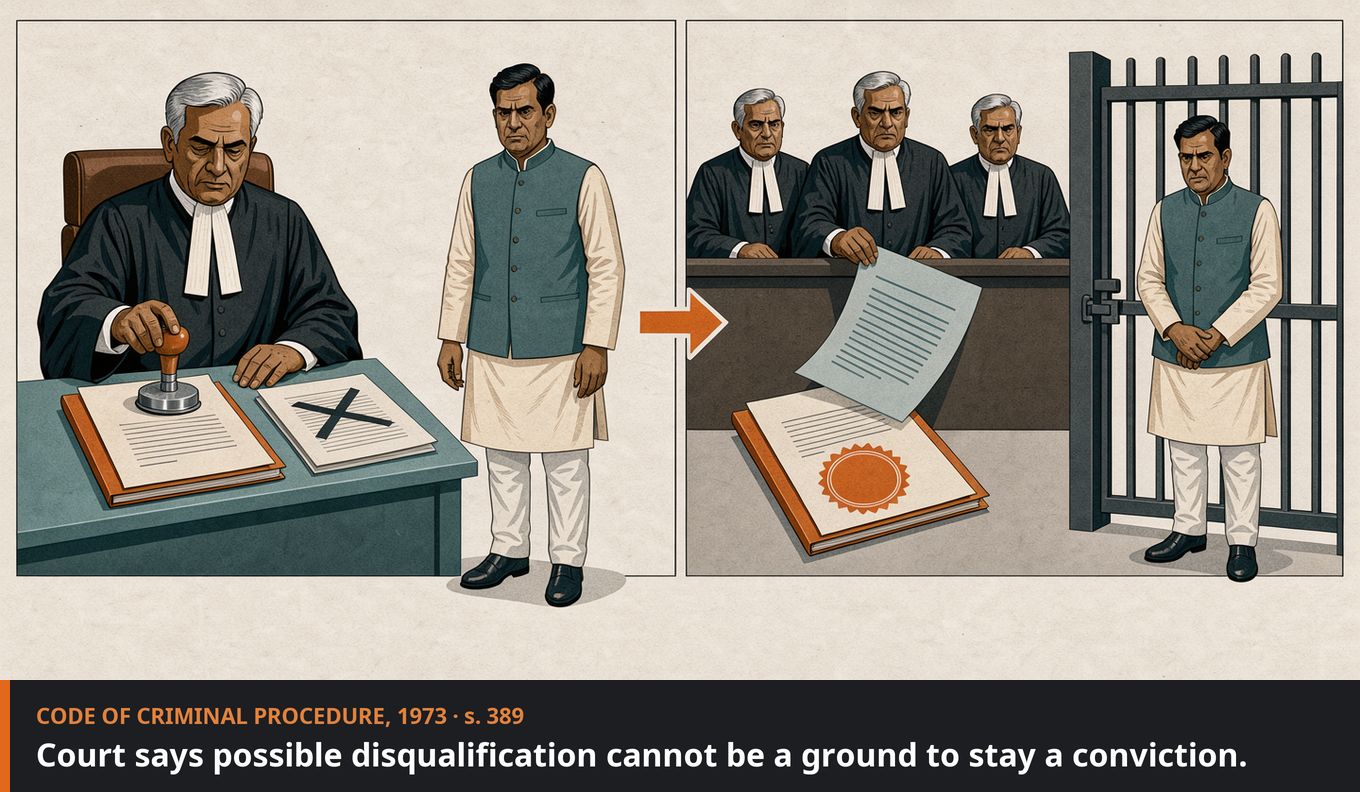
Supreme Court sets aside stay of conviction and suspension of sentence granted to life convicts in murder case
Facts that mattered
- Eight life convicts and an MLA, A-15, convicted of murdering Yogesh Goudar in furtherance of criminal conspiracy, were granted bail by the High Court by suspending sentences and staying A-15's conviction.
- The High Court stayed A-15's conviction reasoning that failure to do so would cause irreversible consequences through disqualification under section 8(3) of the Representation of the People Act, 1951.
- The prosecution case rested substantially on PW10, an approver, with several witnesses including the deceased's wife turning hostile during trial.
- The Supreme Court found the High Court orders did not address the State's contentions nor identify any palpable error in the conviction judgment.
Legal concepts
Stay of conviction requires a higher threshold than a prima facie case: the convict must show a palpable mistake apparent on the face of the record that strikes at the foundation of the conviction.
Laid down · para 12
Possible disqualification of a legislator under section 8(3) of the Representation of the People Act, 1951 cannot be the primary ground to stay a conviction, as every convicted legislator would then be automatically entitled to stay.
Laid down · para 13
Suspension of sentence requires only a good prima facie case with a fair chance of acquittal, a clearly lower threshold than the palpable mistake required for stay of conviction.
Laid down · para 23
The testimony of an approver found truthful by the Court can be the basis for conviction; seeking corroboration is merely a rule of prudence, not a rule of law.
Reaffirmed · para 19 · Rameshwar v. State of Rajasthan, AIR 1952 SC 54: 1951 SCC 1213 : 1951 SCC OnLine SC 83, para 18
Pendency of criminal appeals and remote possibility of early hearing is not a ground to suspend sentence in grave offences like murder.
Laid down · para 22
Read the judgment
D-0096 · 25.11.2026 · s. 34
Deepti Singh v. State of U.P, Crl.A. No.-005555-005555 - 2026
Bench: HON'BLE MR. JUSTICE PRASHANT KUMAR MISHRA, HON'BLE MR. JUSTICE SHREE CHANDRASHEKHAR (2 judges). Judgment by HON'BLE MR. JUSTICE SHREE CHANDRASHEKHAR
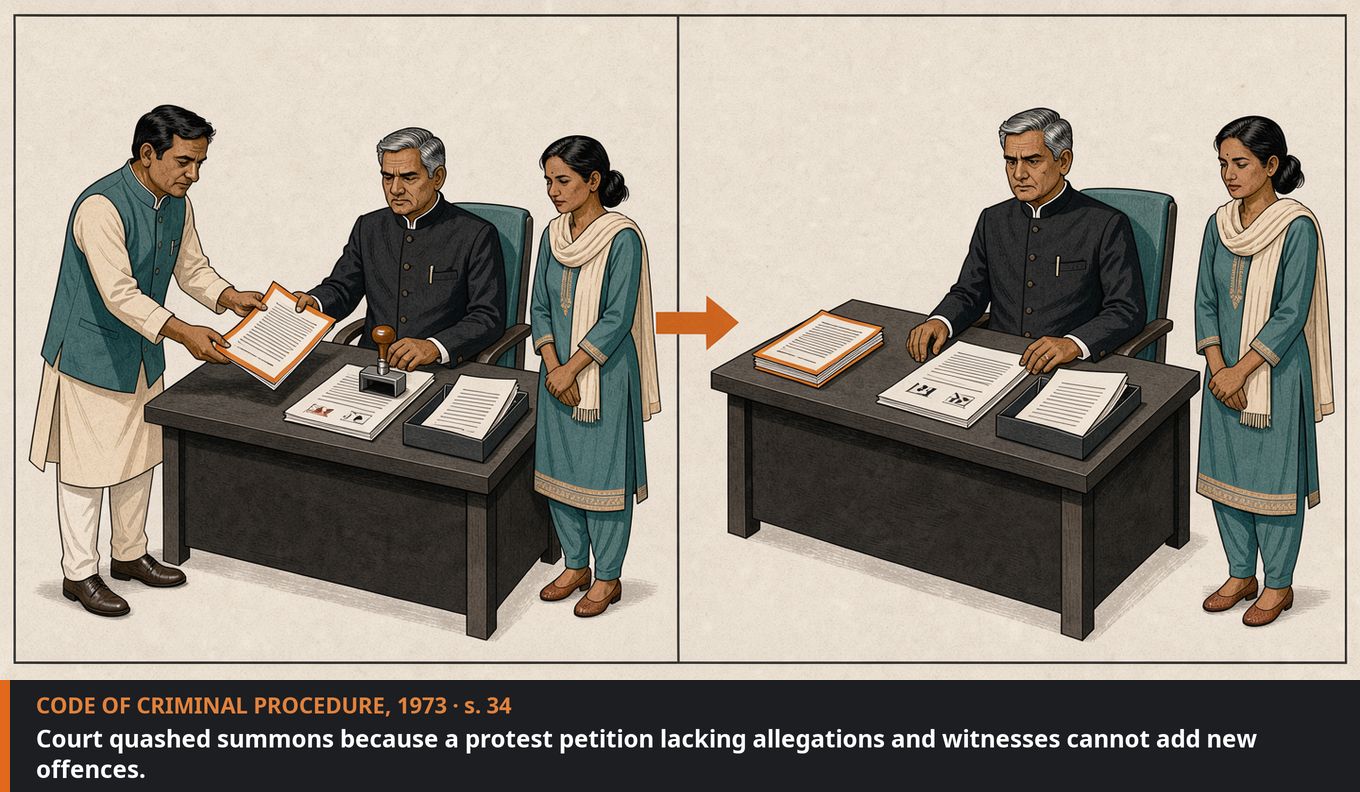
Cognizance on a Protest Petition not meeting complaint requirements is quashed
Facts that mattered
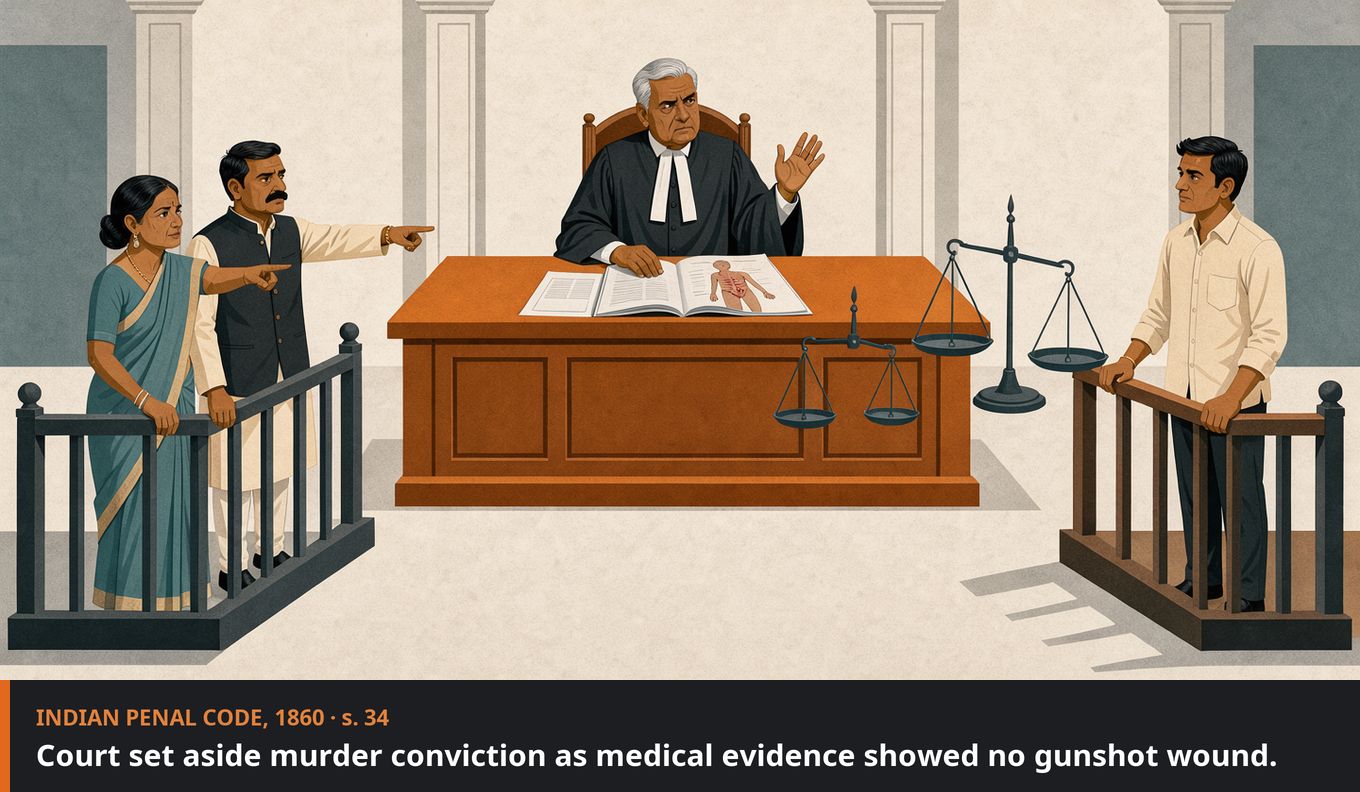
- Crime No. 487 of 2022 was registered under sections 302, 352 and 504 IPC after Abhishek Singh died following an altercation with neighbour Gaurav Singh, husband of the appellant.
- The chargesheet was filed only against Gaurav Singh under sections 323, 504 and 506 IPC, recording that involvement of the appellant was not established.
- The informant filed a Protest Petition, and the Chief Judicial Magistrate took cognizance of offences including murder and issued summons to the appellant and many others.
- The High Court dismissed the quashing application, holding that disputed questions of fact could not be decided at that stage.
Legal concepts
A Protest Petition may be treated as a complaint under Chapter XV only if it contains specific allegations against the accused and a list of witnesses; merely summing up objections to the police investigation does not satisfy the definition of complaint under section 2(d).
Laid down · para 14
When a Magistrate proceeds on a Protest Petition as a complaint, he must follow the Chapter XV procedure, including inquiry under section 202 and the power of dismissal under section 203, before issuing process.
Laid down · para 14
A Magistrate accepting a chargesheet in toto has no power to add any new offence in the order taking cognizance under section 190(1)(b).
Laid down · para 8
An order taking cognizance need not be a reasoned or elaborate order; it is enough that the Magistrate applies his mind to the suspected commission of an offence.
Reaffirmed · para 13 · Kanti Bhadra Shah & Anr. v. State of W.B., (2000) 1 SCC 722, para 13
The High Court's inherent power under section 482 CrPC, preserved under section 528 BNSS, must be exercised where the trial Judge has acted illegally and without jurisdiction, transcending technical barriers.
Reaffirmed · para 15
Read the judgment
Service law (2)
D-0098 · 25.11.2026 · s. 4(1)(14)
Brij Kumar Mishra v. Nilamber Pitambar University, C.A. No.-014678-014678 - 2026
Bench: HON'BLE MR. JUSTICE VIKRAM NATH, HON'BLE MR. JUSTICE SANDEEP MEHTA, HON'BLE MR. JUSTICE APARESH KUMAR SINGH (3 judges). Judgment by HON'BLE MR. JUSTICE VIKRAM NATH
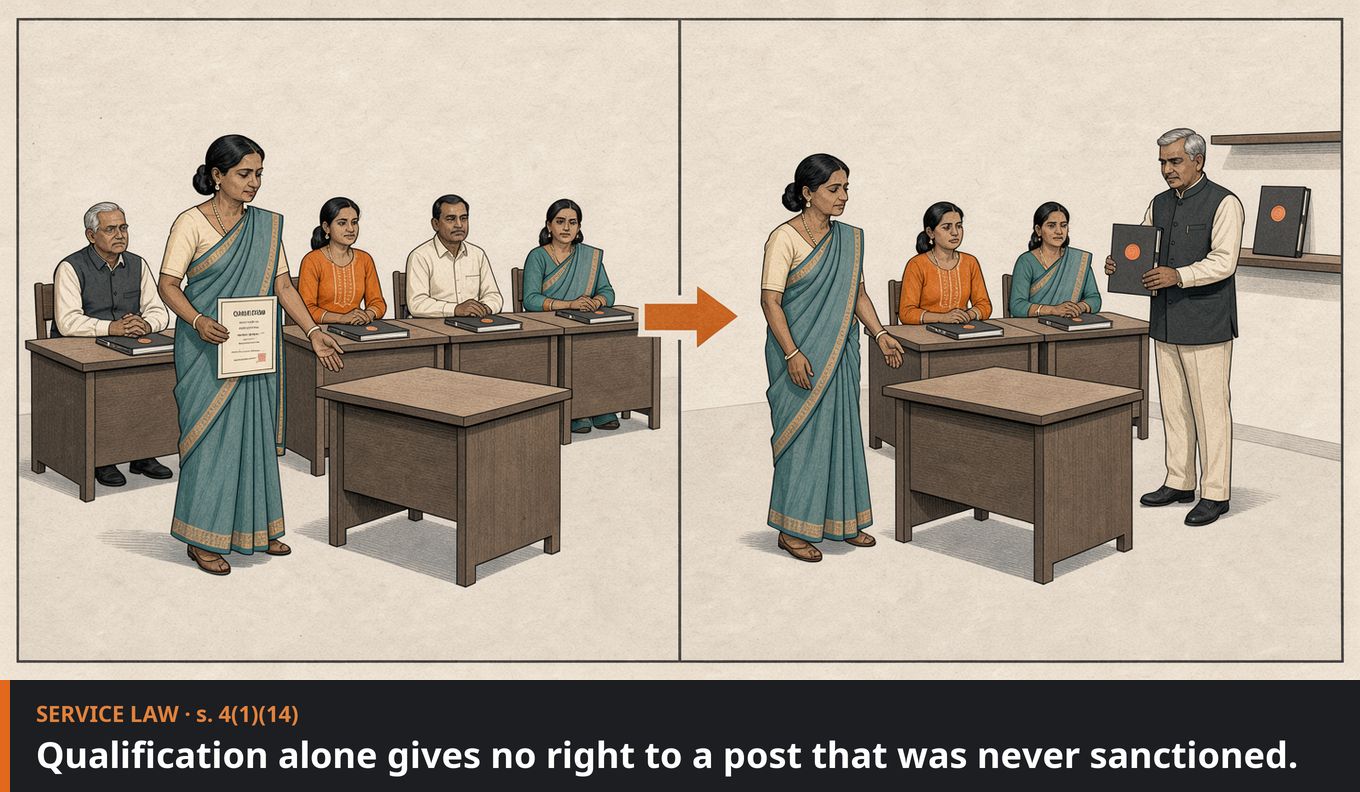
Appeal against absorption from eligibility date dismissed; no right without sanctioned post
Facts that mattered
- The appellant was appointed as Lecturer on a fifth Hindi post on 22.02.1986, but acquired minimum qualifications only on 05.12.1987.
- Only four Hindi Lecturer posts were sanctioned by the cut-off date of 31.03.1987, all held by persons appointed before the appellant.
- The Justice Sinha Commission found the fifth post was never recommended to the State before the cut-off date and upheld absorption from 01.06.2003 when a post fell vacant.
- The Writ Court directed absorption from 05.12.1987 based on Annexure IV-A, but the Division Bench set this aside, and the Supreme Court dismissed the appeal.
Legal concepts
Eligibility is merely a qualifying condition and cannot create a right to absorption where no sanctioned post exists.
Laid down · para 33 · Bihar Rajya MSESKK Mahasangh & Ors., para 33
Absorption must be examined against three categories: appointees on sanctioned posts, posts recommended up to the cut-off date, and posts recommended after or never recommended.
Reaffirmed · para 33 · Bihar Rajya MSESKK Mahasangh & Ors., para 33
Findings of the Justice Sinha Commission on individual absorption claims, made after meticulous adjudication, are appropriate and in accordance with law.
Reaffirmed · para 27 · Krishna Nand Yadav & Ors. vs Magadh University & Ors., para 27
Read the judgment
D-0092 · 20.11.2026 · s. 34
Jc 377745M Ex Sub Maj and Hony Lt Devi Singh v. Union of India, C.A. No.-014606-014606 - 2026
Bench: HON'BLE MR. JUSTICE SATISH CHANDRA SHARMA, HON'BLE MR. JUSTICE NONGMEIKAPAM KOTISWAR SINGH (2 judges). Judgment by HON'BLE MR. JUSTICE SATISH CHANDRA SHARMA
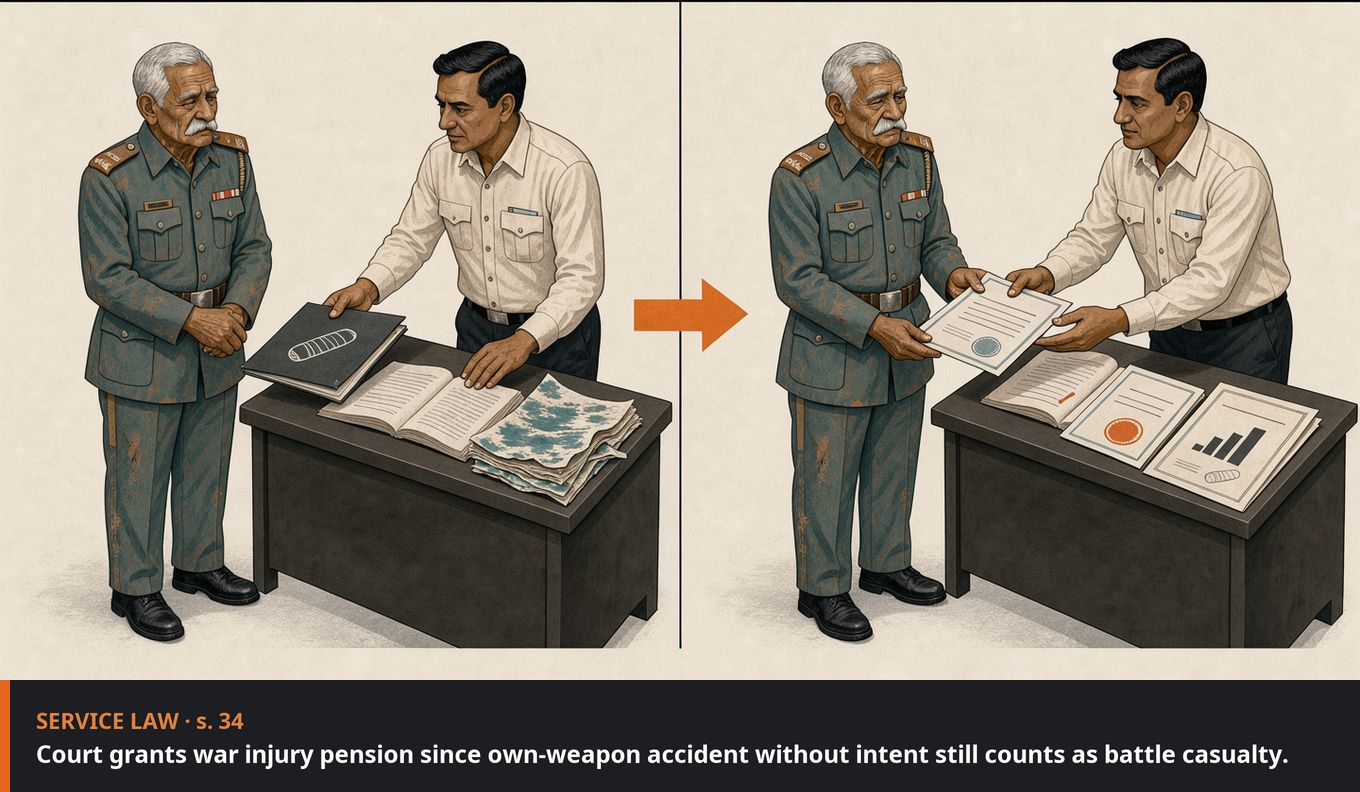
Accidental own-weapon discharge in Operation Rakshak qualifies for War Injury Element pension
Facts that mattered
- The appellant, a retired Subedar Major, suffered a gunshot injury on 7 August 2002 when his weapon accidentally discharged while on duty in Jammu and Kashmir during Operation Rakshak/Operation Parakram.
- The Release Medical Board found the disability attributable to military service at 40% for life, and the Union already granted an ordinary Disability Element of pension.
- Part II Order No. BC-59, an Attributability Certificate from Signals Records, and a Severity Certificate classifying the injury as grievous all supported Battle Casualty status, but the Tribunal rejected the War Injury Element claim because MP-5 had not issued a final Battle Casualty Certificate.
- Original unit records were destroyed in the 2014 floods while in official custody, and the appellant's name was absent from the later digital database.
Legal concepts
An official contemporaneous certificate recording the circumstances of a casualty must be accorded due evidentiary weight when it concerns matters within the institutional knowledge of the issuing authority and is not contradicted by any contemporaneous record.
Reaffirmed · para 19 · Union of India v. Saroj Devi, 2024 SCC OnLine SC 3591, para 18
The exclusion of self-inflicted injury under Army Order 1/2003/MP applies only where intention to inj oneself is shown, not merely because the bullet came from the serviceman's own weapon.
Laid down · para 13
Classification as a wounded Battle Casualty requires both Parameter No. 1 (cause and operational circumstances) and Parameter No. 2 (grievous injury) of paragraph 69 of Army Order 1/2003/MP to be satisfied cumulatively.
Laid down · para 17
Absence of a name from a later digital database and loss of original records in official custody cannot disprove contemporaneous signed official records that have survived.
Laid down · para 20
Read the judgment
Other (5)
D-0107 · 26.11.2026 · ss. 34, 37
State Bank of India v. State of Maharashtra, SLP(Crl) No.-006710 - 2026
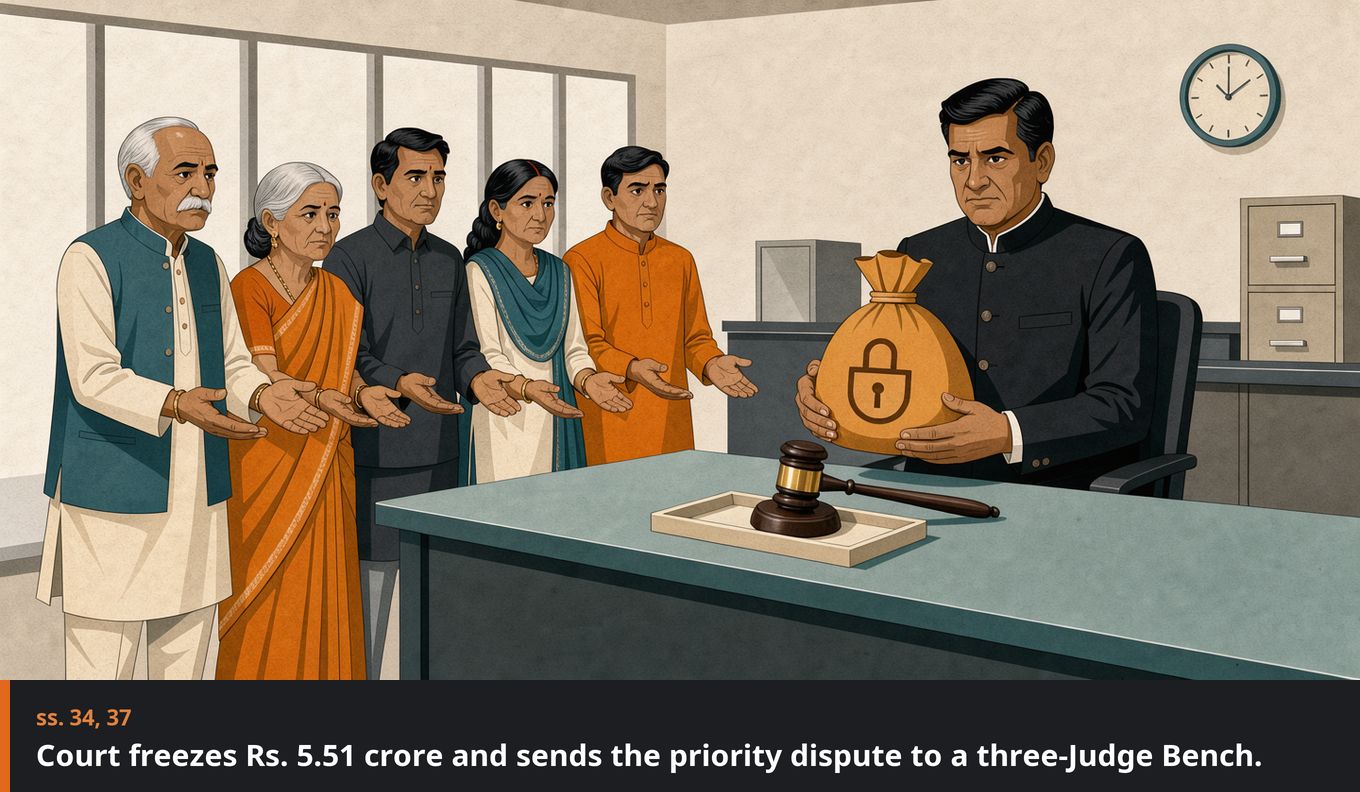
Court stays disbursement of Rs. 5.51 crore, refers SARFAESI-MPID Act conflict to three-Judge Bench
Facts that mattered
- The State Bank of India mortgaged properties of a company whose account was later declared an NPA, and it auctioned them under the SARFAESI Act after obtaining permission from the Designated Court under the MPID Act.
- Sale proceeds of Rs. 19.43 crore were largely adjusted to the loan account, but Rs. 3.5 crore was retained in an FDR which matured to Rs. 5.51 crore, against which 92 depositors claimed Rs. 4 crore.
- The Designated Court and High Court, relying on NSEL, held that MPID Act claims overrode the bank's claim and directed transfer of the amount to the Competent Authority.
- The Supreme Court granted interim relief restraining disbursement of Rs. 5,51,59,816 and referred the core questions to a three-Judge Bench.
Legal concepts
Where two enactments contain conflicting non-obstante clauses, the later enactment ordinarily prevails, but a statutory first charge validly created dehors the non-obstante clause will prevail over a mere priority of recovery.
Reaffirmed · para 107 · Jalgaon District Central Coop. Bank Ltd. v. State of Maharashtra, 2025 SCC OnLine SC 2513, para 106
Repayment of secured debt under the SARFAESI Act must be prioritised over recovery of deposits under the MPID Act, which fall in the category of unsecured debts.
Laid down · para 114
The SARFAESI Act is the dominant legislation on 'recovery of dues' since recovery of dues is essential to banking under Entry 45 of List I, so the MPID Act must bow to it.
Laid down · para 124
Whether MPID Act deposits fall within 'all other debts' in Section 26E, and whether harmonious construction and dominant legislation doctrine favour SARFAESI priority, are referred to a three-Judge Bench.
Laid down · para 129
Read the judgment
D-0106 · 26.11.2026 · s. 148
Ramsakhi Gupta v. Icici Lombard General Insurance Co. Ltd., C.A. No.-009051-009051 - 2026
Bench: HON'BLE MR. JUSTICE UJJAL BHUYAN, HON'BLE MR. JUSTICE ATUL S. CHANDURKAR (2 judges). Judgment by HON'BLE MR. JUSTICE UJJAL BHUYAN
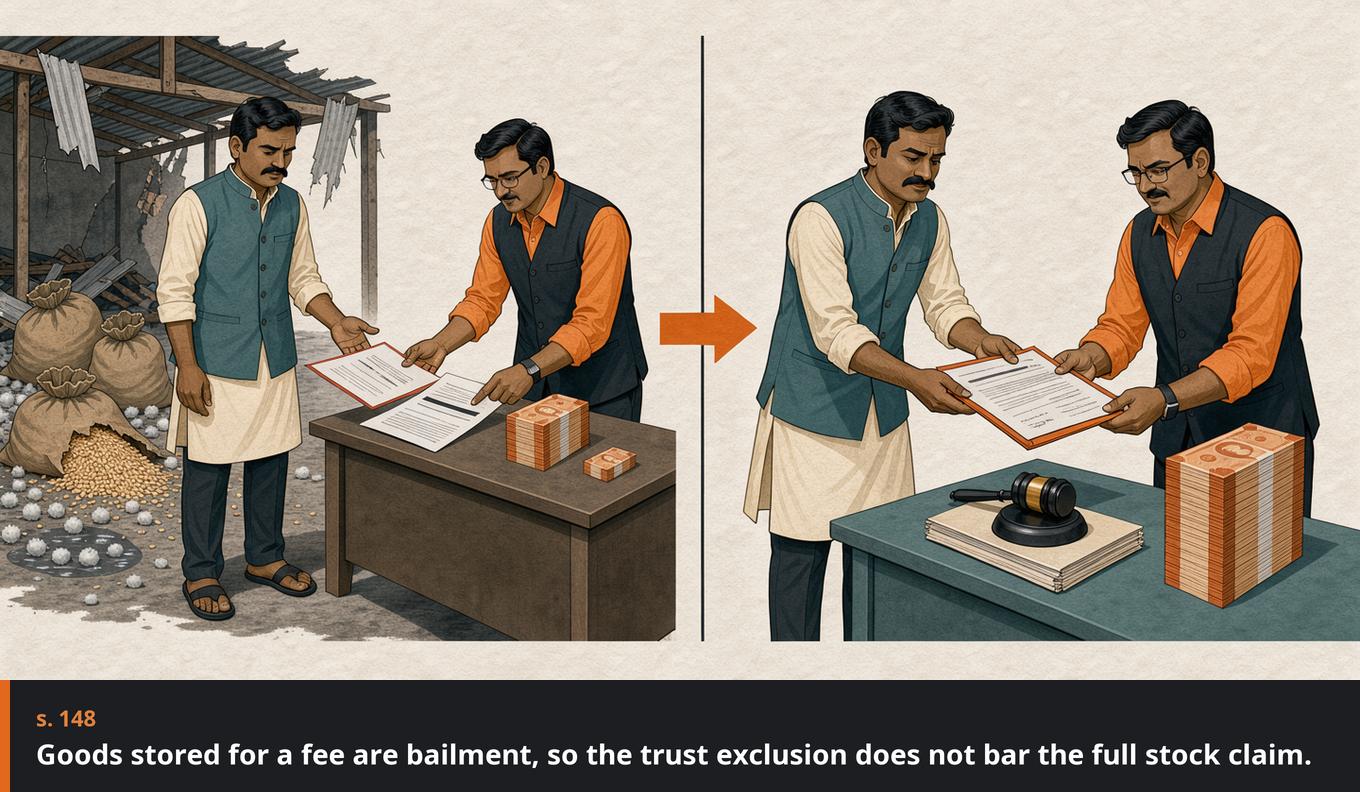
Goods stored for a fee are bailment, not trust, so exclusion clause does not bar the stock claim
Facts that mattered
- The appellant, proprietor of Nikhra Warehouse, stored farmers' agricultural produce for a fee; the stock was hypothecated to SBI and insured under a Standard Fire and Special Perils Policy.
- A hailstorm on 13.03.2007 damaged the warehouse roof and the stored produce; the Tehsildar assessed losses at Rs. 36,83,955 for stock and Rs. 6,41,268 for the building.
- The State Commission allowed the complaint in full, but the National Commission set it aside, applying General Exclusion Clause 5 for goods held in trust and restricting the claim to Rs. 1,44,401.
- The Supreme Court held the goods were held under bailment, not trust, restoring the stock claim while upholding the surveyor's assessment of building damage at Rs. 1,44,401.
Legal concepts
Coverage provisions of an insurance policy must be read broadly, ambiguity resolved in favour of the insured, and exclusion clauses read narrowly, with the policy read as a whole.
Reaffirmed · para 26
Mere fact that goods belonging to another person are kept in a warehouse's custody does not make them goods held in trust or on commission; the nature of the arrangement must be examined.
Reaffirmed · para 49
Ownership of goods is not determinative of insurable interest; a bailee has an insurable interest in goods entrusted to its custody by reason of possession and responsibilities undertaken.
Laid down · para 52
A surveyor's report is neither conclusive nor binding on the insurer or insured, and may be departed from where more reliable evidence is brought on record.
Reaffirmed · para 60 · National Insurance Co. Ltd. Vs. M/s Hareshwar Enterprises (P) Ltd., (2021) 17 SCC 682, para 59
Read the judgment
D-0105 · 26.11.2026 · s. 34
Union of India v. J. Sekar, C.A. No.-001548-001548 - 2024
Bench: HON'BLE THE CHIEF JUSTICE, HON'BLE MR. JUSTICE JOYMALYA BAGCHI, HON'BLE MRS. JUSTICE V. MOHANA (3 judges). Judgment by HON'BLE THE CHIEF JUSTICE
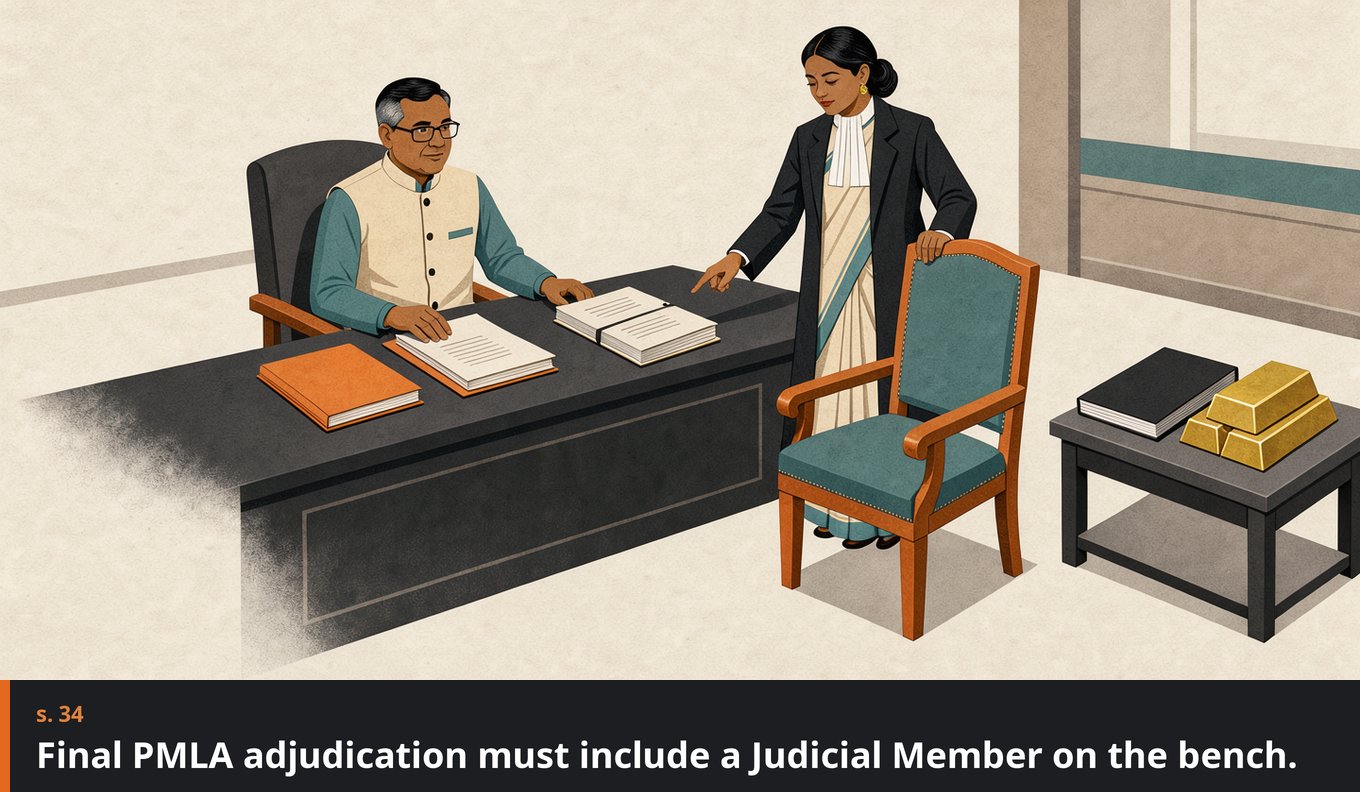
Adjudicating Authority under PMLA must include Judicial Member for final adjudication under s. 8
Facts that mattered
- Income Tax searches on M/s SRS Mining yielded over Rs. 132 crores in cash and 128 kg gold; the CBI registered an FIR and the ED later issued a provisional attachment order under PMLA.
- The show-cause notice under Section 8(1) was issued by an Adjudicating Authority consisting only of a Technical Member officiating as Chairperson, with no Judicial Member in office.
- The Delhi High Court held in J. Sekar that a sole non-Judicial Member could discharge the functions of the Adjudicating Authority, a view followed by the Calcutta and Telangana High Courts.
- The Supreme Court batched these matters with an Article 32 petition challenging the vires of Sections 6(5)(b) and 6(7) of the PMLA.
Legal concepts
The Bench of the Adjudicating Authority that undertakes hearing and final adjudication under Sections 8(2) and 8(3) of the PMLA must necessarily include the Judicial Member, though a single-Member Bench consisting of the Judicial Member alone suffices.
Laid down · para 62
Sections 6(5)(b) and 6(7) of the PMLA are valid and a Bench of the Adjudicating Authority may consist of one or two Members, with or without the Judicial Member, for functions other than final adjudication under Section 8.
Laid down · para 69
There is no legal mandate that only the Judicial Member be appointed as Chairperson of the Adjudicating Authority under the PMLA.
Laid down · para 69
Determinations under Sections 9, 20(4) and 21(4) of the PMLA are ancillary to adjudication under Sections 8(2) and 8(3) and must be assigned to a Bench that includes the Judicial Member.
Laid down · para 69
Read the judgment
D-0100 · 25.11.2026 · s. 24
B. Prema v. B. Rajkumar, C.A. No.-014680-014680 - 2026
Bench: HON'BLE MR. JUSTICE VIKRAM NATH, HON'BLE MR. JUSTICE SANDEEP MEHTA, HON'BLE MR. JUSTICE APARESH KUMAR SINGH (3 judges). Judgment by HON'BLE MR. JUSTICE VIKRAM NATH
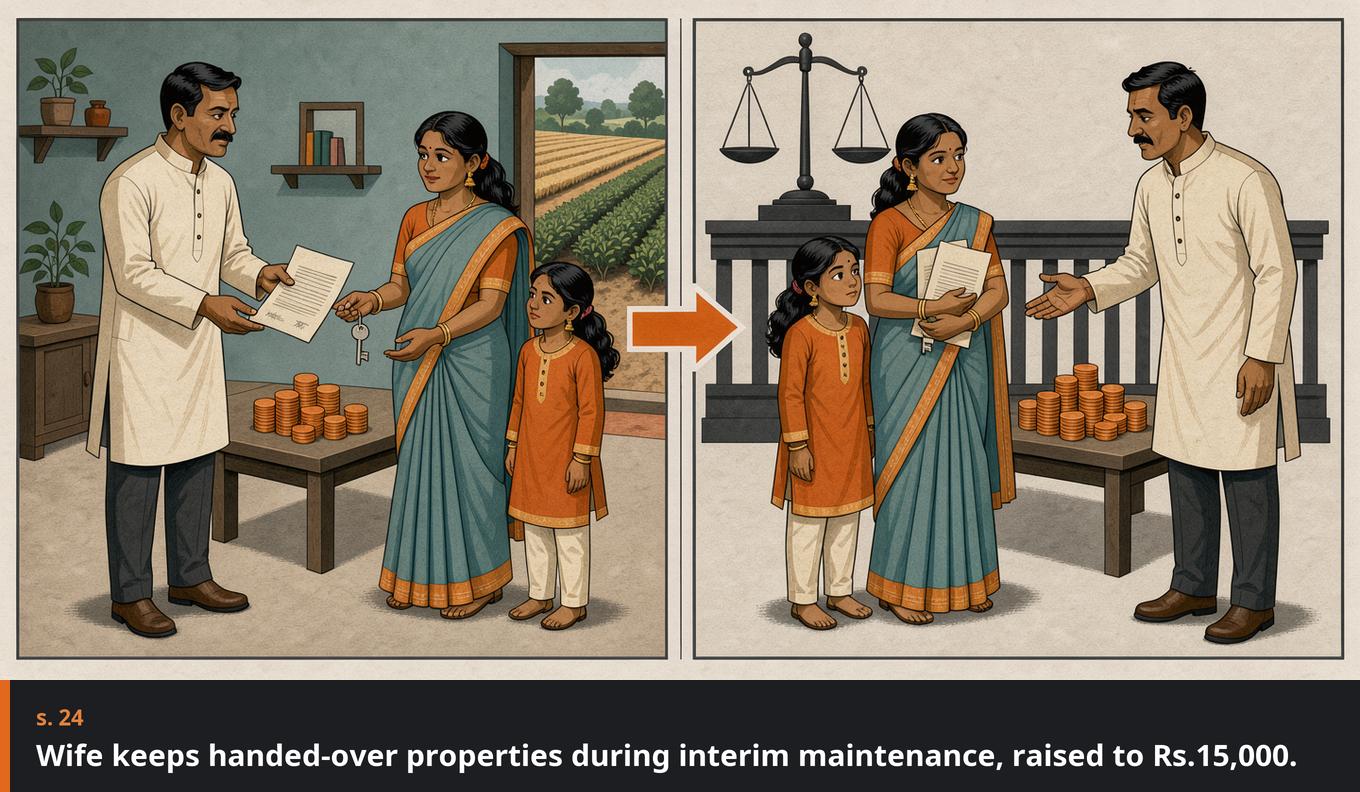
Wife need not surrender maintenance properties at interim stage; maintenance enhanced to Rs.15,000
Facts that mattered
- The parties married in 2007 and a daughter was born in 2009; the wife left the matrimonial home in 2011 alleging non-maintenance.
- By an agreement dated 08.12.2011 the husband handed over possession of a tea estate, agricultural lands and part of a residential house towards maintenance of the wife and daughter, restricting sale or mortgage.
- During the pending divorce petition the wife sought interim maintenance under Section 24; the Trial Court awarded Rs.4,000 per month, unchanged for over twelve years.
- The High Court in revision directed the wife to hand back the agricultural properties as a condition of future maintenance, prompting the present appeal.
Legal concepts
Possession of properties by the wife is a relevant consideration in fixing interim maintenance, but actual income derived, expenses of cultivation and her ability to manage them must be assessed rather than assumed from mere possession.
Laid down · para 10
Properties handed over to a wife under an agreement to secure maintenance of mother and daughter cannot be directed to be surrendered as a condition of the husband discharging his maintenance obligation at the interim stage.
Laid down · para 14
While fixing maintenance, the court must consider the passage of time, the growing needs of the child and the circumstances of both parties; an award unchanged for over twelve years requires reassessment.
Laid down · para 12
Read the judgment
D-0094 · 23.11.2026 · s. 17
J.sakthi Devi @ Chriti v. Joseph Charles, C.A. No.-014664-014664 - 2026
Bench: HON'BLE MR. JUSTICE VIKRAM NATH, HON'BLE MR. JUSTICE APARESH KUMAR SINGH (2 judges). Judgment by HON'BLE MR. JUSTICE APARESH KUMAR SINGH
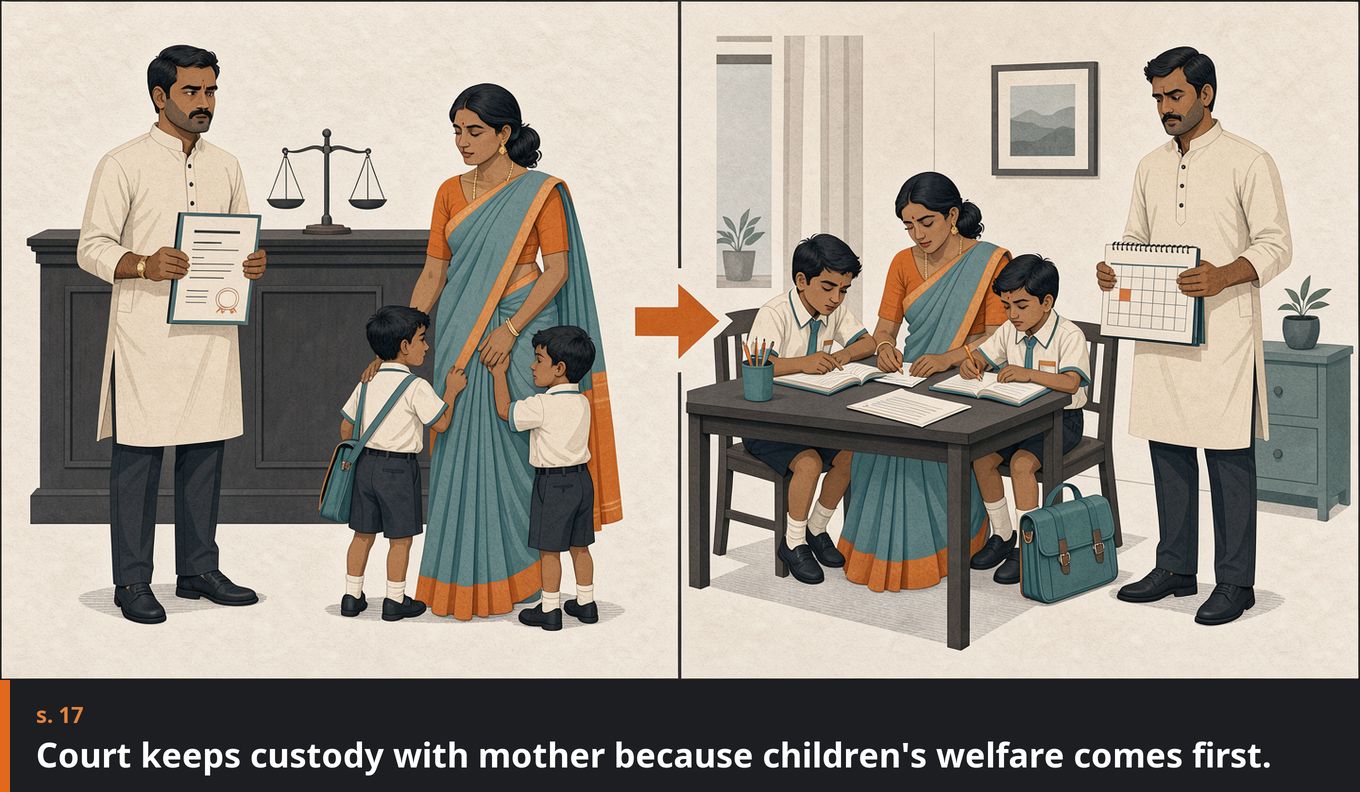
Custody kept with mother despite father being natural guardian, as children's welfare is paramount
Facts that mattered
- The Family Court, Madurai granted custody of two minor sons to the father under the Guardians and Wards Act, 1890, and the High Court affirmed it on the ground that no material showed the father was mentally retarded.
- The children had lived continuously with their mother since 2014, and during interaction with the Court they clearly expressed their unwillingness to live with their father.
- The mother singularly supported the children's upbringing and education in good schools, while the father, a natural guardian, was not shown to have any disentitling factors.
- The father had met the children only four to five times in 10 to 12 years despite visitation rights, and the mother had not permitted contact.
Legal concepts
Welfare of the minor is the paramount consideration in appointing a guardian, and the court must have regard to the age, sex and religion of the minor and the character and capacity of the proposed guardian.
Reaffirmed · para 26
If the minor is old enough to form an intelligent preference, the court may consider that preference under Section 17(3) of the Act.
Reaffirmed · para 26
What would best serve the welfare and interest of the child is the sole and predominant criterion while exercising the power vested in the Court under Section 17 of the Act.
Reaffirmed · para 29 · Elizabeth Dinshaw v. Arvand M. Dinshaw, para 33
Children should not be separated from the parent with whom they have developed a strong natural bond, even where the other parent is not shown to be unfit, as removal would not be conducive to their well-being.
Laid down · para 34 · Anjali Kapoor (SMT) Vs. Rajiv Baijal, (2009) 7 SCC 322, para 32
Read the judgment