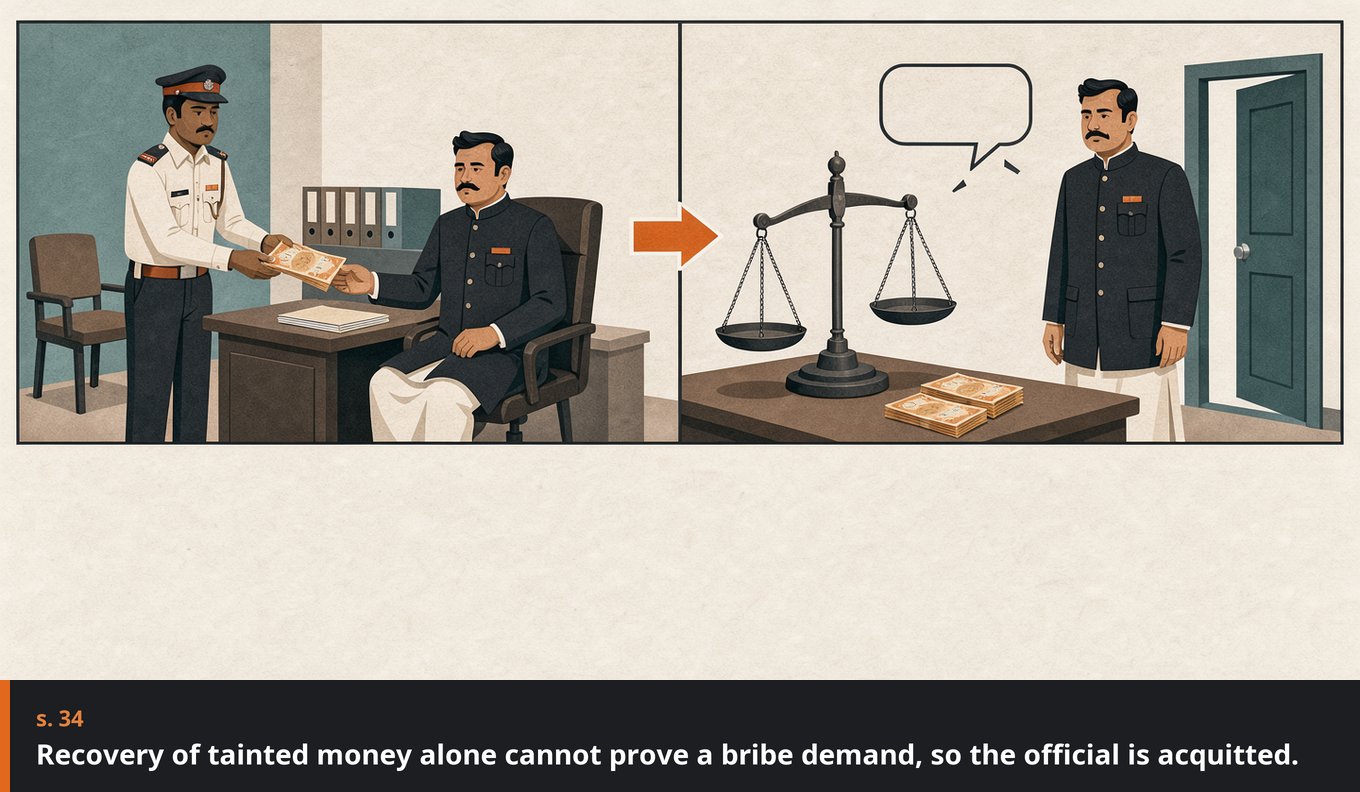
s. 34 · Judgment of
Acquittal as no proof of bribe demand; Section 20 presumption cannot rest on recovery alone
The facts
- The appellant, a Tehsildar, was convicted under Sections 7 and 13(1)(d) of the Prevention of Corruption Act for demanding and accepting a Rs. 1,000 bribe from a labour-court decree holder.
- The complainant and the panch witness both died before their depositions could be recorded, leaving only the trap officer's testimony about what the panch witness relayed to him.
- Tainted currency notes were recovered from the appellant's coat pocket and chemical washes turned pink, but official records showed the recovery cheques had already been dispatched on 28.12.2002.
- The High Court upheld conviction relying on the Section 20 presumption, reducing sentence from two years to one year, and the appellant appealed to the Supreme Court.
What the Court held
Proof of demand of illegal gratification is the sine qua non for an offence under Sections 7 and 13(1)(d)(i) and (ii) of the PC Act; mere recovery of tainted money without proof of demand cannot sustain conviction.
Reaffirmed · para 32 · P. Satyanarayana Murthy Vs. State of A.P., (2015) 10 SCC 152, para 32
Other principles
The presumption under Section 20 of the PC Act can be invoked only when the two basic facts of demand and acceptance of gratification are proved beyond reasonable doubt.
Reaffirmed · para 34
Hearsay testimony of a trap officer relaying what a deceased panch witness told him is inadmissible and cannot establish demand for and voluntary acceptance of illegal gratification.
Laid down · para 42
To rebut the Section 20 presumption the accused need only establish his defence on the touchstone of preponderance of probabilities, unlike the prosecution's burden of proof beyond reasonable doubt.
Reaffirmed · para 47
Summaries are for information and are not legal advice. Read the full judgment before relying on it. See also our disclaimer.