Insolvency and Bankruptcy Code, 2016 · s. 7 · Judgment of
Balance sheet entries acknowledging debt keep Section 7 IBC application within limitation
The facts
- United Bank of India sanctioned a loan of Rs.12,26,00,000 to Kalpataru Cold Storage Pvt. Ltd.; first default occurred on 31.12.2013 and the account was declared NPA on 31.03.2014.
- The debts were assigned to UV Asset Reconstruction Company Ltd. by registered Assignment Agreement on 29.03.2017, and the company filed a Section 7 IBC application on 26.10.2018.
- The NCLAT held the balance sheets contained no acknowledgment and the application was time-barred, setting aside the NCLT order admitting the application.
- The Supreme Court found the balance sheets for FY 2015-16, 2016-17 and 2017-18 acknowledged the liability, so the Section 7 application was within time, and remitted the matter on the question of default.
What the Court held
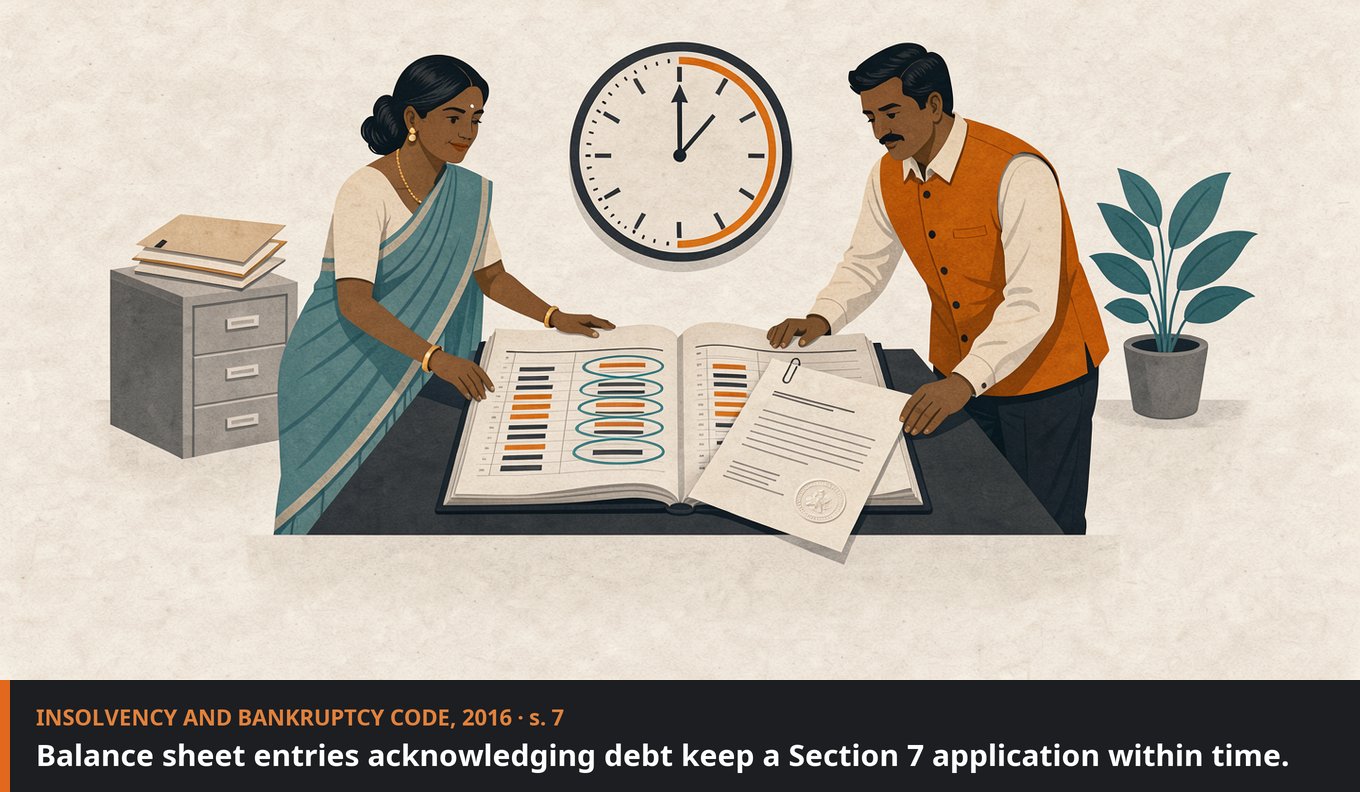
Balance sheet entries reflecting long-term borrowings constitute a clear written acknowledgment of liability under Section 18 of the Limitation Act, extending limitation for a Section 7 IBC application.
Reaffirmed · para 32 · Asset Reconstruction Co. (India) Ltd. v. Bishal Jaiswal, (2021) 6 SCC 366, para 30
Other principles
Section 18 of the Limitation Act cannot be construed with pedantic rigidity in relation to proceedings under the IBC.
Reaffirmed · para 28 · Dena Bank (Now Bank of Baroda) vs. C. Shivakumar Reddy and Another, (2021) 10 SCC 330, para 28
Notes appended to a balance sheet must be read together; a note stating no default cannot negate an acknowledgment where another note records NPA declaration and SARFAESI proceedings.
Laid down · para 33
Summaries are for information and are not legal advice. Read the full judgment before relying on it. See also our disclaimer.