Code of Criminal Procedure, 1973 · s. 34 · Judgment of
Cognizance on a Protest Petition not meeting complaint requirements is quashed
The facts
- Crime No. 487 of 2022 was registered under sections 302, 352 and 504 IPC after Abhishek Singh died following an altercation with neighbour Gaurav Singh, husband of the appellant.
- The chargesheet was filed only against Gaurav Singh under sections 323, 504 and 506 IPC, recording that involvement of the appellant was not established.
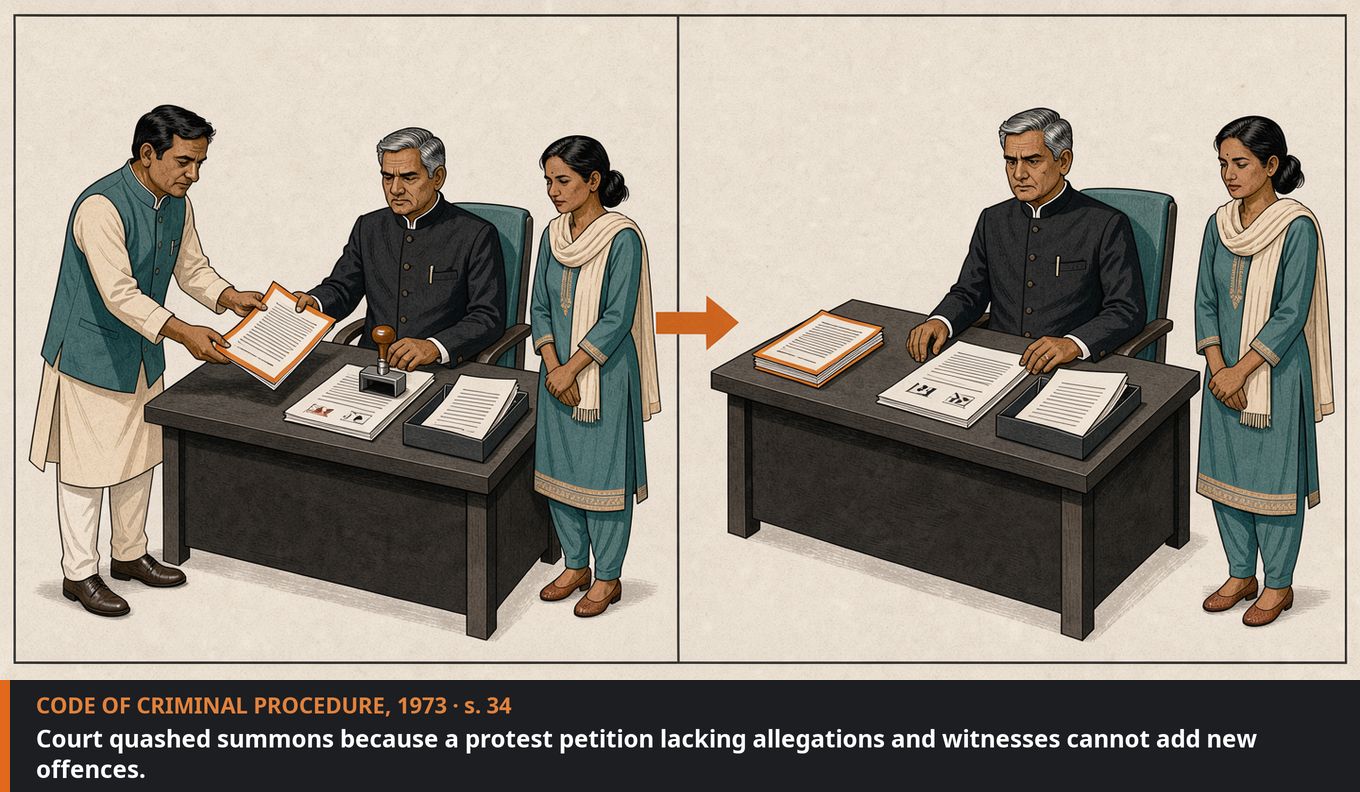
- The informant filed a Protest Petition, and the Chief Judicial Magistrate took cognizance of offences including murder and issued summons to the appellant and many others.
- The High Court dismissed the quashing application, holding that disputed questions of fact could not be decided at that stage.
What the Court held
A Protest Petition may be treated as a complaint under Chapter XV only if it contains specific allegations against the accused and a list of witnesses; merely summing up objections to the police investigation does not satisfy the definition of complaint under section 2(d).
Laid down · para 14
Other principles
When a Magistrate proceeds on a Protest Petition as a complaint, he must follow the Chapter XV procedure, including inquiry under section 202 and the power of dismissal under section 203, before issuing process.
Laid down · para 14
A Magistrate accepting a chargesheet in toto has no power to add any new offence in the order taking cognizance under section 190(1)(b).
Laid down · para 8
An order taking cognizance need not be a reasoned or elaborate order; it is enough that the Magistrate applies his mind to the suspected commission of an offence.
Reaffirmed · para 13 · Kanti Bhadra Shah & Anr. v. State of W.B., (2000) 1 SCC 722, para 13
The High Court's inherent power under section 482 CrPC, preserved under section 528 BNSS, must be exercised where the trial Judge has acted illegally and without jurisdiction, transcending technical barriers.
Reaffirmed · para 15
Summaries are for information and are not legal advice. Read the full judgment before relying on it. See also our disclaimer.