s. 148 · Judgment of
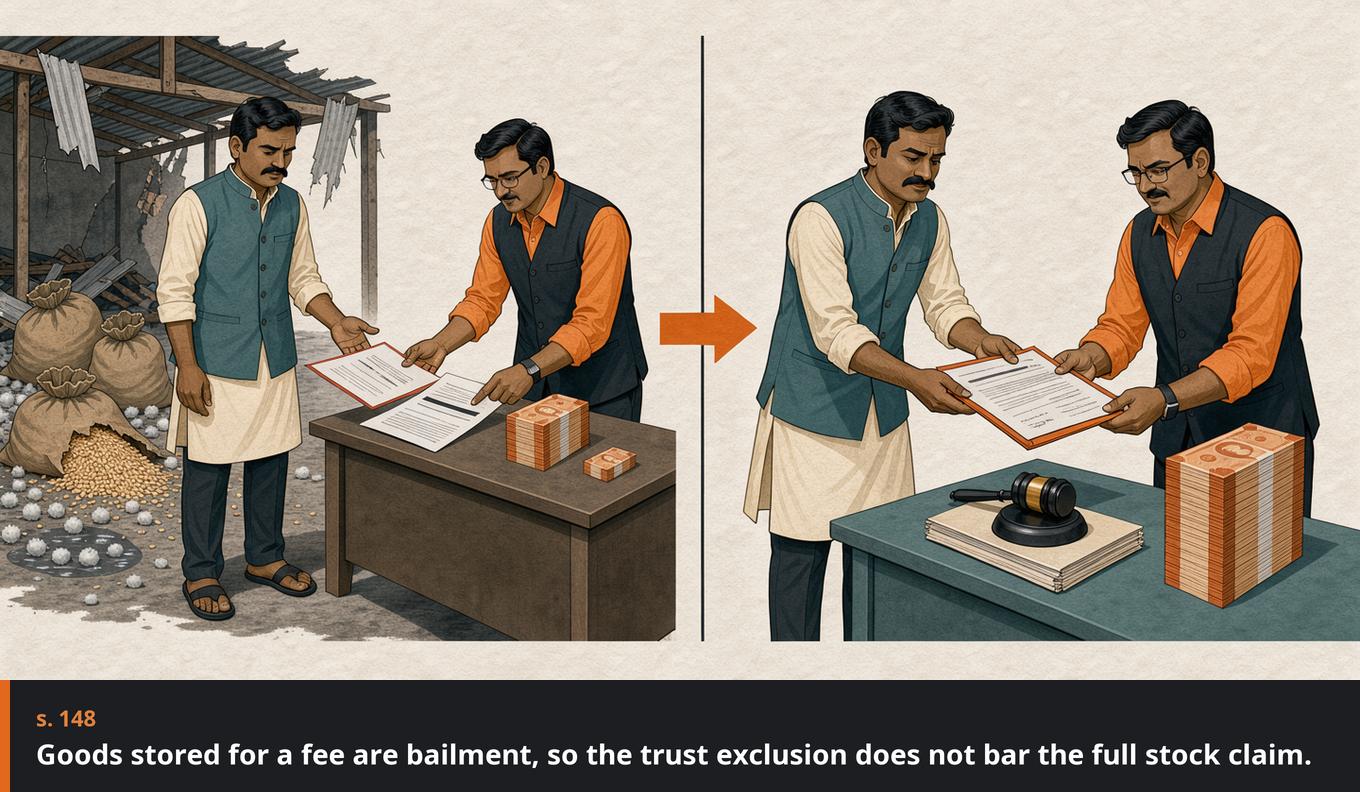
Goods stored for a fee are bailment, not trust, so exclusion clause does not bar the stock claim
The facts
- The appellant, proprietor of Nikhra Warehouse, stored farmers' agricultural produce for a fee; the stock was hypothecated to SBI and insured under a Standard Fire and Special Perils Policy.
- A hailstorm on 13.03.2007 damaged the warehouse roof and the stored produce; the Tehsildar assessed losses at Rs. 36,83,955 for stock and Rs. 6,41,268 for the building.
- The State Commission allowed the complaint in full, but the National Commission set it aside, applying General Exclusion Clause 5 for goods held in trust and restricting the claim to Rs. 1,44,401.
- The Supreme Court held the goods were held under bailment, not trust, restoring the stock claim while upholding the surveyor's assessment of building damage at Rs. 1,44,401.
What the Court held
Coverage provisions of an insurance policy must be read broadly, ambiguity resolved in favour of the insured, and exclusion clauses read narrowly, with the policy read as a whole.
Reaffirmed · para 26
Other principles
Mere fact that goods belonging to another person are kept in a warehouse's custody does not make them goods held in trust or on commission; the nature of the arrangement must be examined.
Reaffirmed · para 49
Ownership of goods is not determinative of insurable interest; a bailee has an insurable interest in goods entrusted to its custody by reason of possession and responsibilities undertaken.
Laid down · para 52
A surveyor's report is neither conclusive nor binding on the insurer or insured, and may be departed from where more reliable evidence is brought on record.
Reaffirmed · para 60 · National Insurance Co. Ltd. Vs. M/s Hareshwar Enterprises (P) Ltd., (2021) 17 SCC 682, para 59
Summaries are for information and are not legal advice. Read the full judgment before relying on it. See also our disclaimer.