Constitution of India · Art. 14 · Judgment of
Supreme Court restores reinstatement, holding familial capture of inquiry panel vitiates termination
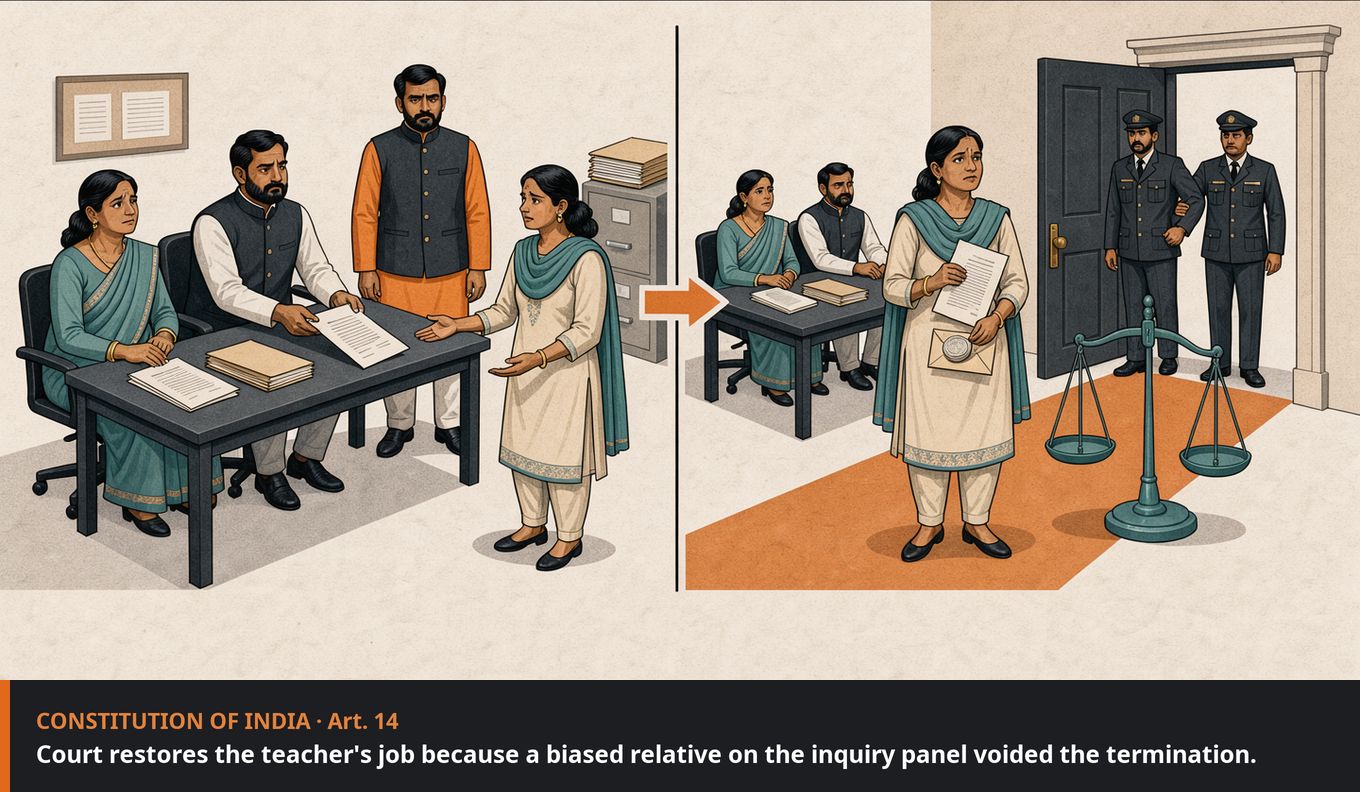
The facts
- The Appellant, an Assistant Teacher, was terminated on 23rd February 2022 following a departmental inquiry by a three-member Inquiry Committee constituted under Rule 36 of the MEPS Rules.
- The Convenor of the Inquiry Committee, Prakash Masurkar, was the real brother of Rajesh Masurkar, who simultaneously acted as complainant, CEO issuing chargesheets, principal witness on eleven of twenty charges, and signatory of the termination order.
- The School Tribunal quashed the termination and granted reinstatement with full back wages, but the High Court set aside the Tribunal's order and upheld the termination.
- The Appellant raised objection to the Convenor's appointment at every stage, including before the Inquiry Committee, the Tribunal, and in the writ proceedings.
What the Court held
The test of bias is not proof of actual bias but whether a reasonable likelihood of bias exists in the mind of a reasonable person, as distinguished from a merely fanciful apprehension.
Reaffirmed · para 49
Other principles
An immediate blood relative of a person who initiates disciplinary action or is directly interested in its outcome is disqualified from acting as an adjudicator; breach of Nemo Judex in Causa Sua is a fundamental jurisdictional defect under Article 14, not a curable procedural irregularity.
Laid down · para 55
Mere compliance with procedural formalities such as multiple hearings, examining witnesses or permitting cross-examination cannot cure a foundational illegality arising from bias in the decision-making process.
Laid down · para 57
The doctrine of necessity does not apply where unrelated members of the Executive Committee were available to be nominated to the Inquiry Committee.
Reaffirmed · para 58 · Krishnadatt Awasthy vs. State of Madhya Pradesh and Ors., (2025) 7 SCC 545, para 41
An alleged waiver of objection to a biased decision-maker must be voluntary, informed and unequivocal to be effective.
Reaffirmed · para 61
Summaries are for information and are not legal advice. Read the full judgment before relying on it. See also our disclaimer.