Code of Criminal Procedure, 1973 · s. 389 · Judgment of
Stay of conviction extended to co-convicts on identical footing, upholding parity under Article 14
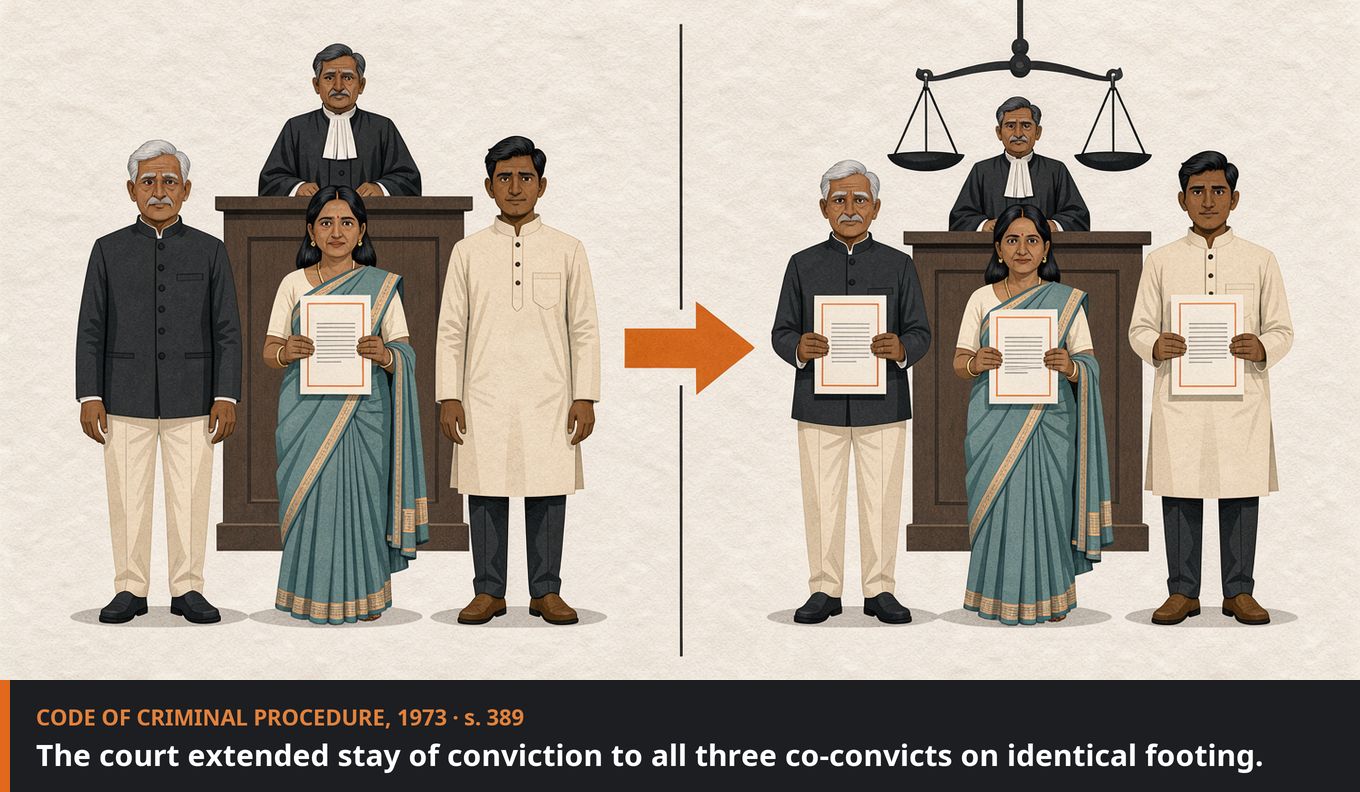
The facts
- Three family members were convicted by a trial court on 18 October 2023 for criminal conspiracy involving two conflicting birth certificates, affirmed on appeal on 23 December 2023.
- The High Court suspended all three sentences and enlarged all three on bail, but stayed only Mohammad Azam Khan's conviction, rejecting stay applications of his son and wife.
- The State challenged the stay of conviction, while the son and wife challenged denial of stay of conviction, all under Article 136.
- The High Court recorded no coherent reason distinguishing the patriarch's case from those of the co-convicts convicted under the identical conspiracy charge.
What the Court held
Where several convicts stand on the same evidentiary footing, an order granting stay of conviction to one while denying it to others must identify and expressly state the distinguishing feature; an order silent on that point is by itself arbitrary.
Laid down · para 19
Other principles
Stay of conviction is an exceptional remedy requiring distinct, compelling judicial justification, qualitatively different from mere suspension of sentence.
Reaffirmed · para 9 · Ravikant S. Patil v. Sarvabhouma S. Bagali, (2007) 1 SCC 673, para 21
A stay of conviction cannot be anchored purely on political expediency, electoral ambitions, or the exigencies of upcoming election campaigns.
Laid down · para 23
Judicial discretion under Section 389(1) must balance the grave and irreversible consequences of conviction for the convict against the sanctity that must attach to a conviction until it is set aside.
Reaffirmed · para 22 · Afjal Ansari v. State of U.P., (2024) 2 SCC 187, para 21
Summaries are for information and are not legal advice. Read the full judgment before relying on it. See also our disclaimer.