Code of Civil Procedure, 1908 · O. 7 r. 11 · Judgment of
Court allows Rs.5 lakh to employee, holding interest claim was a separate subsequent cause of action
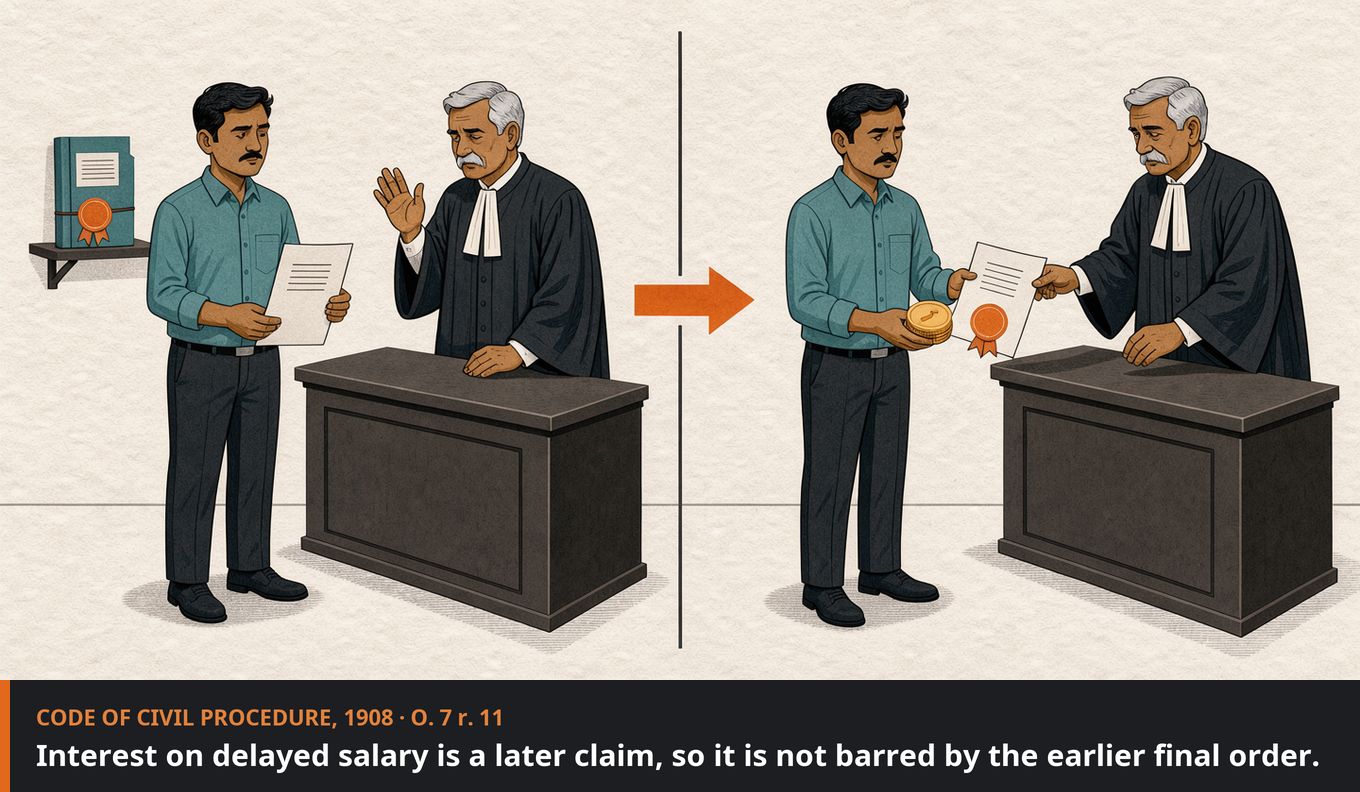
The facts
- Kumar, a bank employee, was acquitted in 1983 of defalcation charges; the acquittal attained finality in 1991 when the High Court dismissed appeals against it.
- The High Court quashed the departmental enquiry in 2007 and ordered reinstatement with consequential benefits; that order attained finality when the Bank's SLP was dismissed in 2011.
- Kumar was paid over Rs.42 lakh in 2011 but later sought 18% interest on delayed salary, first by a fresh writ petition dismissed in 2023, then by a miscellaneous application in the earlier writ petition filed in 2024.
- The Single Judge and Division Bench dismissed the miscellaneous application, holding it barred by constructive res judicata and finality of the 2007 order.
What the Court held
A miscellaneous application in a finally decided writ petition is not an independent proceeding; it has a narrow scope, is procedural not substantive, and cannot be used to agitate a subsequent or independent cause of action.
Laid down · para 21
Other principles
Res judicata and the bar of Order II Rule 2 CPC apply only to a claim that could have been raised when the earlier proceeding was instituted, and a claim based on a subsequent cause of action cannot be barred by a judgment on a prior cause of action.
Laid down · para 20
Interest is a restitution for delay pendente lite and during appeals, a distinct cause of action arising subsequently, and it is not a penalty but a normal accretion on capital.
Reaffirmed · para 23 · Alok Shanker Pandey v. Union of India, (2007) 3 SCC 545, para 23
The technical plea of constructive res judicata should not stand in the way of a litigant where relief is otherwise due, in view of the rule that an act of court should harm no litigant.
Reaffirmed · para 25
Summaries are for information and are not legal advice. Read the full judgment before relying on it. See also our disclaimer.