s. 29 · Judgment of
Supreme Court restores CERC order, holding LILOs used in transmission and tariff claim sustainable
The facts
- PGCIL, the Central Transmission Utility, commissioned two LILOs on the Tuticorin JV-Madurai 400kV line at Tuticorin Pooling Station on 04.01.2015 and 08.01.2015, part of the transmission scheme approved in the 30th Standing Committee Meeting and the Bulk Power Transmission Agreement.
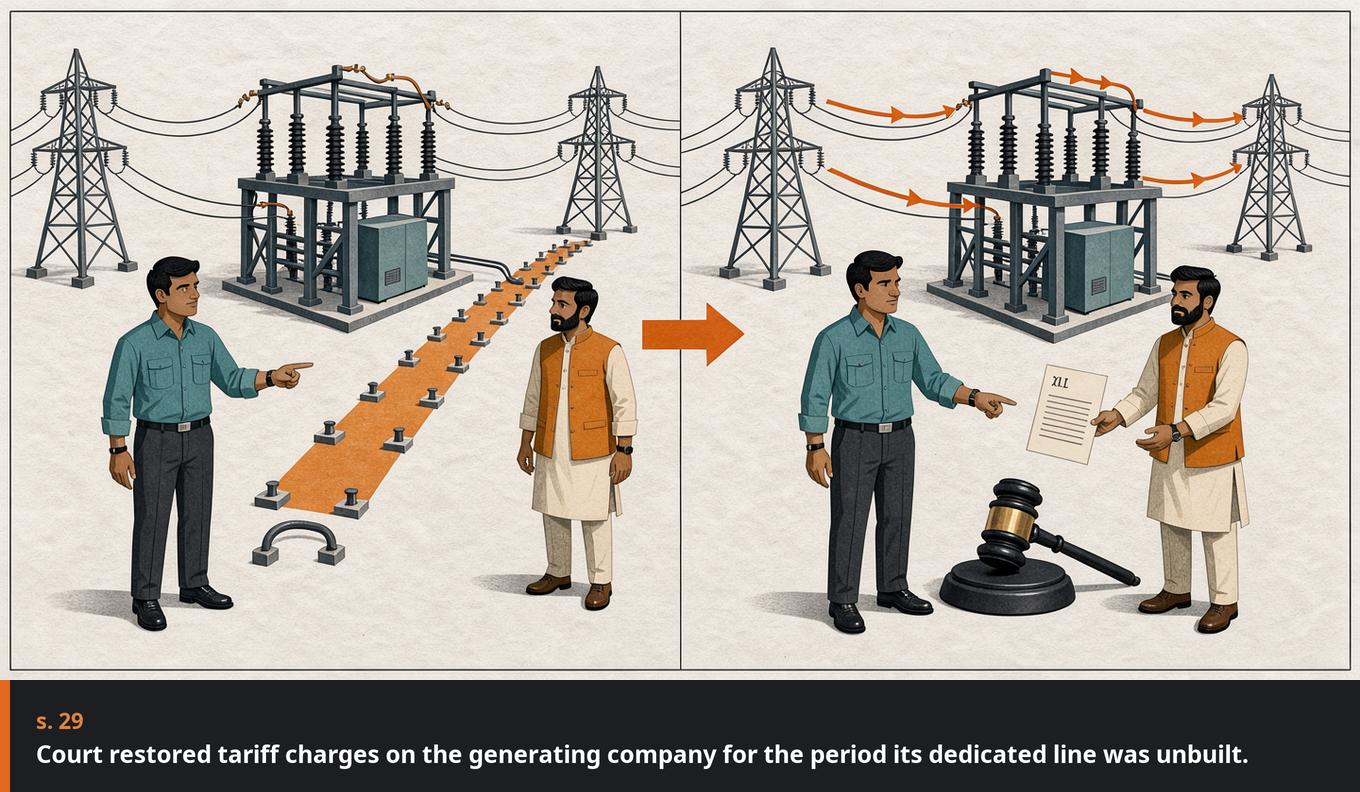
- The generating company, Coastal Energen (now Moxie Power), delayed constructing its dedicated transmission line to the Tuticorin Pooling Station until 27.10.2016, while upstream lines to Salem and Madhugiri were commissioned only later.
- CERC accepted the COD and cast transmission charges on the generating company till DTL commissioning; APTEL set this aside, holding the LILOs were not put to beneficial use since upstream lines were not operational.
- The Supreme Court found power was necessarily diverted through the LILOs to the Pooling Station and restored the CERC order, allowing PGCIL's non-PoC tariff claim for 04.01.2015 to 27.10.2016.
What the Court held
Regulation 4(3)(ii) of the Tariff Regulations applies only where regular service of a transmission element is prevented by delay in commissioning the generating station or the upstream or downstream transmission system, not attributable to the transmission licensee.
Laid down · para 40
Other principles
COD of a transmission element is the date declared by the transmission licensee after successful trial operation and issue of the RLDC certificate, so no redetermination under Regulation 4(3)(ii) is warranted where regular service was not prevented.
Reaffirmed · para 41
CERC may impose liability on a defaulting party under Section 79(1) even in the absence of a regulation framed under Section 178, provided the levy is reasonable.
Reaffirmed · para 45 · Energy Watchdog v. Central Electricity Regulatory Commission and Ors. Etc., (2017) 14 SCC 80, para 45
Decisions of the Standing Committee taken under Section 29(4) of the Electricity Act in furtherance of grid stability and coordinated transmission planning have legal sanctity and bind all stakeholders.
Reaffirmed · para 47
Summaries are for information and are not legal advice. Read the full judgment before relying on it. See also our disclaimer.