Constitution of India · Art. 136 · Judgment of
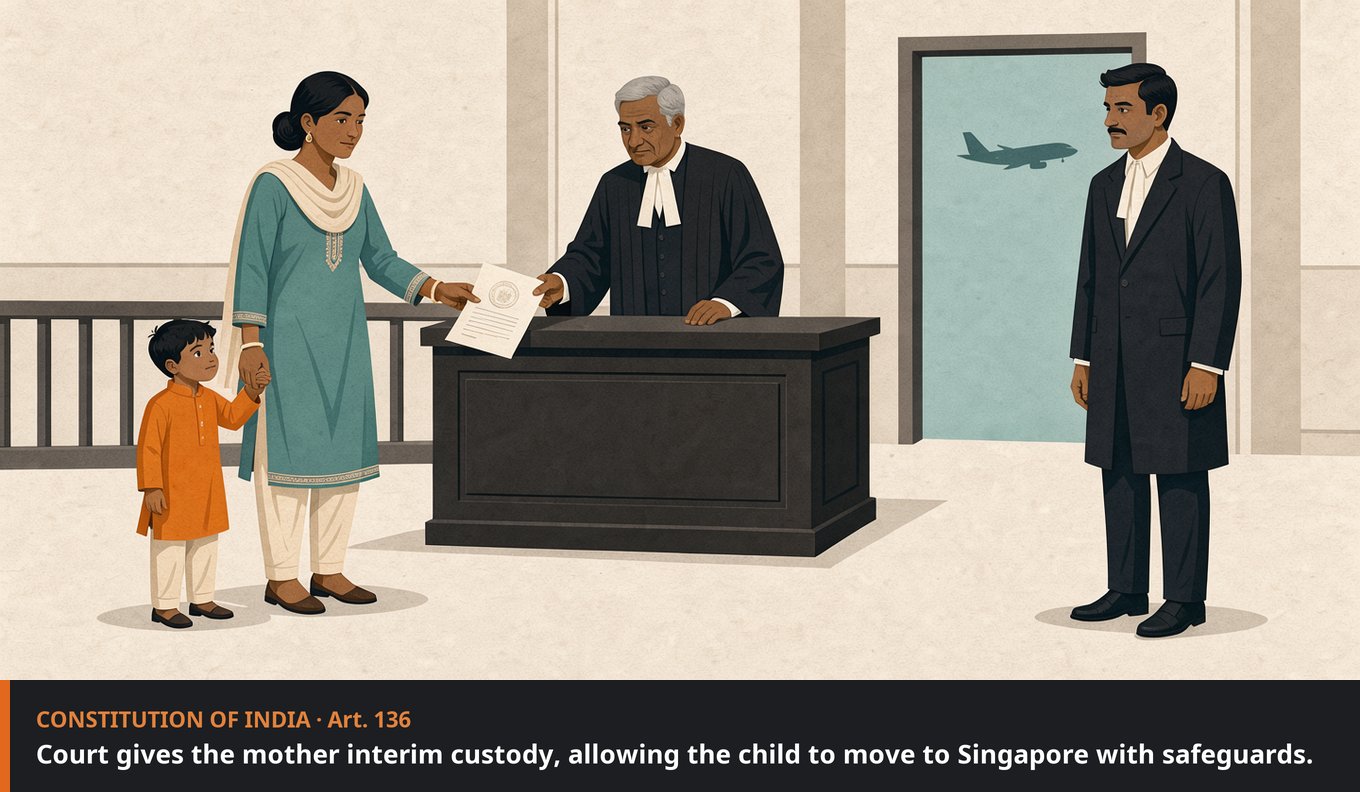
Court grants unwed mother interim custody, allowing child's relocation to Singapore with mirror order safeguards.
The facts
- An unmarried German mother working in Singapore sought access and interim custody of her four-year-old son, an Indian-resident child, from the father, an Indian lawyer based in Delhi.
- The mother filed habeas corpus proceedings in the Bombay High Court; the father later filed guardianship proceedings in West Bengal, later transferred to the Family Court at Patiala House, New Delhi.
- The Supreme Court directed NIMHANS to assess both parents and the child, which found both parents psychologically fit and equally invested in the child's welfare.
- The Court granted interim custody to the mother, permitting relocation to Singapore subject to a mirror order from a Singapore court and a Rs. one crore security deposit.
What the Court held
This Court has jurisdiction to decide interim custody in a habeas corpus proceeding in exercise of parens patriae jurisdiction, and procedural or jurisdictional issues must yield to the child's best interests.
Laid down · para 125 · Rajeswari Chandrasekar Ganesh v. State of T.N., (2023) 12 SCC 472, para 46
Other principles
In a dispute between unwed parents, the mother has a better prima facie claim of custody of a child of tender age, as recognized across legal jurisdictions.
Reaffirmed · para 68 · X1 v. State (NCT of Delhi), (2015) 10 SCC 1, para 66
The child's best interests must be the preeminent consideration in any custody matter, prevailing over all other considerations including parents' rights and jurisdictional issues.
Reaffirmed · para 51 · Sheetal Vasant Thakur v. Chirag Arora, 2026 SCC OnLine SC 1110, para 52
Irreparable harm in a custody dispute must be assessed from the perspective of the child, the most vulnerable party and subject of parens patriae jurisdiction, not the parents.
Laid down · para 75
Summaries are for information and are not legal advice. Read the full judgment before relying on it. See also our disclaimer.