Constitution of India · Art. 14 · Judgment of
Bihar notification deleting murder-of-public-servant remission bar struck down as arbitrary
The facts
- The fourth respondent, a Bihar MLA, exhorted a mob that murdered an IAS District Collector on duty in 1994; he was convicted under ss. 302 and 109 IPC.
- The trial court awarded death, but the High Court altered it to life imprisonment, noting pre-amended Rule 481(i)(a) disqualified him from remission; this Court affirmed.
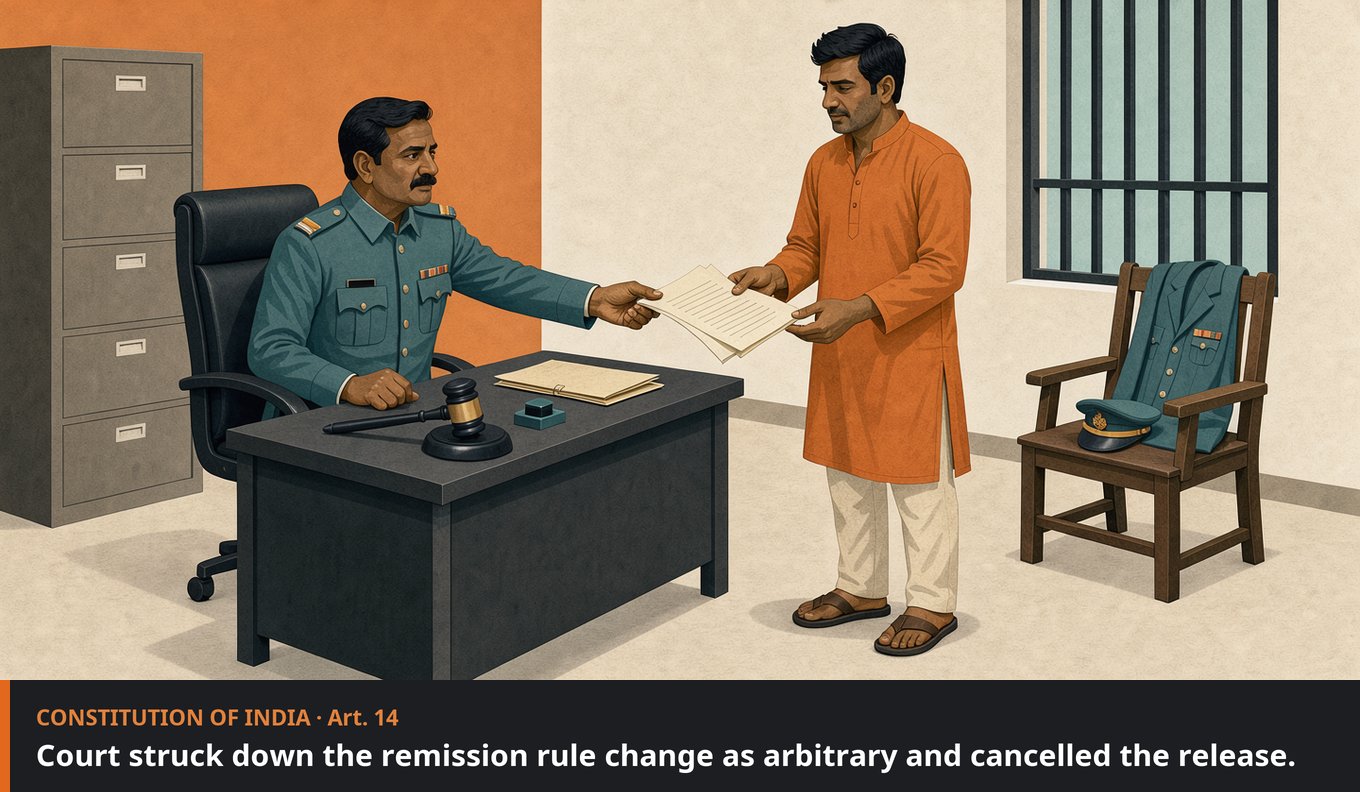
- On 10 April 2023 Bihar deleted "or for murder of a public servant on duty" from Rule 481(i)(a), and released him on 24 April 2023 using a stale 2021 judicial opinion.
- The Court found the amendment a sudden, unexplained departure from policy consistently followed since 2002, and the release procedurally and substantively vitiated.
What the Court held
An identifiable and traceable victim or legal representative must be given notice and a reasonable opportunity to submit a representation before a premature release decision, without any veto over the outcome.
Laid down · para 47
Other principles
Reliance on a stale, mechanically rendered opinion of the Presiding Judge obtained on an inadmissible earlier application, without a fresh reasoned opinion, vitiates the remission decision under Section 432(2).
Reaffirmed · para 53
A selective, unexplained deletion of a long-standing disqualification from a remission policy, lacking rational nexus with any disclosed public purpose, is manifestly arbitrary and void under Article 14.
Laid down · para 88
Where more than one remission policy applies, the policy most beneficial to the convict generally governs, though the date-of-conviction policy ordinarily prevails.
Reaffirmed · para 35 · State of Haryana v. Jagdish, (2010) 4 SCC 216 (3-judge bench), para 33
Summaries are for information and are not legal advice. Read the full judgment before relying on it. See also our disclaimer.