Indian Penal Code, 1860 · s. 302 · Judgment of
Supreme Court affirms acquittal, holding chain of circumstantial evidence incomplete
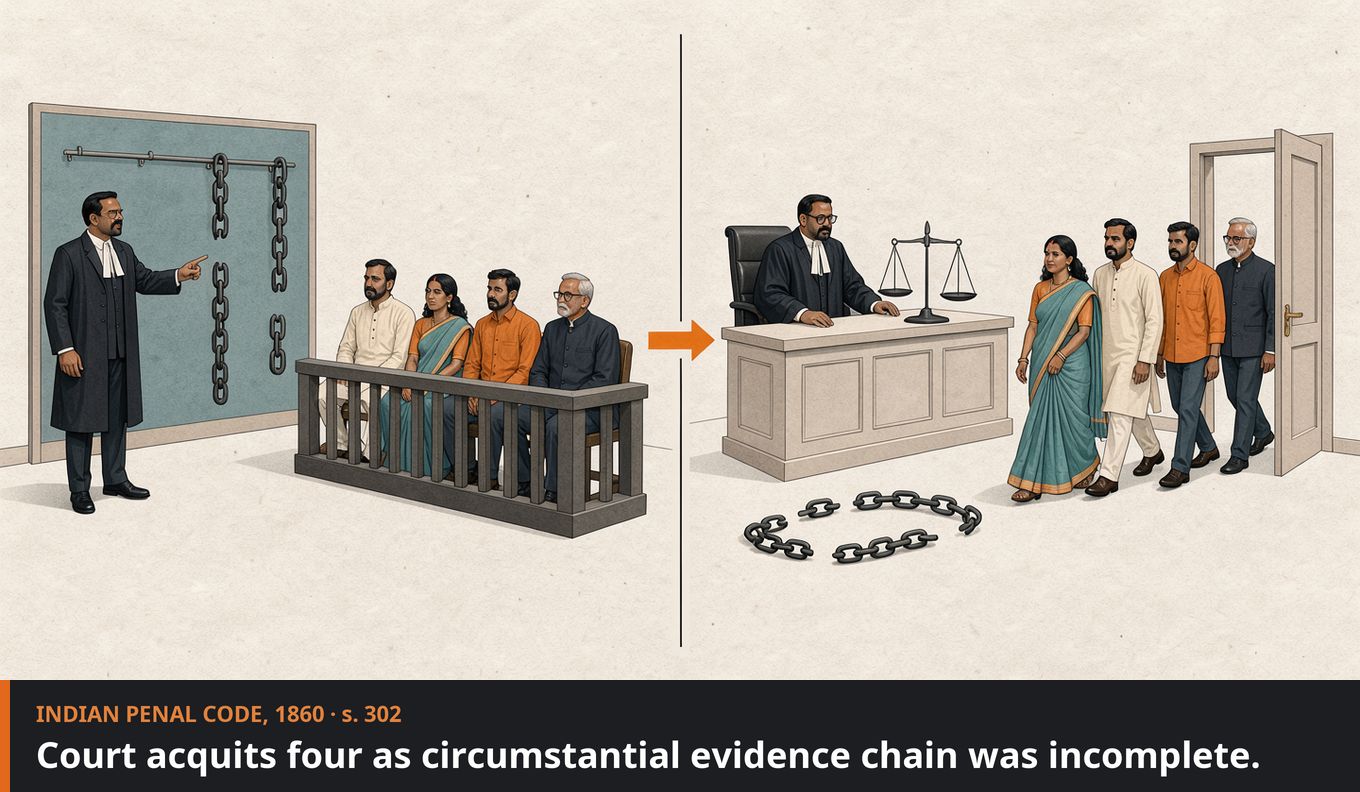
The facts
- The informant found his wife lying in a pool of blood with gold ornaments missing; FIR was registered and four accused were arrested based on recoveries.
- The Sessions Court convicted all accused under Sections 302 and 382 of the Penal Code and sentenced them to life imprisonment and ten years' rigorous imprisonment.
- The High Court set aside the convictions, holding that vital links in the chain of circumstantial evidence were missing and recoveries alone were insufficient.
- The Supreme Court noted that except the informant and his father, no other evidence linked the respondents to the crime, and several prosecution witnesses turned hostile.
What the Court held
In a case based entirely on circumstantial evidence, the chain of events must be complete in all respects so as to lead only to the hypothesis that the accused alone are guilty.
Reaffirmed · para 12
Other principles
A conclusion of guilt can be recorded only when all circumstances are collectively considered and lead to the irresistible conclusion that the accused alone committed the crime.
Reaffirmed · para 12
Summaries are for information and are not legal advice. Read the full judgment before relying on it. See also our disclaimer.